Monday, July 4, 2011

Pedaling Your Politics: The Variable Meanings of Critical Mass


Over the past two decades, the prevalence of biking in our nation’s cities has increased rapidly. Never mind unique creations like Portland, Oregon, today, places as diverse as New York, Chicago, San Diego, Seattle, and Austin have vibrant cycling cultures. In San Diego, a Saturday night without a fixie would be like Sunday morning without Mass (for those of us influenced by popery). The same could be said for Williamsburg, Brooklyn, Silver Lake, CA and elsewhere. This increase in bike culture stems from several forces. Environmental concerns, energy issues, aesthetics, and the appropriation of subcultures (after all it would be impossible to say that aspects of hipster aesthetics weren’t taken from the aggressive bike messenger lifestyle made famous in Kevin Bacon classics like Quicksilver –- feel free to insert sarcasm) are all part and parcel of these developments. However, the meaning of bike culture in each metropolis leans heavily on several factors, not least among them, the built environment and politics. To be clear, what we are discussing here is not mountain biking or the kind of suburban ET kids on dirt bikes (a more modern equivalent might be the Arcade Fire’s video for “The Suburbs” or this summer's Super 8) flying around from planned community to planned community. Rather, a hard nosed urban cycling aesthetic that seems at once welcoming and forbidding.

But, how does one assess this variation? One means might be to examine the ways in which one of the largest expressions of this burgeoning bike culture expresses itself, Critical Mass. Undoubtedly, CM causes controversy in nearly every city in which it unfolds. An international phenomena begun in 1992 San Francisco, on the last Friday of every month bikers congregate and then take over thoroughfares in cities not only in America but internationally. What are the political statements made? How do they vary according to a city’s built environment? Does this same built environment temper or shape the ways in which residents criticize or support CM? Think about it this way, does a city like NYC, defined by its public transit see CM differently than the car-centric metropolis of San Diego? How does this shape CM actions/politics?

First, what is CM? According to many supporters, it appears to be a leaderless, act of metropolitan biker agency, as the final Friday of each month results in a sometime massive display of riders. In New York, the apparent headlessness of CM has frustrated one of its greatest critics Mayor Bloomberg who has on more than one occasion blasted Critical Mass. Its alleged lack of formal leadership means suing CM remains nearly impossible. Up until late summer of 2004, NY had enjoyed a friendly relationship with CM. Activists used to even inform the NYPD of the routes they intended to take each Friday. However, in the most liberal of cities, it was ironically the 2004 GOP Convention in which tensions between police and riders resulted in hundreds of arrests and charges of police brutality.

Since that fateful summer, the relationship between the two grew increasingly antagonistic. (James Barron, "Police and a Cyclists’ Group, and Four Years of Clashes," August 4, 2008) Arrests, fines, and tickets served as tools for the city to depress turn out and discourage the once a month excursions. Riders admitted the rides had become less enjoyable but that they now felt compelled to participate. As technology consultant and long time rider Eric Goldhagen summarized the change in 2008, “Since the police decided to treat it as a criminal act, the entire tone of the rides has changed, Instead of being fun, it’s now something that I don’t enjoy, but feel I have to do.” The 2007 passage of the Parade Law was viewed by many as a direct attempt by the city to repress CM. Even City Council Speaker Christine Quinn supported the legislation. “Some critics will find fault no matter how reasonably the rules are drawn,” argued Quinn, who then suggested the Parade Law struck the “proper balance between protection of civil liberties with the need for public order.” Many riders resented accusations of anarchism and disruption. A 2009 lawsuit filed by several prominent New Yorkers including eminent urban historian Kenneth Jackson of Columbia attempted to get the law revoked.


Of course, for every Ken Jackson there appears to be a Louise Hainline. This past March contributor Matthew Shaer asked whether NY was too NY for cycling (“Not Quite Copenhagen: Is New York Too New York for Biking Lanes?”). The addition of a bike lane in Prospect Park sparked antipathy from some of Brooklyn’s most respected citizens. Hainline, a Dean at Brooklyn College, came across as an obsessed boomer intent on destroying the park’s bike lane, going so far as to set up cameras to monitor its usage, which she claims officials exaggerated. Hainline described the new bike lane as “monstrous” and “truly offensive." The Brooklyn College administrator and several other prominent Brooklyn residents formed the Neighbors for Better Bike Lanes, which includes former deputy mayor and sanitation head Normal Steisal. Iris Weinshall, Bloomberg’s first transportation commish and wife of NY Senator Chuck Schumer, has also registered her support.

A couple of years earlier, New York magazine famously documented the conflict between Williamsburg’s Hasidic community and their hipster/bohemian counterparts. Needless to say, the antics of each side tended to discredit both groups. Framed as a “Clash of the Bearded Ones”, the image of Grizzly Adams hipsters and devout Hasids warring over neighborhood bike lanes proved both jarring and hilarious.

Even San Francisco has had its issues with Critical Mass. A 1997 San Jose Mercury News article described CM’s fifth year anniversary in the city by the Bay. Clearly, past Fridays had caused more than a little consternation. A July 1997 Friday ride resulted in marked gridlock and conflict when over 7000 riders “brought Market Street to a standstill, tied up intersections and ignited volatile confrontations with drivers and police.” (Rodney Foo, Jeordan Legon, and Renee Koury, San Jose Mercury News, “Repeating Critical Mass,” September 27, 1997) Though over 100 cyclists were arrested only 8 ever suffered prosecution. If one thinks incidents such as these were simply the acts of a headless mass spontaneously reacting, it might be useful to consider comments by participants themselves. The fifth year anniversary ride engendered far less conflict but riders seemed very aware of why. Thirty four year old artist Dean Gustafson remarked, “''We're abiding by the laws now . . . Before, we were taking over the streets. You can make more of a point that way, but it would have resulted in the ending of the event.'' Joe Carrol, San Francisco Bike Coalition member commented similarly, “''We're here for fun. But by being a group, together, we're saying we want safer streets for pedestrians and bikes.''

What about more car centered San Diego? How does a city defined by car culture react? Predictably, not well. Unlike SF or NYC, San Diego’s public transit remains anemic. People expect to get from place to place via the “iron horse.” Five lane highways don’t exist so that commuting takes longer. As Thom Bahde, a cycling advocate and member of the San Diego Bike Union noted in an interview, these expectations shape reactions by both drivers and bikers alike. Cyclists, Bahde points out, feel especially marginalized as the car-centric city features few bike lanes and a conservative culture that looks negatively on cycling generally but especially CM. In a way, Bahde commented, it’s as if bikers see it as their turn “to bully [drivers].” San Diego’s built environment also offers CM sites of protest unavailable to counterparts in NY or SF. For example, unlike many cities, San Diego’s airport is situated relatively close to its downtown. CM rides frequently block traffic attempting to reach the airport. On Black Friday (the day after Thanksgiving) CM has on several occasions ridden through the malls of Mission Valley. Moreover, because the city’s highways cut through various neighborhoods rather than proceeding around San Diego’s outskirts, they provide another space of protest. On one Friday, bikers took to HWY 163 backing up traffic and angering drivers. Bahde suggested this last example especially illustrates a fundamental problem with the SD CM. “It went from a neutral statement, ‘We have a right to [this space] to now it’s a right to be where we don’t have a right.” (Interview with author, June 23, 2011)


If the political message here seems diffuse, that’s because it is. As Todd Gitlin pointed out in The Whole World Is Watching, 1960s rights movements became little more than vehicles for the goals of individual leaders rather than rank and file members. The media then distorted the utterances of said leaders undercutting lower ranking participants and crystallizing the movement in the words of a few. Unfortunately, it would appear CM suffers from the opposite. Ostensibly, all CM Fridays are about increasing bike transportation, public safety, and environmentalism. However, in San Diego and elsewhere groups within the movement attempt to emphasize their own political movements. Again, as Bahde noted about San Diego CM, the message is at best a collection of somewhat coherent movements in the confines of a larger space or as Bahde described it "like raisins in oatmeal. They’re there and they add to it, but they don’t dominate.” (Interview w/author 6-23-2011) In this way, CM probably seems like a sphere of anarchist counterpublics jockeying for position.

Interestingly, police in San Diego seem to take a more measured view of CM. Despite rides that sometimes feature over 1000 riders, the SDPD officers seem to arrest and ticket far fewer participants. Speaking to the San Diego Union Tribune in 2008, police Capt. Chris Ball commented " Critical Mass is an interesting and challenging phenomenon for law enforcement worldwide," Ball said. "Is it some form of civil disobedience? Is it political speech? This isn't just a bike ride." (Pauline Repard, San Diego Union Tribune, “Once a month county cyclists claim the streets,” August 10, 2008) San Diego motorists certainly don’t appreciate CM. Though unscientific, the San Diego’s Yelp users pillory CM in harsher terms than nearly anywhere else, including New York, Chicago, and LA. As one 71 year old tourist described his encounter with a CM ride in 2008, “It was arrogant, more like anarchy, to take over the streets like that.”


In a city known for its conservatism and military discipline, one can see how a group of tattooed cyclists disobeying stop signs and red lights might engender hostility. In New York, hostility seems to flow more from police authorities and the mayor than individual citizens. Granted Louise Hainline and others are vocal critics, but in general, most people simply do not drive in the city. The subway, for all its negatives, remains unaffected by car traffic. If one does drive in the city, he or she rarely expects it to go smoothly or quick. However, in San Diego, messing with one’s car is akin to blasphemy.

Still, there is also the issue of diversity. While New York, LA, Chicago, and SF CM rides seem to exhibit higher levels of economic/racial/lifestyle/age diversity, SD’s appears particularly militant and narrower in terms of demographics. Take this 2008 description:

Young women in summer dresses and young men in cutoffs and T-shirts show up in flip-flops, on beach cruisers. Serious cyclists sport Spandex and aerodynamic helmets. Antlers or stuffed animals adorn ballcaps. Some riders sneak swigs of alcohol tucked into packs. Bikes range from multispeed and fixed speed, to BMXs, mountain bikes, tandems and giant-wheeled homemade ones.
Sounds like a “diverse” mix of hipsters and Tour De France hopefuls. Bongs and blood doping. Rides in Chicago and San Francisco frequently consist of families, older folk, and others, not just those looking to join the European cycling tour or those looking to show off their latest sleeve tattoo.

Even the normally sleepy Pacific Northwest has seen its share of rider conflict. In July of 2008, Seattle riders attacked one driver with chains in apparent retribution for a cyclist that had been struck by a car. Oregon recently passed a law that essentially bans fixies due to their lack of a “brake”. This lead to this recent awkward exchange in a Portland courtroom regarding arrest of bike messenger Ayla Holland:

Defendant Lawyer Ginsberg

"When you approached the rider did she stop?"

Officer Barnum:

"Yes."

Ginsberg:

"How'd she stop the bike?"

Officer Barnum:

"I don't know."

Ginsberg:

"The gear itself stopped the bike."

Officer Barnum:

"But the gear is not a brake."

Ginsberg:

"What is a brake?"

Officer Barnum:

"A lever, a caliper or a coaster brake hub."

Ginsberg:

"Can you show the court where in the vehicle code a brake is defined as such?"

Officer Barnum:

"No."

Ginsberg:

"Did you at any time during the traffic stop ask my client if she could skid (thus meeting the performance requirement of the statute)?"

Officer Barnum:

"No."
Truly, as the judge eventually ruled, the gear is not a brake. One might suggest a recent skit from the excellent Portlandia series encapsulates many of the issues above from the diffuse politics to the archetype of the overly aggressive (and gauge pierced cyclist).


Yet, the capital of the Midwest seems more bemused by Critical Mass than challenged by it. Chicago’s August 2007 ride featured the very diversity that San Diego’s seemed to lack, “"Massers" ranged from 20-something, tattooed, pierced bike messengers to middle-age parents pulling kids in trailers, from spandex-clad, hard-core gearheads to women riding in flip-flops.” In fact, while Sun Times writer Dave Newbart noted some ambivalence on the part of drivers, he also found support as the 2,000 strong group entered Chicago’s Little Village triumphantly. “As we rode in Little Village, families ran to the street to see us, holding out their hands for high-fives and repeating our greeting, 'Happy Friday!'" This raises another example of how the built environment and culture affect how CM and cycling is seen more generally. Thom Bahde noted that many riders felt more comfortable in San Diego’s more ethnic and lower income City Heights area where a diverse group of cultures share space. Likewise, Chicago’s Little Village, today a predominantly Mexican/Mexican American neighborhood seemed open to CM. One might suggest expectations regarding public spaces in these communities, shaped by the cultures of varying immigrant groups creates a baseline understanding of cycling and CM. As Bahde commented, City Heights has more people on the street. Public spaces seem imbued with a sense of community, one that apparently allows for CM. Little Village illustrates a similar dynamic. (Dave Newbart, Chicago Sun Times, “Has 'Mass' ride run its course?, August 5, 2007)

Clearly, cycling as both a means of urban transportation and leisurely enjoyment will only grow in the coming years. The influence of environmentalism, the growing popularity of the activity itself, and municipal policies that seem to grow friendlier to biking communities (even when authorities find CM atrocious, many cities continue to add bike lanes; New York serves as prime example #1) all point in this direction. The DIY nature of cycling and the aesthetics/purity of fixies will draw more militant participants who unsurprisingly will bring with them corresponding political views.

However, it would be a mistake to think that this will manifest itself identically in urban areas across the nation. The built environment shapes not only the bikers’ perceptions but also those of motorists and the police. Irrespective of CM, if riding a bike in NYC is seen as eco-friendly and aligned with the city’s general anti-car ethos, doing the same in San Diego means something different. In Chicago, some riders worried less about the radical politics of some "massers" and more about CM’s lack of political vision. Little Village resident Howard Kaplan, an admittedly Anglo sounding name (it might be worthwhile to note that while City Heights and Little Village are predominantly immigrant/minority communities they also feature small pockets of the dreaded bohemian white), lamented that CM “is not as much an instrument of change as it used to be.” Instead, Kaplan suggested it had become little more than an “Indiana Fraternity Party.” (Editors note: from a Midwestern perspective it is critical Kaplan referred to Indiana and not Illinois or Wisconsin. If you don’t know why you aren’t from the Midwest. Which depending on your viewpoint might be good.) Ultimately, riders there seemed concerned about conditions. Thirty six year old Dan Korn pointed out that, “Things have gotten better, but we have got a long way to go." Mayor Daley’s parks and beautification campaign and own cycling enthusiasm clearly resonated with cyclists. Critical Mass supporters had even asked Mayor Daley to serve as “Mass Marshall.” Hard to imagine the same for Hizzoner in NY.

Ryan Reft

Monday, June 27, 2011

Goats, Swords, & Fried Oreos: The Old 321 Flea Market as a Landscape of Globalization


The Old 321 Flea Market in Dallas, NC is now known as the I-85/321 Flea Market, even though it is even farther from Interstate 85 than it is from Highway 321.  The name change is most likely designed to lure the bargain hunters who seek out flea markets to come to the small town of Dallas by suggesting that the market is right off the interstate, when it is actually situated in a semi-rural stretch of town on the way to the even tinier hamlet of High Shoals.

But the name change also reflects the greater connection of Dallas and Gaston County in general to the broader world, as symbolized by the interstate that connects the area's mill villages to a more cosmopolitan circuit of commerce and culture from Atlanta to Raleigh, with the all the migration that the transportation infrastructure brings.  Gaston is part of the larger Charlotte-Concord-Rock Hill metropolitan statistical area with an estimated 2009 population of 1,745,524, a large increase of the 2000 census tally of 1,330,448.  Up until the 2008 financial crash, the economic prosperity of the greater Charlotte region brought not only migrants from dying industrial areas in the Northeast and Midwest but also a vast number of immigrants from beyond the borders of the United States.  Gastonia itself witnessed an 8.2% population growth rate between 2000 and 2010, and large numbers of new Latino, Asian, African and other migrants contributed to these totals.  

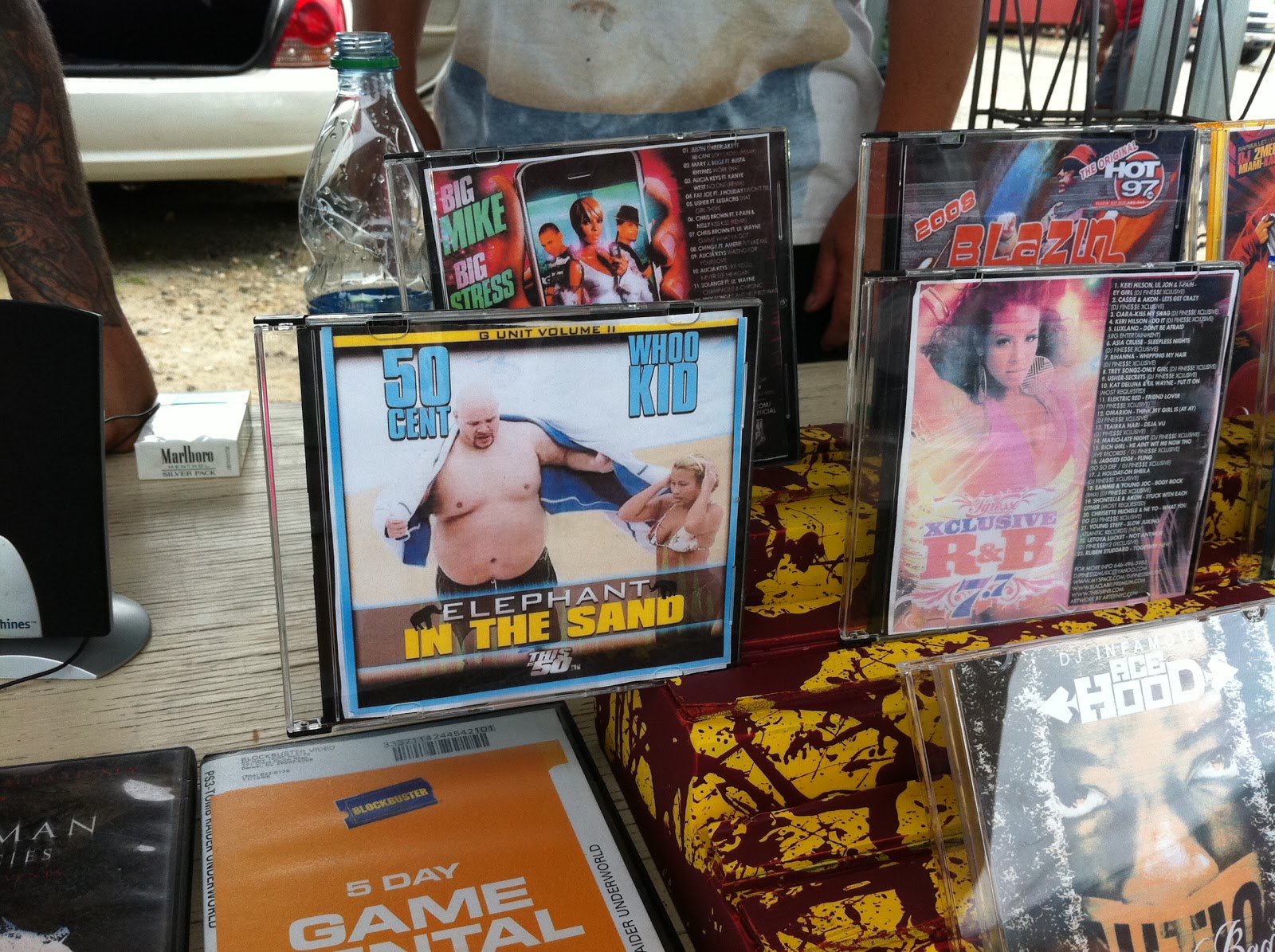
The Dallas flea market offers a fine indicator of the economic and demographic changes that have reshaped Gaston County over the last twenty years.  Home to trucking and bartering in all things cheap, defective, reused, copied, stolen, unregulated and possibly illegal, it offers a place for enterprising people to make something out of next to nothing, from bootleg CDs and bizarre household nicknacks to low-priced necessities for families struggling to stretch every dollar.  Its complexion has surely changed in the years since it was a dusty outpost of good old boys chatting and haggling in the Southeastern Sunday morning heat, and the material culture of the flea market -- Mexican wrestling masks and pinatas side by side with Confederate flags, 50 Cent remixes and Earnhardt encomia -- reveals how commerce can bring people of different origins and ideologies into the same space.  Indeed, it is one of the few spaces in Gaston County where people of different races, religions, and immigration status regularly come into contact with each other.

A Saturday Morning at the Flea Market


KY gel and a gonorrhea test -- everything you need to plan for a big weekend.


Many of our photos were taken from oblique angles.  People often do not like having their picture taken, of course, but the flea market brings with it many other issues of intrusion and anxiety where documentation is concerned.  Anyone with a camera who comes into another person's world may be an unwelcome intruder, and although I went to high school around the corner and have been coming to the flea market for years, I am still an outsider -- especially when I'm holding up my phone to take pictures.  Some shoppers and sellers at the market might have their own suspicions about who was taking pictures: undocumented immigrants, for example, might wonder if the INS or the local police were monitoring them, especially given the recent passage of bills in states such as Arizona and Georgia that gave local authorities the right to profile and harass immigrants.  At least one food seller instructed his employees not to let me take pictures of the food they were selling.  When I was asked why, the young woman said, "I just work here," although I imagine they might have been concerned about a visit from the Gaston County Health Department.  We also did not take many direct photos of the "Out of My Cold Dead Hands"-style gun dealers because they might think we were agents of Obama's oppressive regime and they are, of course, armed.
.


1990s R&B and 1970s punk are neighbors at the Inner Hippie Shop, one of the vendors that operates within several closed hangar/warehouse buildings at the market.  Other memorabilia includes framed photographs of classic jazz musicians, Bob Marley, and Dale Earnhardt -- an amalgam that strays over the boundaries of standard head-shop/counterculture fare.


Ismaili, a Turkish emigre, sells iPhone accessories.  Note his scowling colleague with the eye patch in the back.


We generally tried not to take pictures of people's faces when they could be targeted for any kind of prosecution for what they were selling (e.g. see photos of bootleg CDs and DVDs without the merchants).  It is no guarantee that a local cop or an RIAA/MPAA crusader will not randomly click on this blog and decide to "crack down" on these small sellers; indeed, in the IRB era, our project of documenting the flea market raises a lot of thorny issues.  Are we obligated not to take photos of this social arena for fear that somehow, someone there might be threatened as a result?  Is there any scholarly or journalistic imperative to create a record of this place and the people there?  Should we have to get permission from everyone whose photo we would take, and if so, what are the implications for photojournalism?  Should people only be depicted in the way they want to be depicted -- and not depicted at all if they say no?


Sandra's Simply Sinful Side Items, home of the fried Oreo, fried cheese danish and, of course, funnel cakes.


At the end of the morning we sample the legendary fried Oreos, drizzled with chocolate syrup and caramel.

.
The Flea Market as Historical Crossroads

It goes without saying that people have long associated trade and marketplaces as transnational spaces of interaction. In the pre modern and early modern world, Timbuktoo, Baghdad, London, and what was then Constantinople and today Istanbul, provide only a few spaces of this economic cosmopolitanism. Adam Smith saw civilization in free markets and capitalism’s invisible hand. The Islamic religious prophet Muhammad was a trader. Any high school history teacher worth his or her salt will tell you that trade is one of the main forms of cultural diffusion, enhancing the spread of language, religions, ideas, and products. These seem to be obvious facts.


So perhaps it should come as no surprise when Professor Cummings points to the Dallas, NC flea market as an amalgamation of transnational kitch. The professor’s points about immigration are well taken. A 2004 Economist article pointed out the increasingly suburbanized nature of immigration. For example, as of 2000, more immigrants resided in suburbs than cities and the numbers continued to rise. Furthermore, this suburbanized migration proved as true in New York and Chicago as it did in newer sites like Las Vegas, Washington D.C., and yes, Raleigh Durham. It happens fastest in the new “emerging gateways” of Dallas, TX and Professor Cummings’s southern jewel, Atlanta (Economist, “Immigration into the Suburbs”, March 11, 2004).


Cities like Chicago have long exhibited this sort of travel vista via marketplaces. For example, Maxwell Street market in Chicago began on Chicago’s west side over 120 years ago. The flea market, located on predictably, Maxwell Street, stretched from 16th Street all the way to Halsted Avenue. Forced to move in 1994 by a larger more moneyed transnational institution, the University of Illinois Chicago, the market landed on Canal Street in 1994 staying there until 2008 when it was forced by area businesses to relocate to the River North area along Desplaines Street between Roosevelt Road and Harrison Street. As one vendor admitted, “Flea markets such as Maxwell Street don't fit the changing image of the area.” Though it has long been heralded as multicultural space, who predominated usually developed accordance with migration to the city. What began with Russian Jews gave way to Poles who then receeded as African American migrants from the South became a dominant presence to today, where Mexican immigrants define the market. In fact as a Chicago chef Rick Bayless pointed out on a recent episode of the Travel Channel’s Bizarre Foods, Chicago has become the artisanal tortilla capital of the world. Moreover, some traditional Mexican cooking is more available in the city of Big Shoulders due to the wider availability of ingredients, which partially reflects the Midwestern agricultural hinterland that supports the metropolitan area. As with any change, some viewed the market’s current configuration with a sense of loss, "I miss the hot dog stands and the smell of onions," noted on longtime customer. "And pork chop sandwiches. Some of that comes with the changes in ethnicity. Today, you have a lot of taco stands."


Still, one should always remember the multi directional nature of these kind of spaces even when located in “semi-rural” or suburban locals. Mike Davis explores these locations in his work on Latino immigrants in America. In Magical Urbanism, Davis notes the more traditional insights in this regard such as whole “transnational communities” residing in one city block in L.A. but also draws attention to the place transnational suburbs have come to occupy for Latino immigrants. Remittances from work fuel rural development in Mexico, while creating a transnational flow of capital and people to these burgeoning suburban/metropolitan communities. “More than ever, repatriated “migradollars” (an estimated $8 billion to $10 billion annually during the 1990s) are a principal resource for rural communities throughout Mexico and Central America. Surpassing sugar and coffee, they are now the largest source of foreign exchanged in the Dominican and Salvadorean economies.” (Davis, 80) Global restructuring forces traditional communities to juggle capital and people between “two different, place rooted existences.” (80) Davis describes these connections between places like Dallas, NC and Puebla, Mexico as “economic and cultural umbilical cords.” (80) In this way, the “sending communities” serve as “transnational suburbs” distant from places like Atlanta, New York, or Miami, but as “fully integrated inot the economy of the immigrant metropolis as their own nation-state.” (80)


The power of these places is not confined to economics. Mexican politicians have been known to purchase media advertisements in American urban areas enticing Mexican nationals to vote from their homes in metropolitan areas of San Diego, Chicago, New York, and elsewhere. When the Dominican Republic’s dictatorial president Joaquin Balaguer exiled leading Dominican dissidents to New York, the Big Apple became the “main base for the country’s oppositional politics.” When political reforms relaxed the once authoritarian government’s grip on the nation, New York remained “the second home for the republic’s turbulent political life.” Davis notes it probably should then be no surprise that when Leonel Fernandez Reyna, who grew up on New York’s upper west side, won the nation’s 2004 presidency. Reyna still held a green card and fully expected to split his time between Manhattan and the D.R making Reyna perhaps the first transnational migrant ever elected to such an office. (84)


Still, if one believes the Economist, the Sunbelt is the future of immigration. After all, sprawl, a defining trait of many Sunbelt metropolitan areas, attracts immigrants. “Now, as sprawl consumes an ever-widening swathe of cornfields and meadows, immigrants are close behind," the Economist declares. "Who else will cut the grass, clean the houses or flip the burgers of suburbanites?” However, as has been seen in Queens, NY and elsewhere, immigrants can also generate what Saskia Sassen has called “low level gentrification.” Immigrant purchases and home starts in the greatest borough of New York spurred development. This points to the bifurcated nature of today’s immigration where on the one hand you have English speaking college educated legal immigrants and non-English speaking, poorly educated, and largely unskilled undocumented migrants: “Indian doctors and engineers represent the first group, Mexican day-labourers the second.” Granted, it is unlikely the Dallas flea market serves as a site for the H-1 Visa set, but as Leonel Fernandez Reyna illustrates, that vendor you bought the velvet Bob Marley picture from just might the next President of somewhere.

Tuesday, June 21, 2011

MLK Ain't No Al Capone: Even Sunny CA Has a Dark Side


Often when people think of racism and segregation they look South. Ask anyone of southern extraction attending a northern university how often they are subject to comments about racial discrimination and the like, they are likely to roll their eyes and ask how much time you have. One friend of mine, a South Carolina native and Macalester grad, often recounts the numerous remarks he endured while attending the St. Paul, Minnesota university. As he often noted, it's kind of easy to claim openminded nondiscriminatory beliefs when your state remains predominantly white and yes, Nordic. T of M fave Lisa McGirr has mapped the rise of the new right in Southern California while gadfly Mike Davis has traced the region's racial tics in Magical Urbanism and City of Quartz. In Magic Lands, John Findlay explores the influence of Disneyland, through its exportation of its racialized suburban built environment, in contributing to the nations's white normativity. Eric Avila has shown us how popular culture emphasized L.A.'s surburban urbanism, notably its glorification of white middle class domesticity. Moreover, Charlotte Brooks' excellent Alien Neighbors, Foreign Friends traces the place of Asian Americans in segregated California of the 20th century.

What these handful of works reveal is a shifting "othering." If Asian Americans and Mexicans served as the primary threat to white Southern California normativity in the first half of the century, Blacks replaced them in the post war period. As more and more African Americans took advantage of burgeoning industrial work in the West, white Californians came to their accept their Asian American neighbors as the lesser of two evils. Additionally, Brooks argues, Cold War influences led many to justify their inclusion of Asian Americans as a tactical decision meant to exhibit American openmindedness to the broader world -- winning hearts and minds in communist threatened Asia, if you will. True, today one is more likely to point to Arizona for fresh evidence of racism, but if one desired evidence of a calcified SoCal racism one need look no further than the place of Mexicans and Mexican Americans. The aforementioned Mike Davis has illustrated the continuing racial overtones plaguing Anglo-Mexican/Mexican American relations.

Clearly, Southern California discrimination as elsewhere hinges on demographics and proximity. Shifting discriminatory winds react to both factors. If the Chinese and Japanese were demonized in the first half of the century, while not lionized in its second half, they emerged with greater socioeconomic strength than did their counterparts. Today, California continues to illustrate such shifting tides. A recent report by William Frey revealed that California's youth is distinctly not white. Statewide only 27% of its children are white while 51% and 6% identified as Latino and Black respectively. This left the remaining 16% to be divided between Asian and Middle Eastern populations. Still, while this diversity appears encouraging, it fails to obscure a Southern California history that remains awash in racial social imaginaries. While suburbanization rates nationally for Latinos and Asians have improved, Blacks continue to endure greater barriers in their efforts to suburbanize. This is not to say Blacks are absent from suburbia. Andrew Wiese and Mary Patillo McCoy have pushed back against this idea. Indeed, Blacks have long been a presence in the suburbs, even if in smaller numbers. One wonders why the same avenues to suburbanization have not reached Blacks at the same level as other minorities.

While numerous reasons can be marshaled to explain this inequality, one simple answer is the residual racist thought that continues to connect blackness to inferiority. The Sunbelt has not proven itself to be any more colorblind than other regions. If one remembers correctly, Arizona would never have officially declared Martin Luther King Jr. Day a holiday had it not been for the NFL yanking the 1993 Super Bowl from the state. In response, Arizona, ironically, became the only state to popularly vote for the holiday and put it into legislation. With that said, one should remember that MLK Day only became official in 1986 and even then only 26 states observed it. The letter below to local Southern California news paper the Star News illuminates the kind of racial discourse we have normally associated with the segregated South. I don't know James Matherly, but I am from Chicago. Al Capone Day sounds terrible (especially for Geraldo Rivera), but to compare the former gangster to MLK makes even this Chicagoan cringe. So the next time you see one of those smarmy "come to California" commercials, just remember, Californians are as fucked up as the rest of us.

The Star News (local newspaper for the South Bay San Diego metropolitan region)
Feb 5, 1985

He’s outraged by King holiday

The student essay on Dr. Martin L. King seems divorced, separated, estranged form the truth of what King said and did.

I spoke before the San Diego Board of Supervisors Jan. 3 and before the Metropolitan Transit Development Board Jan. 12 in opposition to any King holiday.

As I recall, not one member of the public spoke in favor of this holiday at either meeting. A King holiday is an insult for those who served in the military forces. A King holiday is an insult to the memory of Harry S. Truman, an insult to the memory of Franklin D. Roosevelt, an insult to the memory of Dwight D. Eisenhower. These men and others did much more for the entire American people.

The life of King cannot stand honest, searching inquiry. The idea of hiding FBI documents, tapes, papers on King for a number of years cheapens the idea of a King holiday. The idea of a King holiday is as morally fraudulent, intellectually fraudulent as a funny holiday for someone called Al Capone.

James Matherly
402 Oaklawn Ave, Apt. G
Chula Vista

Thursday, June 16, 2011

Stop Me If You've Heard This One Before: Tea Parties, Filibusters, and More in the 1970s

 
Historians like almost nothing better than to find precedents in the past for supposedly new things.  "X is nothing new" is a formulation that is likely to be heard in a graduate seminar, an AHA panel, or anytime anyone makes the mistake of suggesting something is genuinely novel.  (This is partly why history dissertations almost always end up going further into the past than their authors originally intend.)  It is an annoying professional tic, but there is a degree of truth to Solomon's old axiom that "there is no new thing under the sun."  Even dismissing the newness of things, it seems, is as old as the hills.

Recently I flipped through some primary sources I had collected about piracy in the 1970s, and one news clipping after another seemed eerily familiar.  All came from North Carolina newspapers such as the Raleigh News and Observer, Greensboro Daily News, and Charlotte Post, and most were published in 1978.  The prevalence of tape piracy, of course, is important for my own project, which aims to show how people wrestled with questions of copying culture long before Napster and Limewire came along.  But there are many other similarities.  For instance, Republicans have lately tried to tar President Barack Obama with the brush of Jimmy Carter's failed presidency, comparing today's economic doldrums to the crisis of the 1970s; whether that charge sticks or not, there is an undeniable correlation between today's news and the topics and themes discussed in these newspapers (taxes, unemployment, an angry middle class) that should worry any current officeholder.  Indeed, the similarities go much deeper than a mere recession.  Here are a few that you are bound to recognize:

The Age Old Agony of the Academic Job Market


As early as 1971, people began to worry that there were more people with doctorates flooding the market than there were academic jobs for them to fill.  Looks like academia has been waiting for the boomers to retire ever since they first started on the job.

Women of the Tea Party


Not long after Sarah Palin first "killed her a bar when she was only 3," American women began to rise up against the tyrannical hand of the IRS.  Their leader was Vivien Kellems of New Haven, Connecticut; at the age of 74, the AP referred to her as "Miss Kellems" but reminded readers that she was "still a lady."  One newspaper called her a "self-liberated woman," but Kellems disdained feminists for "invading" bars and "men's restaurants" when they should really "be concentrating on electing women to public office and shooting for a woman president."  The IRS sued Kellems for unpaid taxes the previous year, and she vowed to lead a "national Boston Tea Party" against the unequal taxation of single people like herself.

Kellems was a wealthy industrialist, an individualist, and a supporter of the Equal Rights Amendment.  Her case symbolizes the tangled politics of resistance in the early 1970s, when the emerging "tax revolt" was not yet an entirely conservative affair and rhetoric invoking the Boston Tea Party could be employed by an independent businesswoman in her 70s to fight for what she saw as equal treatment under the law.  (Sociologist Isaac Martin has explored how the early tax revolt shared both liberal and conservative support in his book The Permanent Tax Revolt, and we have previously written about early uses of Tea Party language here.)

The Filibuster Thwarts Progressive Agenda
.

Long-time civil rights leader Bayard Rustin writes in this piece for the Post, the newspaper of Charlotte's African American community, about how a conservative minority was able to stymie progressive policies by invoking the filibuster, despite the fact that Democrats controlled the White House and both houses of Congress.  Sound familiar?

Class Warfare on the Right


Class warfare, as conservatives never tire of reminding us, is unAmerican when practiced by the Left, but it is just dandy when the Mama Grizzlies want to wield their pitchforks and assault rifles against pointy-headed cultural elites.  Kevin Phillips helped usher in the political ascendancy of Richard Nixon and Ronald Reagan in the late 1960s with his book The Emerging Republican Majority, but he was honest enough to admit the utility of class resentment for conservatives in this column.  "Analysts who suggest that the politics of class conflict must necessarily come from the socialist Left could be missing a new and intriguing trend," Phillips noted, described a "middle-income, class-conscious politics."  He cited the work of sociologists Richard Coleman and Lee Rainwater, who argued that "as US citizens can no longer take economic growth for granted, not only will belief in social mobility erode but also many people will begin to fear an absolute loss in social and economic status.  Voters will then embrace class politics as a tool of keeping one's self and one's group afloat."  Phillips's words seem especially prescient when he observes, writing in 1978, that "if the United States drifts into economic turmoil and eroding prosperity, then a politics of anti-elite resentment could conceivably be a powerful one.  The next three or four years should tell the tale."  

Tell the tale, they did.  Carter was out and Reagan was in two years later.  With today's meandering economic policy and chronically high unemployment, what are the odds that the resentment behind the current Tea Party movement will grow stronger in the years to come?  Its supporters may direct their anger at both the lazy, parasitic poor and the sybaritic elite, as Reagan so successfully did with his rhetoric of "welfare queens" and "limousine liberals." They may rail against government handouts and corruption even as they cling to whatever scraps of prosperity they have left.  (Hence the seeming paradox of opposing government spending and socialism while shouting "Hands off my Medicare!")  Let's hope this is not the outcome.

Austerity Is Always the Answer


This op-ed by Joseph Califano, a former close aide to LBJ and then-Secretary of Health, Education, and Welfare under Carter, does not give much cause for comfort.  The Democratic policymaker looks wistfully back at the 1960s as a time when liberals could wield the growing prosperity of American society to pursue ambitious initiatives to benefit children, the elderly and the poor.  The late 1970s, he suggested, were a time of limits, and liberals had to confine themselves to showing a skeptical public that government could actually be efficient and do its job well.  The fundamental premise of government services seemed to be under attack, and Califano's answer was one we have been hearing a lot about lately -- cutting spending in the name of efficiency and austerity.  Reading through the Secretary's proposals, one gets the sense that liberals had run out of ideas and had no real solutions to address the country's economic crisis.  One also gets the impression that the Obama Administration has given up on trying to pass any initiatives to fix the economy and hopes to just ride it out through the next election.  We saw how well that worked for Carter.

Best Days Behind Us?

Of course, not everyone gets unknowingly swept along in the currents of history, whether in the 1970s or today.  The following cartoon appeared, ironically enough, right next to Califano's op-ed.  In it, the Lumpits weigh in on the misguided nostalgia of American culture in the era of American Graffiti and the Fonz.


Before we come down with a bad case of nostalgia and flip on That 70's Show, we might do well to look at the history and learn from another era of filibusters, tea parties, and too many PhDs.  We might just manage to avoid repeating some of the mistakes of the past.

Alex Sayf Cummings