Showing posts with label more conservatism. Show all posts

Monday, August 29, 2011

Building the Perfect Echo Chamber: The 1970s and Political Discourse in the 21st Century


Just before Bob Dylan breaks into “Like a Rolling Stone” on his 1966 Wembley Hall Bootleg series album, one audience member yells “sell out” while another cries “Judas” -- both references to Dylan’s famous transformation from earnest urban folkie to ironic electric hipster. Dylan growls into the microphone, “I don’t believe you,” then as several moments pass by bellows, “You’re a liar!” As the band cranks into the song, you can clearly hear an angry Dylan scream “Play it fucking loud!” Ten years later, during his Rolling Thunder Revue (1975), a crowd member sarcastically begged Dylan “to play a protest song.” The audience laughed and Dylan and the Band ripped into “Oh, Sister.” Not quite the ideological heights of 1966.
.

Regardless of one’s musical preferences, one can agree the career of Bob Dylan spans several decades, often reflecting the currents of the time. If the 1966 concertgoers mirrored the self-righteous sincerity of the 1960s, Dylan’s jaded ironic 1975 audience epitomized the kind of altered consciousness of the decade that followed. As Bruce Schulman has noted,“[s]eventies sensibility then offered a kind of antidote to the melodrama of Sixties sensibility, an antidote devised by a generation of youth just plain sick and tired of being told how they missed out on the glory days.” (158) In many ways, the 1970s laid the groundwork for the mi x of ambivalence and divisiveness that have come to characterize late 20th century and early 21st century American life. Swaying between ironic indifference and froth mouthed partisanship, it would seem Americans either check out completely or are compelled to descend into sharp divide.
For those born in the latter half of the 1970s, for much of our lives, Republicans and the New Right seemed to be the driving force in American political and cultural life. Gerald Ford, Ronald Reagan, Bill Clinton (zing! Ok, not fair, but undoubtedly Clinton’s agenda was heavily influenced by Reaganite philosophies that even former members of the New Left felt obligated to adopt or engage) and both Bushes served as presidents for the vast majority of Generation Xers’ lives. It would be foolhardy to claim that it had no effect; my own understanding – and I suspect others born within a similar time frame – was colored by this experience. From birth to adulthood, America appeared to be center right, conventional, big business oriented, and increasingly privatized. Culturally, outside of L.A., NY, San Francisco, and a handful of other U.S. cities, America seemed more invested in conservatism than the avant garde or bohemianism.
.

Of course, this view ignores the long trajectory of 20th century political history. In fact, for decades the New Right appeared an unattractive aberration to the largely Democrat-led consensus governments that ruled throughout much of the postwar period. From some vantage points, the 1970s appear liberal to a fault. Even looking at the high school yearbooks of some of my older high school teaching colleagues revealed a very different America from the one most of Generation X experienced. One of my coworkers shared her early 1970s yearbook with me pointing out thinly veiled pot jokes - the kind that would have earned me a suspension in the 1980s or 90s- and odd sexual innuendo. Politically, both presidents Nixon and Carter seriously considered decriminalization and even legalization of cannabis. While the medical marijuana issue continues to gain converts, for much of the 1980s and 1990s, the drug remained an anathema. Three relatively new books examine how, as Professor Alex Cummings related in an email to the author, “white, straight, homogeneous, New Deal-era American culture began to fragment in the 60s and 70s": Rick Perlstein’s Nixonland, John McMillian’s Smoking Typewriters, and Edmund White’s City Boy.

If one wanted to think about this more simply (like primate simply), consider popular culture. Children coming of age in the 1980s had St. Elmo’s Fire, Wall Street, Ordinary People, and The Breakfast Club. Adolescents and adults of the 1970s had Five Easy Pieces, Easy Rider (okay, not quite the 1970s but pretty damn close), Chinatown, and Breaking Away. So what happened? How did a country that appeared worried about endemic corruption (Chinatown) and viewed the promise of the American dream warily (Easy Rider/Five Easy Pieces) become a nation of navel gazing yuppies (St. Elmo’s Fire/Breakfast Club) that only occasionally deemed the actions of big business as nefarious (Wall Street)?
.

Certainly, economic shifts of the 1970s had a deep effect on American culture and politics. As T of M has explored, many historians trace the shift to the early 1970s connecting deindustrialization, the end of Fordism, stagflation, government corruption and a brutal energy crisis as the driving forces of this change. In addition, the rise of New Right figures such as Barry Goldwater, Richard Nixon, Ronald Reagan, William F. Buckley, and Bill Kristol harnessed a right wing movement, once populated by John Birchers and anti-Semites, into a political juggernaut that would dominate the country’s politics in the last third of the century. Yet, by the 21st century, the conservative movement of the 1970s no longer satisfied modern day right-wingers. Richard Nixon would probably struggle to win a Republican primary today, let alone a national election. Where did this shift begin? How did the “Silent Majority” emerge? Who were they responding too? What countervailing forces affected it? What about those who placed themselves outside the suburban Silent Majority, who chose to reside in New York City, the epitome of 1970s decline?

Nixon and Smoking Typewriters .
Nixonland: it is the America where two separate and irreconcilable sets of apocalyptic fears coexist in the minds of two separate and irreconcilable groups of Americans … Nixonland is what happens when these two groups try to occupy a country together. By the end of the 1960s, Nixonland came to encompass the entire political culture of the United States. It would define it, in fact, for the next fifty years. (Rick Perlstein, Nixonland: The Rise of a President and the Fracturing of America, 46-47)

Modern day America, if one were to oversimplify, often seems split between those who watch Fox and those who watch MSNBC . I guess everybody else watches CNN or more likely just doesn’t pay attention. “The parties have reorganized themselves along ideological lines, as white conservatives have abandoned the Democrats and northern liberals the Republicans,” a recent Economist article observed. “The ideological factions have built mighty propaganda machines stretching from Washington think tanks to the studios of Fox and MSNBC. And ideologues have resorted to previously taboo weapons, such as the threat of default.” (Economist, “American idiocracy”, Aug 13, 2011) How we got here is the subject of Rick Perlstein’s Nixonland: The Rise of a President and the Fracturing of America.
.

The value of Nixonland lies in Perlstein’s ability to contextualize Nixon within the zeitgeist of late 1960s and early 1970s America. In reality, Nixon was less ideologue than political operator. According to Perlstein, Nixon’s main interest lay in foreign policy. In Tricky Dick’s mind , domestic politics served as little more than political theatre. Speaking to Theodore White Nixon once opined, “I’ve always thought the country could run itself domestically without a president.” (393) However, Nixon utilized the stage as few others. In language eerily reminiscent of today, Nixon castigated the “liberal media,” gave cultural but not economic recognition to the working class, and critiqued anti-war protesters and others by claiming their work emboldened the enemy. Take Nixon aid Bob Haldeman, for instance, telling Barbara Walters on the Today show that “Democrats still opposing the president were aiding and abetting the enemy of the U.S.” Nixon followed this up shortly after arguing that Democratic opposition regarding his decisions in Vietnam, “might give the enemy an incentive to prolong the war after the election.” (623) Sound familiar?

Perlstein portrays the late 1960s and early 1970s as a rapid fracturing of the American public. The Vietnam War, leftist and rightist radicalism, and a faltering economy combined to place strain on the very seams of public life. Though many writers highlight the violence of the extreme left like the Weatherman, Perlstein points out, far right extremists employed similar tactics just as frequently but the media reported on these events far less frequently. Perlstein illustrates how a chastened media felt compelled to represent America’s great middle classes more equally. When journalists critiqued Mayor Daley’s handling of the 1968 Democratic Convention, letters poured in chastising the media and praising the aggression of the Chicago Police Force. When in 1972 National Guardsmen shot dead four Kent State University students, citizens opposing the student protests provided their own response. “I extend appreciation and whole hearted support of the Guard of every state for their fine efforts in protecting citizens like me and our property,” wrote one. Another lamented “When is the long suffering Silent Majority going to rise up?” A local resident speaking to a researcher uttered a common feeling for many of the period. “Anyone who appears on the streets of a city like Kent with long hair, dirty clothes, or barefooted deserves to be shot,” related the Kent City citizen. (489) Letters and responses greatly circumscribed media coverage in the decades that followed. Nixon successfully exploited this hostility.
.
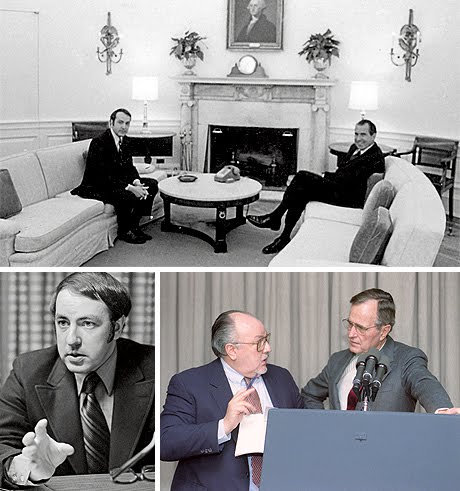
Contrary to popular belief, youth movements of the day were not dominated entirely by leftists. At Queens College, where radicals “rampaged” through the library and occupied administration buildings, another conservative group referred to as the Students Coalition held a sit in in the registrar’s office in order to protest the “college president’s failure to call the police to evict the students occupying the administration building.” (380) Similar scenes unfolded on other campuses as well. As Perlstein points out, the Left did not monopolize youth. Roger Ailes, Pat Buchanan, Ron Ziegler, and others were only in their mid to late twenties when Nixon plucked them from obscurity.

Of course, while the mainstream press seemed fixated on the antics of leftists, left leaning editors and writers in what became know as the Underground Press (UP) purposely sought to make waves. In Smoking Typewriters: The Sixties Underground Press and the Rise of Alternative Media in America, John McMillian explores the milieu of radical journalists and publishers of the period. McMillian tracks the initial emergence of radical newspapers like the Free Press (Los Angeles), the Rag (Austin, Texas), Berkeley Barb (take a guess) and the Paper (East Lansing, Michigan aka Michigan State) noting that in the very early stages each operated in isolation from one another, a symbol of the very uncoordinated leftism that emerged in the mid 1960s and early 1970s.
.

However, with the establishment of Underground Press Syndicate (UPS) and the Liberation News Service (LNS) all that changed. For McMillian, the underground press played a vital role in institutionalizing the New Left: “Although historians are fond of referring to an overarching ‘youth community’ in the 1960s, before the advent of the underground press, the youth revolt was marked more by fragmentation than cohesion.” (McMillian, 73) Though UPS came first and provided much needed organization, the LNS proved even more influential. “A kind of radical alternative to the Associated Press,” McMillian writes, “LNS aimed to centralize news gathering and dissemination in the underground media.” (83) The ability of LNS to distribute materials widely served as critical factors when reporting on major protest events like the 1968 Columbia University Revolts.

Though the journalistic practices of some UP writers remain questionable, they nonetheless highlighted aspects of protest that New York Times an others ignored or purposely obscured. Moreover, the UP projected a culture that united readers. “Underground newspapers functioned as vital institutional bases for radical political and aesthetic communities,” McMillian argues. “In their pages, they replicated the creativity, zaniness, humor – and otherworldliness – of the youth movement at large.” (81) Through their influence, the world of alternative weeklies developed soon after, often eschewing the kind of politics the UP celebrated but clearly shaped by the UP’s successes and failures. Without the UP, publications like the Chicago Reader probably would not exist.

Considering the level of paranoia that pervaded both the Left and the Right in the late 1960s and early 1970s, the UP’s radical take on political affairs had to rankle and frighten many a conservative. In all likelihood, the promotion of Marxism and bohemian lifestyles did little to ease the fears of the Silent Majority. The fact that many writers and UG editors professed a desire to shake things up only added to the tensions that had been mounting.

City Life

During this period, few sites elicited trepidation like cities. Many of the UPs developed on college campuses or in urban settings. McMillian acknowledges this development, noting, “many of the ideas that gave rise to New Left journalism had an important material context – they were generated in urban spaces.” (36) Moreover, while many fled cities for the suburbs, others took solace in the caverns of metropolises like New York City. In his 2008 memoir, City Boy: My Life in New York During the 1960s and ‘70s, Edmund White recounts his own experiences, recasting New York as a space of danger but also artistic and social ferment:
It is difficult to convey the intensity and confusion in our minds back then in the sixties and early seventies as we tried to reconcile two incompatible tendencies – a dandified belief in the avant-garde with a utopian New Left dedication to social justice, both of which in my case could be overruled by an admiration of the simple humanity of the Great Russians or Singer. Looking back now, I’d say that because we were Americans emerging from the stultifying 1950s, we were extraordinarily naïve about both politics and esthetics – humorless, unseasoned, dogmatic – because untested. (White, 38)

White’s memoir reveals the complexities of identity for those the Silent Majority deemed unworthy. White’s homosexuality would have clearly stigmatized him among the suburban masses that Nixon attempted to woo through naked patriotic tropes. “Not that concepts like ‘patriotism’ meant anything to me,” White recalls. “As a gay man I didn’t think that I was American or that I belonged to a society worth defending … I felt powerless to affect national policy, and I also knew that any policy might be devised by any government present or future would contain a clause condemning me as a homosexual.” (24) As White notes later, it was to the city they felt devoted, a city that nurtured the artistic creativity and sexuality of himself and others: “Perversely, we were proud to be New Yorkers but not Americans.” (211) As a native Midwesterner, White came from the very stock that made up the Silent Majority. However, despite his own origins, White claimed that Midwestern transplants like himself were the only ones who truly loved the city. As White recounts, 1970s, New York “was so shoddy, so dangerous, so black and Puerto Rican, that the rest of white America pulled up its skirts and ran off in the opposite direction.” (210) Ignoring White’s gendering, the longtime literary critic and author represents a central irony of the “Silent Majority”. Its dissidents, self perceived outcasts like White – whether due to sexuality, political beliefs, or other like factors - provided the very life blood to the nation’s symbol of urban decay. Throughout City Boy, White continually returns to this theme. For White, “no one loved New York except us, the gay and the artsy misfits from the Midwest.” (210)

If many Americans portrayed New York as a city of negative energy filled with malcontents, criminals, and angry minorities occupying public spaces White saw it differently. Clearly, White agrees with Perlstein’s assertions regarding violence. “Suburbia, television, and the automobile had isolated everyone – perhaps a good thing in such a potentially violent country.” (224) Still, also like Perlstein, White points to the kind of mindset that befell American suburbanites, people in gated communities “miles away from the nearest ghetto” so petrified they fortified their homes with weapons or karate training. In fact, despite White’s own proximity to the alleged urban trouble spots, “it was precisely in those places that were the safest that the sheltered populations most often expected imminent violence.” (224) To be fair, White himself acknowledges that simmering tensions in New York meant that by the late 1970s, the 1977 blackout revealed “how racially divided we were, how much anger seethed just below the surface, how rapacious and every man for himself we’d become.” (225). The larger point here is how fear and anger had pervaded the nation especially in places where violence and protest seemed a distant possibility.
.

Whether Perlstein hangs this on Nixon or simply positions him as a knowing conduit through which fear and anger could be broadcast remains less important than the fact that regardless of where it originated, the divisions that seem so stark today emerged then. If Bob Dylan’s sarcastic ironic audience of 1975 seemed comfortably ambivalent, other citizens felt anxiety ridden and furious. Vietnam, assassinations (Bobby Kennedy, MLK to name only two), campus protests, Kent State, the 1968 DNC, various rights movements, and the resentments of the “Silent Majority” collided. In the years that followed, Americans increasingly placed themselves in camps that operated like political and cultural echo chambers. John McMillian’s Underground Press at the outset provided the New Left with a vehicle for a clarion call of beliefs that initially won converts, but soon after devolved into the very echo chambers that plague public discourse today. Responses to recent events such as the London Riots illustrate this tension as Conservatives harnessed arguments that blamed the riots on immorality and a bureaucratic nanny state, while liberals portrayed all rioters as victims who simply needed more government intervention. The best remedy to these issues is probably something between the two poles: one that accounts for law and order, but also provides social and economic measures that address poverty and racism. Unfortunately, when the only voice you hear is an echo of your own, real solutions become that much harder to divine.
.
Ryan Reft

Thursday, June 16, 2011

Stop Me If You've Heard This One Before: Tea Parties, Filibusters, and More in the 1970s

 
Historians like almost nothing better than to find precedents in the past for supposedly new things.  "X is nothing new" is a formulation that is likely to be heard in a graduate seminar, an AHA panel, or anytime anyone makes the mistake of suggesting something is genuinely novel.  (This is partly why history dissertations almost always end up going further into the past than their authors originally intend.)  It is an annoying professional tic, but there is a degree of truth to Solomon's old axiom that "there is no new thing under the sun."  Even dismissing the newness of things, it seems, is as old as the hills.

Recently I flipped through some primary sources I had collected about piracy in the 1970s, and one news clipping after another seemed eerily familiar.  All came from North Carolina newspapers such as the Raleigh News and Observer, Greensboro Daily News, and Charlotte Post, and most were published in 1978.  The prevalence of tape piracy, of course, is important for my own project, which aims to show how people wrestled with questions of copying culture long before Napster and Limewire came along.  But there are many other similarities.  For instance, Republicans have lately tried to tar President Barack Obama with the brush of Jimmy Carter's failed presidency, comparing today's economic doldrums to the crisis of the 1970s; whether that charge sticks or not, there is an undeniable correlation between today's news and the topics and themes discussed in these newspapers (taxes, unemployment, an angry middle class) that should worry any current officeholder.  Indeed, the similarities go much deeper than a mere recession.  Here are a few that you are bound to recognize:

The Age Old Agony of the Academic Job Market


As early as 1971, people began to worry that there were more people with doctorates flooding the market than there were academic jobs for them to fill.  Looks like academia has been waiting for the boomers to retire ever since they first started on the job.

Women of the Tea Party


Not long after Sarah Palin first "killed her a bar when she was only 3," American women began to rise up against the tyrannical hand of the IRS.  Their leader was Vivien Kellems of New Haven, Connecticut; at the age of 74, the AP referred to her as "Miss Kellems" but reminded readers that she was "still a lady."  One newspaper called her a "self-liberated woman," but Kellems disdained feminists for "invading" bars and "men's restaurants" when they should really "be concentrating on electing women to public office and shooting for a woman president."  The IRS sued Kellems for unpaid taxes the previous year, and she vowed to lead a "national Boston Tea Party" against the unequal taxation of single people like herself.

Kellems was a wealthy industrialist, an individualist, and a supporter of the Equal Rights Amendment.  Her case symbolizes the tangled politics of resistance in the early 1970s, when the emerging "tax revolt" was not yet an entirely conservative affair and rhetoric invoking the Boston Tea Party could be employed by an independent businesswoman in her 70s to fight for what she saw as equal treatment under the law.  (Sociologist Isaac Martin has explored how the early tax revolt shared both liberal and conservative support in his book The Permanent Tax Revolt, and we have previously written about early uses of Tea Party language here.)

The Filibuster Thwarts Progressive Agenda
.

Long-time civil rights leader Bayard Rustin writes in this piece for the Post, the newspaper of Charlotte's African American community, about how a conservative minority was able to stymie progressive policies by invoking the filibuster, despite the fact that Democrats controlled the White House and both houses of Congress.  Sound familiar?

Class Warfare on the Right


Class warfare, as conservatives never tire of reminding us, is unAmerican when practiced by the Left, but it is just dandy when the Mama Grizzlies want to wield their pitchforks and assault rifles against pointy-headed cultural elites.  Kevin Phillips helped usher in the political ascendancy of Richard Nixon and Ronald Reagan in the late 1960s with his book The Emerging Republican Majority, but he was honest enough to admit the utility of class resentment for conservatives in this column.  "Analysts who suggest that the politics of class conflict must necessarily come from the socialist Left could be missing a new and intriguing trend," Phillips noted, described a "middle-income, class-conscious politics."  He cited the work of sociologists Richard Coleman and Lee Rainwater, who argued that "as US citizens can no longer take economic growth for granted, not only will belief in social mobility erode but also many people will begin to fear an absolute loss in social and economic status.  Voters will then embrace class politics as a tool of keeping one's self and one's group afloat."  Phillips's words seem especially prescient when he observes, writing in 1978, that "if the United States drifts into economic turmoil and eroding prosperity, then a politics of anti-elite resentment could conceivably be a powerful one.  The next three or four years should tell the tale."  

Tell the tale, they did.  Carter was out and Reagan was in two years later.  With today's meandering economic policy and chronically high unemployment, what are the odds that the resentment behind the current Tea Party movement will grow stronger in the years to come?  Its supporters may direct their anger at both the lazy, parasitic poor and the sybaritic elite, as Reagan so successfully did with his rhetoric of "welfare queens" and "limousine liberals." They may rail against government handouts and corruption even as they cling to whatever scraps of prosperity they have left.  (Hence the seeming paradox of opposing government spending and socialism while shouting "Hands off my Medicare!")  Let's hope this is not the outcome.

Austerity Is Always the Answer


This op-ed by Joseph Califano, a former close aide to LBJ and then-Secretary of Health, Education, and Welfare under Carter, does not give much cause for comfort.  The Democratic policymaker looks wistfully back at the 1960s as a time when liberals could wield the growing prosperity of American society to pursue ambitious initiatives to benefit children, the elderly and the poor.  The late 1970s, he suggested, were a time of limits, and liberals had to confine themselves to showing a skeptical public that government could actually be efficient and do its job well.  The fundamental premise of government services seemed to be under attack, and Califano's answer was one we have been hearing a lot about lately -- cutting spending in the name of efficiency and austerity.  Reading through the Secretary's proposals, one gets the sense that liberals had run out of ideas and had no real solutions to address the country's economic crisis.  One also gets the impression that the Obama Administration has given up on trying to pass any initiatives to fix the economy and hopes to just ride it out through the next election.  We saw how well that worked for Carter.

Best Days Behind Us?

Of course, not everyone gets unknowingly swept along in the currents of history, whether in the 1970s or today.  The following cartoon appeared, ironically enough, right next to Califano's op-ed.  In it, the Lumpits weigh in on the misguided nostalgia of American culture in the era of American Graffiti and the Fonz.


Before we come down with a bad case of nostalgia and flip on That 70's Show, we might do well to look at the history and learn from another era of filibusters, tea parties, and too many PhDs.  We might just manage to avoid repeating some of the mistakes of the past.

Alex Sayf Cummings

Wednesday, May 4, 2011

Stalking the Tax Man: The Pervasive Influence of the Property Tax Revolt


"Assessment Excess"

To the Editor,
In January of this year my retirement annuity was increased 1.3 percent due to the increase in the cost of living. In April of this year the city of Norfolk reassessed my property, raising it 6.87 percent. This is more than five times the cost of living percentage and will unfairly and excessively increase my property taxes.

I understand some city officials in the area may consider the hike in tax revenues by this means as tax "windfalls" or "bonanzas." We all know better. Every penny comes from someone who must live within means not derived from windfall gains.

According to figures in a recent Virginian-Pilot article, Norfolk can trim its tax rate to prevent windfalls and still receive the revenue needed for the present tax year ("Property taxes: vital seldom understood." March 29) A rate of $1.19 per $100 assessed valuation would suffice in Norfolk vs. the $1.25 now in effect. Portsmouth's rate of $1.30 per $100 could have been reduced to $1.21, according to the figures.

I hope elected officials are concerned and competent enough to reduce rates and assessments to their proper levels before concerned citizens activate a larger, angrier Norfolk Tea Party for fair taxation.

J.A. Johnson
Norfolk, VA
Virginian Pilot Ledger, May 12, 1987

Over the past eighteen months or so, the constant baying and mobilization of the Tea Party Movement has captured the attention of the American public. Conservatives, liberals, and centrists must at the very least acknowledge the social movement’s presence in the wider public sphere. However, though most observers treat the Tea Party as a modern 21st century phenomenon, a little digging reveals that the Tea Party moniker has been used by numerous groups in numerous decades to pursue various goals.

J.A. Johnson’s letter in May of 1987 illustrates the longer historical trajectory that the Tea Party label embodies in the post 1970 era. In his letter to Virginia Pilot Ledger, Johnson invoked the name of the local Norfolk Tea Party, a title that today often drives fear into the hearts of moderate conservatives and terror in the minds of liberals.

According to an October 1981 Virginia Pilot article, the local Norfolk Tea Party had formed in 1978 as a response to property taxes. Evolving from a “coalition of civic league representatives” angry over the municipality’s real estate tax, the Norfolk Tea Party gathered over 21,000 signatures protesting the city’s property tax hike. (It had been set at $1.62 per $1000 valuation, the Tea Party wanted it lowered to $1.15 per $1000.)  Though the city initially rejected the petition, the party responded by collecting over 17,000 more signatures in an attempt to force a special election so that voters could decide the issue. Though the circuit court thwarted their effort, that newspaper noted “it is generally acknowledged that the group was largely responsible for the council’s lowering the tax rate to $1.30” (Virginia Pilot Ledger, October 12, 1981).  

From 1978 through 1981, the party continued its activities in local electoral politics. The originally non-partisan Tea Party turned partisan. It backed several local candidates for city council, the House of Delegates, and the then-mayor Vincent J. Thomas. The 1981 incarnation hoped to boost the electoral hopes of one George S. Hughes. Hughes, a former Norfolk city councilman, who received the endorsement of the Norfolk branch in his attempt to secure the city treasurer position. If Hughes “reluctantly” admitted that he had sought their endorsement, he also acknowledged he knew little of the party’s intent.  “I don’t know their plans," he said.  "If they feel that (endorsement) is the thing to do, I’m sure they’ll do it.” While the paper described the local Tea Party as conservative, the group seemed willing to support Democrats, like Howard Copeland, who the Virginia Pilot identified as a “a former Tea Party lawyer, [who won] in a 1979 primary battle that enabled him to secure membership in the Virginia House of Delegates.” Still, though today’s Tea Partiers seem exclusively associated with the Republican party, Copeland illustrates the greater ideological malleability of the Norfolk Tea Party.

Naturally, the next question that arises revolves around this early Tea Party incarnation and the tax revolt of the 1970s.  The 1978 Norfolk tax revolt, as represented by Tea Party efforts, emerged as part of a larger process. Robert Self notes as much when he points to the pervasive influence of California’s Prop 13 property tax referendum: “Immediately identified not as a tax revolt but the Tax Revolt, Proposition 13 … along with the anti-statist (and antipolitician) political groundswell that underwrote it, was quickly exported around the nation in a wave of imitative ballot measures and state legislation from Massachusetts to Oregon” (Self, Prelude to the Tax Revolt: The Politics of the “Tax Dollar” in Postwar California”).  Clearly, the Norfolk Tea Party petition serves as one example of the very process Self documents. For Self, the leaders of the 1978 Tax Revolt were motivated by the failure of the “grand compromise” suburbia had established with the federal government. The conflict between business elite support for the perpetual “growth machine” and residents’ desire to focus on quality of life and minimized costs had been dodged through the combination of “federal subsidy and local tax policy” (Self, 147).  However, by the 1960s and 1970s, this compromise no longer sufficed. Homeowners rejected the explanations of state and municipal politicians. As Self summarized, “the tax revolt was thus one manifestation of a return in Suburban California to a classic growth machine politics that postwar liberalism had temporarily displaced” (147).

Self’s insights remain salient, but UCSD Sociology Professor Isaac Martin has also waded into the debate with his 2008 work, The Permanent Tax Revolt: How Property Tax Transformed American Politics. Like Self, Martin sees the property tax revolt as a transformative process. While Martin notes that by the 1970s the tax revolt had shifted right, in its initial form it featured political views from the left and the right. Conservatives and liberals had begun to question taxes in 1950s and 1960s, but each had different reasons for their skepticism. Moreover, the UCSD professor builds on aspects of Self’s argument that Self notes but fails to pursue.

For Martin, the tax revolts of the 1960s and 1970s reshaped American politics. The idea of “tax limitations” became embedded in political discourse, placing tax cuts “permanently on the political agenda.” (13) The apparent success of property tax limitations convinced politicians like Ronald Reagan that tax cuts provided a useful electoral strategy. Republican leaders, lobbyists, and the burgeoning rank and file embraced the tax cut approach, forcing moderates and the party as a whole to “redefine the GOP as the party of tax cuts” (14).


Fundamentally, the early “tax rebels,” as Martin labels them, sought not to prevent the state from collecting taxes but rather to reinstate a tax privilege that had been removed in the early 1960s under the auspices of good government. Martin points out that what early tax rebels really wanted was the restoration of “fractional assessment.” Describing fractional assessment as an example of an informal tax privilege imposed and maintained through custom, Martin notes that even though many states had no provisions for its implementation, nearly all employed it. Thus, fractional assessment came to function as a “kind of hidden social policy” (7).  How significant was this social policy? According to Martin, studies illustrate that the electorate and their representatives view “tax subsidies for homeowners as substitute for direct social programs like Social Security (8).  By the 1960s, this meant fractional assessment provided more benefits than all other social policies save Medicare and Social Security. Moreover, as the government provided subsidies to suburban development through highway appropriations and the like, the values of homes rose, thus, theoretically raising property values and assessments. The standardization of assessments through modernization removed this tax privilege from numerous groups, but especially politically valuable ones.

How did fractional assessment work? Fundamentally, fractional assessment operated as a clear political process. Though divided between elected and appointed officials, assessors were hardly property experts. “They typically lacked training in appraisal methods, and even where they were capable of appraising property accurately, the political imperatives to avoid blame for tax increases trumped the constitutional imperative to assess property at its full market value,” notes Martin (27).  Predictably, assessors' “assessment ratio[s] varied widely from place to place” so that the system lacked uniformity. Additionally, fractional assessment spread its benefits asymmetrically and inequitably. Poorer homeowners and businesses endured higher rates of fractional assessment; as Martin suggests, “the system was unfair to any taxpayer who was not lucky or savvy enough to get a good assessment” (28).  As one can imagine, this system failed to provide the necessary revenue to growing municipalities. Not only did assessors purposely keep the “measured tax base small,” they under-assessed properties. Reflecting the model of Charles Tiebout, local municipal leaders competed with one another to draw new residents to their communities. Having lower assessments provided one means to attract new homeowners. As housing values rose, in part due to government expenditures, so too did housing prices. By the 1960s and 1970s, the tax privilege that fractional assessment provided had grown, not shrunk.

Efforts to reform or modernize the property tax system emerged in eras prior to the 1960s. Arguing that the nation missed a prime opportunity to reform the system during WWII, Martin traces the emergence of a reform movement to modernize this tax base in the post war period. Modernization entailed a “centralization, professionalization, and standardization of tax administration” (26).  Basically, this meant county assessors would now have to take a formalized test to illustrate competence and were now required to impose a “common preference standard. County assessors would henceforth appraise all taxable property uniformly at its market value and assess all property for tax purposes at 25 percent of that value with no exceptions” (26).  Early postwar attempts to reform the system in California failed. First, the modernization movement featured a wide array of city officials both supporting and opposing modernization. Officials who dispensed tax privileges as political benefits viewed modernization as a threat. In contrast, those who lacked the ability to level fractional assessments wanted to curb their influence since reforms would bring more revenue their way. Second, state officials feared raising taxes while modernization foes used assessments as a political resource.


The demographics of the “tax rebels” might serve as a source of surprise. Though historians and others frequently conflate the 1970s tax revolt with suburban populations, Martin illustrates that in its initial stages, the tax revolt movement consisted of rural, metropolitan and urban supporters. Even in the 1960s, the movement’s support crossed ideological boundaries. Politically, leftists like George Wiley, executive director of the National Welfare Rights Organization (NWRO) embraced the property tax’s abolition as tightly as conservatives like Howard Jarvis. However, Martin explains that though homeowners on the left and right opposed property tax because each deemed it a threat, the meaning of the threat differed. “From the right some complained that it was a tax on property, and therefore punished those who worked hard and saved money," Martin says. Meanwhile the left "complained that [the tax] was regressive and that poor communities had to charge high tax rates to pay for the same public services that wealthy communities could get more cheaply” (75).

While tax revolts proliferated locally in the 1960s, they failed to coalesce into a social movement until modernization had been imposed. Like numerous other recent scholars, Martin views the 1970s as decisive in regard to the tax revolt’s emergence as national movement.  The Permanent Tax Revolt pinpoints three reasons for this: 1) the common target of modernization enabled the formation of coalitions across county boundaries (removing assessors from the equation led many to realize the state was the target of their collective ire); 2) modernization standardized assessments so that protesters now “confronted … the same threat at the same time” (58); 3) under modernization assessments now “meant more than a one time cut in your informal benefits.”  New regulations required assessors to constantly maintain current values. This meant taxes rose with housing markets. “Homeowners, in short, saw that their tax privileges might be permanently reduced or altogether revoked," Martin says.  "Homeowners mobilized in proportion to the threat they faced” (58).  Likewise, the early 1970s represented property tax opponents' greatest opportunity to do away with the tax permanently. The movement found allies among elites. Many elites believed the property tax “to be in crisis,” and facing upcoming elections, the focus on property taxes provided an easy political strategy. For example, Nixon’s 1972 re-election campaign depended on reaching suburban voters. In the face of rising housing values, few issues captured the passions of suburban homeowners more than property taxes. Still, though the 1970s represent a burgeoning movement about to go national, it did not reach its apex until 1978.

So if the abolition of the property tax enjoyed popular and elite support, why does the property tax persist? Martin states simply, “Federalism foiled the American tax rebels” (86). How so? One of the strengths of Martin’s work is the use of comparison. From introduction to conclusion, Martin harnesses examples from Europe and Britain (and of course numerous comparative examples from within the US). This use of comparison helps refute ideas about American exceptionalism. In most cases where modernization impinges on a tax privilege, revolt has followed. These examples illuminate many of the points he makes regarding American property tax controversies. Here, Martin notes the success of Scotland’s unitary government in abolishing property taxes. However, in America, the flexibility of federalism meant Nixon could not impose a property tax ban. Property taxes were the responsibility of the state. Thus, states acted on their responsibilities by enacting numerous tax relief reforms. Martin notes that three reforms dominated this process: circuit breaker laws (favored by the left), classification laws (favored by the right), and tax limitation laws (favored by the center). In sum, these reforms acted as new “tax privileges,” as “the 1970s saw a burst of innovative policy making to provide homeowners with security from rising taxes and rising prices” (95).  The Scottish government lacked the flexibility to enact such reforms.

Martin’s conclusions challenge recent studies on federalism and fiscal policy that argue federalism impedes innovation “by multiplying veto points.” In this way, Martin acknowledges the contributions of these studies, but encourages scholars and policymakers to consider federalism’s “second face.”  Federalism “also appears as a structure of access points that encourage policy proposals from political outsiders … [it] blocked [Nixon’s] plan to abolish the property tax – but it encouraged the proliferation of other property tax relief policies” (96).  In part, this also explains why England did not embrace property tax cut. As a result of federalism’s flexibility, states were able to put reforms into practice such that many tax innovations had been operating under the watchful eye of the public. When Ronald Reagan, influenced by Prop 13’s electoral success, began advocating for property tax cuts, he appealed to state policies then in existence. When Margaret Thatcher attempted a similar feat, she failed. Unlike Reagan, Thatcher had pinned her hopes on an untested and relatively unknown new policy that Martin describes as “catastrophically unpopular” (144).  Thus, American conservatives now view tax cuts as the veritable Holy Grail, while Britain’s Tories see only electoral disaster.


Undoubtedly, the acknowledged epicenter (or the example most often employed) of the property tax revolt remains California. Prop 13 plays a central role in Robert Self’s metropolitan history of postwar Oakland, American Babylon, and likewise, Martin pays homage to the Golden State’s devotion to tax limitation, positioning Prop 13 as a catalyst for other movements in Michigan, Massachusetts and New York. In Massachusetts, Prop 13 “inspired conservative groups to take interest in the property tax issue,” resulting in the coming together of three separate camps of Massachusetts conservatism, who collectively helped push through Proposition 2 ½ in the state legislature.  (Prop 2 ½ “established a 4 percent limit on the annual growth of local taxes, but exempted all school districts and any local governments that voted to override the cap” [115].)  In Michigan, moderates saw Prop 13 as the proverbial “writing on the wall.” Sitting Governor William G. Milliken, a moderate Republican opposed to property tax cuts, defeated a 1976 attempt to impose tax limitation, but in the wake of California’s decision did not think a second victory appeared imminent. Miliken agreed to a less severe 1978 tax limitation out of fear of more drastic legislation. Finally, New York’s political leadership settled on a hybrid combination of tax limitations and classification. For liberals in the Empire State, Prop 13 demonstrated the power of public support. Many liberals justified their support of tax limitation on the argument that tax limitations would help the middle class but also significant numbers of low income homeowners.

Why did Prop 13 reverberate so widely? Martin points to three reasons. First, the symbolic power of Prop 13 sparked a belief, among proponents of property tax limitations, that opposition to property taxes had the support of the broad public.  Second, California’s sheer size suggested that the nation’s largest state and future electoral kingmaker represented broader opinion. After all, Martin notes, a 1972 Washington state constitutional amendment that tightened the state’s “existing, statutory property tax limit” garnered very little attention six years earlier. Finally, because California liberalism was seen as the dominant political culture in the state, the victory of an economically conservative fiscal policy like Prop 13 drew greater media attention than otherwise might have been the case, thus, magnifying its importance. Moreover, politicians and protesters around the nation took note that property tax limitation appeared to be a “viable solution to the property tax crisis” (111).


The right’s appropriation of property tax cuts emerged in the wave of legislative and electoral victories the revolt inspired. Conservatives used property tax limits as a central part of a larger package of conservative ideas. In many ways, property tax limits helped conservatives paper over differences while also energizing their base. Supply side economics encouraged a larger dedication to tax cutting. Ronald Reagan and his heirs argued that by cutting taxes, more money flows into the economy thus expanding the tax base and “thereby actually [increasing] federal revenues” (130).  As Martin argues, tax cuts as political tradition is a fairly new development. Tax cuts came to dominate political discourse in direct relation to the property tax revolt. "Tax limitation policies, watered by the Reagan Revolution, and flowering in the heart of the Republican party,” incubated a burgeoning new language of politics, the lexicon of tax cuts (145).


Over the 33 years since its approval, the discourse that has grown around Prop 13 often obscures its larger effects. First, the doomsday scenario that many state officials, conservatives and liberals alike, feared never came to fruition. The budget shortfalls failed to impact local municipalities as severely in Prop 13’s early years, because budget surpluses were used to patch up fiscal holes. As the Economist explains in a recent survey on California, “the state had a budget surplus and decided to bail out local governments by passing to them roughly the amounts they had lost in property tax revenues” (Economist, “Prop 13: War by Initiative”, April 23, 2011).  Moreover, this paradoxically resulted in a “permanent financing mechanism” that meant all future property tax revenues had to flow through Sacramento. In this way, “cities, counties and school districts thus lost their funding independence. Instead of local governments setting their own taxes they became tentacles of the state octopus.” Not exactly what a freshly scrubbed Reaganite conservative dreamt.

If Martin focuses on how California paced the nation, the Economist notes the pervasive influence of Prop 13 on the state’s internal politics. Referendums became less regulated and more common. Prior to Prop 13, the initiative/referendum process was viewed as a “safety valve”; after, it became “an industry and a circus.” Large interests intervened and bankrolled the process (see the controversial Prop 8 from 2008). The qualification process changed as well. Gathering signatures no longer fell under the purview of individuals committed to a cause, as "signature gathering became an industry and access was determined by money."  Paid professionals now corral thousands of John Hancocks and then sell them to organizations and interests who need them for ballot qualification. The costs of sponsoring initiatives have soared. Prior to Prop 13, initiative spending amounted to about 9,000,000 per election.  Ten years later, the typical initiative campaign cost 127,000,000. As one observer noted, “any billionaire can change the state constitution. All he has to do is spend money and lie to people.”

Perhaps, the largest misconception regarding Prop 13 regards who the real beneficiaries are. Traditionally, supporters frame the debate as “the little guy versus the established powers” (Economist, “How voters decide: What do you know?”, April 29, 2011). However, few seem to realize that Prop 13’s tax reduction includes businesses such as large firms, trusts, and hedge funds which own commercial property.  Does this count as David and Goliath?

Martin points to the results of Prop 13 by pointing to school appropriations. By far, education spending ranks as California’s largest expenditure. As of 2010, spending on schools accounted for 34.5% of the state budget (Economist, “The People’s Will”, April 29, 2011).  Though it took time to take effect, Prop 13 did lead to education problems. Martin acknowledges that studies have illustrated that “property tax limits like Proposition 13 reduced spending per pupil, lowered teacher qualifications, increased class sizes, and – the acid test for skeptical economists – reduced test scores” (141).  Prop 13 proponents argued they only voted to cut taxes, not to diminish services that those taxes funded. The Economist pointed out that in response Californians simply passed more initiatives to restore the very funding they had cut. The British periodical reflected that this was an “irony [that] often eludes Californians” (Economist, “Education: A Lesson in Mediocrity”, April 29, 2011).  To be fair, the failure of public education in California cannot be pinned to one factor or reason alone, but Prop 13 did not do the state’s students any favors.

For some, Martin’s argument fails to address issues regarding distrust of government (Vietnam, Watergate, stagflation) or the kind of economic changes that unfolded in the 1970s that historians such as Bruce Schulman have suggested transformed America from a savings society to an investment economy. This transformation increased the importance of exchange value and increased the home’s role as site for capital accumulation. Matthew Lassiter, Kevin Kruse, and the aforementioned Self focus on how a white taxpayer/homeowner identity emerged to contest integration through the language of race-neutral middle class respectability. Without mentioning race, homeowners in Charlotte, Atlanta, Oakland, and Richmond promoted their middle class consumerist interests through this identity. Martin’s work thickens our understanding of this development. In The Permanent Tax Revolt, homeowners seek to reinstate their tax privilege, one earned by their taxpaying/homeowner status. Lizabeth Cohen points to similar developments, “during the last two decades, a new combined consumer/citizen/taxpayer/voter has gained influence in a Consumerized Republic, where self-interested citizens increasingly view government policies like other market transactions, judging them by how well served they feel personally” (Cohen, A Consumer’s Republic, 9).  As Reagan appropriated the language of the people against uncaring, ignorant government officials, deregulation emerged as a populist tool to engage voters. Cohen furthers this point, noting that the ensuing deregulation contributed to exaggerating these developments such that by the 1990s, “the market relationship became the template for the citizens’ connection to government …. [bringing] a consumer mentality to their relationship with the government, judging public services and tax assessments much like other purchased goods, by the personal benefits they derived from them” (397).  One can see how Martin’s interpretation complements this model. Still, as Cohen points out, this consumerism did not guarantee equality, as occupation and housing segregation greatly limited the access to resources for minority communities. Prop 13 illustrates this clearly, as Self notes that Oakland endured greater difficulties than the surrounding metropolitan communities.

In the end, the property tax revolts of the 1970s may have subsided but their influence persists. One of Martin’s larger points is that social movements have lasting consequences. The language of tax cuts and the institutionalization of property based tax relief remain bricks in metropolitan governance. Moreover, Prop 13 reshaped national and local politics, while enabling the right to unite disparate arms of its ideology through the talisman of property tax limitation. Accordingly, even if its origins prove more diverse, the last two decades of Republican dominance emerged in relation to the tax revolt movement. One wonders if today's Tea Party can hope to have the same kind of influence. God help us all.

Ryan Reft

Wednesday, January 12, 2011

The World in 2011

As regular readers know, we at Tropics of Meta try in all things to be as much like The Economist as possible.  For this reason, we have consulted a distinguished panel of historians, political scientists, fishmongers and Daley machine hacks to weigh in on their expectations for the year 2011.  Their predictions range from likely events in academia and politics to music, fiction, and fast food -- and sometimes a combination of these fields.  So without further ado, we give you the shape of things to come:

...........................................................


The writers of the defunct TV show Lost will admit they were just kidding and air a new sixth season.


Columbia University will outrage animal rights advocates and community activists by showering the site of its new West Harlem campus in a rain of tiny frog fetuses.


To deflect mounting criticism over its monetary policies, the Federal Reserve will plant a rumor on Politico that former chairman Paul Volcker was replaced by a lookalike actor some time in the early 2000s. The “Paul Volcker is dead” theory will become an unexpected viral phenomenon.


Harvard historian Jill Lepore will a conduct a drive-by shooting at Gordon Wood’s Providence residence. Spokespeople for the New Yorker will claim that condescending rhetoric played no role in the year’s increase of white-on-white violence.


You think you big time?


Teaching to the test will no longer confine itself to high school education but will apply to STDs as well.


Robot rights will become a major subject of political debate and ethical concern. Conservatives will complain that the Obama administration values robot life more than human life and warn that FEMA is building an army of clones to imprison Christians. John McCain will express skepticism about laws protecting “the health of the robot.” And in an unexpected reversal, Markos “Kos” Moulitsas will appear on the Sean Hannity show, insisting that “guns don’t kill people, robots with laser eyes kill people.”

j
Secret genius


Failed South Carolina gubernatorial candidate Alvin Greene will be revealed to be the lead character in Sacha Baron Cohen’s latest mockumentary. Joaquin Phoenix will subsequently slide into a Brian Wilson-like spiral of depression. 


University of Wisconsin wunderkind Jeremi Suri will reveal that he has been leading a Montanaesque double life as Canadian pop sensation Avril Lavigne for the last ten years.


A dance craze that mixes elements of the Dougie and the John Wall will sweep Baghdad’s nightclubs, as well as some of its hottest spider-holes.


Surprisingly large influence on Grizzly Bear


Slayer’s South of Heaven will replace Pet Sounds as the new hipster soundtrack, leading to pentagrams constructed out of hand-crafted woodland creatures.


In order to make up for loss of state funding, the University of California system will begin charging students fees for hope.


Zoolander will emerge as the new foundational text on child labor and globalization.


Tron III will be as incomprehensible as Tron I and Tron II, but it will look great.


The Honda Fit will be the new Pinto.


Jury duty will be outsourced to South Asia.


Spoiler alert: the author was dead the whole time


Foucault’s unpublished novel Biographies Are for Losers will make The Girl With the Dragon Tattoo look like a self-published farce.


Sociologists utilizing the ideas of Habermas will create new theories regarding public space and elevators, proving that rapid vertical travel serves as modern day social mobility.


Eating Irish babies will become the new black.


During a press conference on the Obama administration's “new detention policy,” George W. Bush's Barack Obama costume will accidentally unzip while at the podium.


Olbermann smash


Keith Olbermann will die of a heart attack during an on-air “Special Comment” in which he expresses righteous indignation at Sarah Palin's seventh grade paper on reproductive rights.


John Lewis Gaddis will win the Socialist Workers Party’s Excellence in Truthful Reporting about the Boss Class award.

 
“I brake for insurance fraud” bumper stickers will become a national phenomenon.


Heroin chic and competitive eating will merge for a new sport: competitive rehab.


Alan Greenspan will be caught in the Library of Congress sexually molesting Atlas Shrugged.


His circumstance is somewhere between Cabrini and Love Jones


John McCain's hip hop album I Thought I Told You I Ain't No Mother F***** Maverick will top the Billboard charts for 40 weeks straight. Hit singles will include "Build the Dang Fence," "My Friends (and F**** Homies)," "That Hoe Palin," and "No Gays Getting Married in McCeezy's Military."


With circulation dwindling and financial insolvency imminent, Time and Newsweek, two of America's most venerable news magazines, decide to merge. The new magazine will be called Vapid.


The increasing penury of Americans will lead McDonald's to create a new "quarter menu." Items will include McPorridge, McPaint Chips, and McKetchup Packet Soup. Subsequently, Larry Summers will attack McDondald's for its attempt to subvert the free market.


The Replacements’ old mantra “straight to the middle” will become the new motto of the United States.


Richard Hofstadter will come back from the dead.  Upon seeing the state of History, he will kill himself.


Francis Fukuyama will declare The End of Political Science, and with any luck, he'll be right.


Mahmoud Ahmadenijad will try to give Angela Merkel a backrub.


Chicagoans will finally eat vegetables.


"Wrong" will finally become a social construction.


David Brooks will stimulate a conversation about our national character by observing that “America is an argument it has with itself about love.”

.