Showing posts with label immigration. Show all posts

Tuesday, July 26, 2011

American Arab Kitsch: From Ahab to Abed and Back Again


When I was a kid, I thought Pinkard & Bowden were pretty funny. The comedy duo’s parodies of famous country songs were often promoted on TV for just $19.95 plus shipping and handling, and I got a kick out of them. “Blue hairs driving in my lane.” “Won’t you help me make it through the yard?” I never heard their song “Arab, Alabama” back then, and I wonder what I would have thought of it when I was 9 or 10. I might have thought it was funny just because they were referring to Middle Eastern stuff (the PLO!), and I was generally interested in anything that had to do with my Arab background. After six long years of grad school, though, I can’t not see some of the bizarre ethnocentrism underlying the song, which proudly declares, “There ain’t no PLO in Arab, Alabama!”

Not long ago, Tropics of Meta discussed the pop cultural portrayal of Asians and Asian-Americans, whose coming-out party in the US might well be considered Harold and Kumar. After years of being confined to subservient side roles (Sulu) or one-dimensional running gags (Apu), Asians could headline a major Hollywood movie. They could also be perfectly normal Americans, in a certain understanding of the term: pot-smoking college kids with a crippling lust for tiny cheeseburgers.


Arab and Muslim characters have enjoyed a similar kind of enhanced visibility in the early twenty-first century, albeit in a series of still-stereotypical roles. There was Whoopi Goldberg’s Iranian sidekick in her ill-fated 2003 sitcom, played by comedian Omid Djalili, who appeared as a similar character in Paul Reiser’s miserably failed NBC show: a paunchy businessman who always “knows a guy” who can get you what you need. In contrast to this stereotype—the stocky supporting character (mustache-optional) who provides comic relief—there was, of course, Sayid on Lost. The show could be accused of practicing mild Orientalism, given how Sayid was a soulful, mysterious lover with near-superhuman skills for fighting and fixing stuff, but it also deserves points for introducing American TV viewers to a diverse range of characters of different ethnicities, nationalities and languages.

Middle Eastern peoples have long occupied a liminal and confused place in American culture: the oil-gouging sheikh (think of Ned Beatty’s speech in Network: “The Arabs have taken billions of dollars out of this country, and now they must put it back!”); the amusing shopkeeper or small businessman (a role shared with South Asians and, to a lesser extent, East Asians); the mortal enemy of Western civilization and cartoonish film villain (Osama/True Lies); as well as the technical Caucasian and honorary white person. As America shifts from a white-black racial binary to a more complex understanding of diversity, Arabs and Arab-Americans still find themselves “othered” more often than not. Yet a look at the recent past shows how American pop culture has constructed the Arab Other in much more awkward and problematic ways. Tony Shalhoub’s journey from vaguely ethnic foreigner/sidekick in Wings to essentially not-nonwhite Adrian Monk might symbolize the slipperiness of the Arabic place in pop culture; the actor has played Italian, Cuban, Arab and many other characters in film and television, serving as a sort of all-purpose off-white.

Why There's No Gorbachev in Moscow, Idaho
.
Pinkard & Bowden’s 1980s anthem “Arab, Alabama” is both a celebration of American exceptionalism and a way of identifying that uniqueness with the pride of the white working class. Like so many country songs, it hangs on a jokey hook - there are lots of places in America that are named after rather different places, such as Palestine, Paris and Moscow. America is both unoriginal and thoroughly authentic, because New Madrid is full of proud, peaceable folk, poor in style but rich in pride. Pinkard & Bowden can’t resist a few throwaway jabs at hoity-toity Europeans, especially given the largely European origins of the settlers who named many of these towns: “In Paris, Tennessee they don’t eat escargot.” Most of the song, though, is dedicated to contrasting American wholesomeness with foreign dysfunction and violence. Gorbachev, Castro, and the PLO come in for ridicule. Notably, the singers suggest that we take Fidel to Kentucky, “put a coal shovel in his hand, marry him off to one of Loretta’s sisters, and we’ll never hear from him again.” To my ear, they seem to be saying that Loretta Lynn, the icon of coal country womanhood, would have no trouble muzzling the obstreperous dictator, the man the CIA could not shut up despite numerous ridiculous assassination attempts. Communist despotism is nothing next to the ferocity of a coal miner’s daughter.

 
It would be easy to say Pinkard & Bowden are racializing the foreign nemesis, and perhaps they are. But a few stray references complicate the picture. The dig at Gorbachev contrasts the Kremlin capital of godless Communism with a town in famously white and conservative Idaho. The Russians may be honorary nonwhites – more red, in a sense, than white despite their skin tone. They also throw in a line about Dublin, Georgia, noting that “Irish people don’t shoot each other” there. At first I thought this was a general reference to bar-brawling Irish drunkenness and criminality, but it actually fits well into the no-PLO theme. We don’t have such terrorist organizations in the USA, although we do have right-wing extremists who blow up government buildings and Irish-American politicians who like to contribute to the IRA while inveighing against Islamic terrorism. (See King, Rep. Peter [R-NY].) Overall, the message seems to be “We don’t have that here”—“that” being the problems of dictatorship, terrorism, and war that plague the rest of the world. The theme is an old one, stretching back to the Founders’ disdain for the corruption and poverty of Europe, as well as the isolationist impulse of later Americans who saw their nation as a happy island far from the endless wars overseas.

Nationalism and exceptionalism may be the core of Pinkard & Bowden’s message, but they still cannot escape race. They suggest we take the “sheetheads” up to Alaska and “make them be Eskimooooooesssss…” as if white Americans can swap one troublesome race out for an apparently less threatening one. The music video for the song shows a cartoonish Castro and Arab sheikh jamming on a Kalashnikov, while lots of modest white people grill out, wave flags, and generally act goofy. This is America: a big, funny, all-white cook-out where caricatures of the nation’s deranged enemies are the hired clowns. The specific thrust of the song is ridiculing the Other, but the general mood of the video is simply one of exultation in the virtues of old-fashioned, homespun American whiteness.

Chubby Checker and the Crimson Jihad


Comedian-musician Ray Stevens has dipped his toe more than once into the Sea of Galilee, so to speak. I remember hearing his song “Ahab the Arab” many times when I was a kid, as I had relatives who loved screwball songs like “The Mississippi Squirrel Revival.” “Ahab” seemed like a fairly innocuous ditty about “the swingin’ sheikh of the burnin’ sands”—lacking the somewhat nasty edge of Pinkard & Bowden’s song, if also missing the progressive self-awareness of 1953’s “Istanbul (Not Constantinople).” Here is the rich Arab, “with rubies and emeralds just dripping off a him, and a ring on every finger.” But the lyrics also turn on a familiar tale of foreigners embracing American culture:
He brought that camel to a screeching halt
At the rear of Fatima's tent jumped off Clyde,
Snuck around the corner and into the tent he went
There he saw Fatima laying on a Zebra skin rug
Wearing rings on her fingers and bells on her toes
And a bone in her nose ho, ho.
There she was friends lying there in all her radiant beauty.
Eating on a raisin, grape, apricot, pomegranate,
bowl of chitterlings, two bananas, three Hershey bars,
sipping on an ice cold Coca Cola listening to her transistor,
watching the Grand Ole Opry on the tube
reading the Mad magazine while she sung,
"Does your chewing gum lose its flavor?"
and Ahab walked up to her and he said,
(imitates Arabic speech)
which is Arabic for, "Let's twist again like we did last summer, baby."
You know what I mean! Whew!
The “zebra skin rug” and “the bone in her nose” are a more than a little cringe-inducing, but overall the song is more ignorant than racist. It could be trumpeting the superior appeal of US consumerism, or it could be simply saying we’re all the same, even the sheikh of the burning sand: everyone loves Coca Cola, Chubby Checker, and Hershey bars. The song was first released in 1962, years before the oil embargo helped begin Arabs’ long career as go-to villains in pop culture.
.


Of course, Ray Stevens has always gone with the times. His goofy song “The Streak” was one of the finest meditations on 70s exhibitionism; he touched on Middle Eastern kitsch again in his 1980 country hit “Shriner’s Convention,” which described the shenanigans of an “Illustrious Potentate” named Bubba at a Holiday Inn where a lot of redneck Shriners with Harley Davidsons and big-haired girlfriends come to meet. The video for the song features at least one African American character – not a common sight in country music videos or the traditionally white, middle class Shriner membership – who gets to join in the fun of wearing fez hats and driving tiny cars. The Shriners themselves were founded in the nineteenth century by a Mason who had attended a party thrown by an Arab diplomat and decided to start a men’s fraternity that aped Middle Eastern styles, traditions, and architecture. Playing Arab dress-up has a long history in the US, but the practice has clearly taken a more mean-spirited turn in recent years.


Indeed, the more recent work of Ray Stevens makes Shriner shenanigans look like good clean fun. Stevens may once have been a harmless spinner of novelty songs, yet his career in the early twenty first century speaks to an increasingly bitter tone in the way his mostly white, conservative audience imagines the ethnic Other. Ironically, the author of the syrupy Gospel ballad “Everything Is Beautiful” panders to racial resentment and lust for revenge nowadays, making his bread by catering to the Walker, Texas Ranger demographic with songs like “Obama Nation” and “Caribou Barbie.” His 2010 single “Come to the USA” offers an appalling portrayal of the persecution suffered by native English speakers at the hands of immigrants and big government. Such leanings were suggested by his 2002 “Osama Yo Mama,” a minor country hit that exploited the reaction to the September 11th terrorist attacks. Opportunistic and undoubtedly conservative, the song is more about revenge than race. “Osama, yo mama didn’t raise you right, she musta wrapped your turban too tight,” Stevens sings, as he dances around in a pink costume. A tiny cartoon Osama darts across the screen while, randomly enough, Stevens fires at him as an ersatz Rambo. We’ve come a long way from Ahab eating Oreos on the burning sands.

Muslims in a Liberal Mirror
.
 

If YouTube videos by Ray Stevens were all there were to American pop culture, of course, we would be in serious trouble. Meanwhile, liberal Hollywood has tried to portray Arabs and Muslims in a favorable light, in an awkward quest to build intercultural bridges through the time-tested means of TV. The networks once sought to build sympathy for urban people of color by placing them under benevolent white tutelage (The White Shadow, Webster, Diff’rent Strokes), and the 2007 sitcom Aliens in America seems to fit into this history. The show, which only lasted a season on the CW, tells the story of a Wisconsin family that takes in a foreign exchange student from Pakistan named – wait for it – Raja Musharraf. For some reason, Raja is always wearing a shalwar kameez, presumably because that’s what all people from Pakistan wear. The family tries to adjust to this Muslim “alien” in their home, and everybody does their best to overcome the cultural misunderstandings that provide much of the grist for the plot. The show did not quite work; even though the Pakistani character was overdone, the dynamic between him and his hosts never created enough real dramatic frisson or humor. Tip-toeing around cultural sensitivities may be the problem – how do you make a Muslim-Christian conflict funny without offending someone? The show’s writers made Raja into a sweet, innocent soul who almost always tried to do the right thing, like a smarter version of Balki, the Perfect Stranger. If the producers wanted to cast a Muslim character in a favorable light, they likely went too far. The  problem with humanizing the inhuman is that you run the risk of coming up with something in between.

.
Which brings us to Abed, the star of NBC’s well-loved but still-struggling postmodern sitcom Community. The show depicts its Palestinian character as a robotic sponge for pop culture, who quickly identifies the film and TV tropes that each episode parodies. It plays with the idea that Abed is “different” while he is “just like us” in his love for everything American. In one episode, the cranky boomer played by Chevy Chase is surprised to find out that Abed loves Christmas: “Don’t your people spend this season writing angry letters to TV Guide?” Yet the Muslim character still loves the holiday for its TV specials, colorful gifts, and general (secular) spirit of camaraderie. Community tries hard to situate Abed in the show without pandering to Muslim or Arab stereotypes or going the opposite direction by making him completely “normal” – say, a dumb jock who loves Ed Hardy, Katy Perry and disc golf. This is part of the reason why Abed is so appealing, and works as a sitcom character better than the pious Raja. He is different, and that difference may derive in part from the conditions of his origin as an immigrant – he seems to possess a detached, outside view of American pop culture, like Chance the Gardener in Being There – yet the writers have not constructed his difference in direct response to some set of expectations about race or religion.

Arab as they wanna be

I would count that as progress – getting out of the straightjacket of the Crimson Jihad and writing a unique character on his own terms. What does not work so well is casting. Danny Pudi plays Abed, yet he is half-Indian and half-Polish. Sayid, the Iraqi character from Lost, was played by the Indian-British actor Naveen Andrews. Even the evil terrorist Salim Abu Aziz in True Lies was played by a Pakistani-British actor. Tony Shalhoub, who is Lebanese, is one of the only Arab actors in Hollywood and he gets cast as almost everything but Arab. Shalhoub has, of course, made a conscious effort not to play stereotypical terrorist characters and has worked to promote different kinds of roles for Arab actors. Yet Arab and Muslim identities continue to be fraught with tension in the US; even as shows like Lost, Aliens in America, and Community attempt to present characters who are more varied and three-dimensional, we still see political abortions like the preposterous election year campaign against the “Ground Zero Mosque.” Such events not only gin up fear and hostility toward Muslims. They cast doubt on whether certain groups will ever be fully admitted into the privileges and the imagination of American citizenship.

Also known as Masih ad-Dajjal

This blog does not accept the pessimistic premise that Arabs and Muslims, from the Barbary Pirates down to Pamela Geller, are doomed to be a permanent out-group in America, forever barred from possessing full citizenship. (For a compelling overview of the argument, see this piece by Steven Salaita.) Dearborn is as much America as Arab, Alabama. So are Edison, New Jersey and what we like to call “Little Edison” in Decatur, Georgia. People on the Right may bloviate about our Judeo-Christian heritage, as if Islam were not an inheritor of the exact same tradition; a novelty country singer may whip out the word “sheethead” in a general screed against the outside world; and no doubt, the receptiveness of country music and talk radio listeners to racist name-calling is troubling; but such mischief is not equal to the reality of American culture, and certainly not its potential. Why Americans have fixated on the Arab Other from the Shriners down to Barack Obama (our “Arab American” president, according to some theorists) is a question for another day. Perhaps their indeterminate place in the US spectrum of race makes people from the Middle East an ideal screen on which Americans can project our jumbled hopes, desires, anxieties, and fears about the politics of identity. If that’s the case, Abed may represent a turning point: a mirror, not a screen, that reflects us back at ourselves.

Alex Sayf Cummings


Monday, June 27, 2011

Goats, Swords, & Fried Oreos: The Old 321 Flea Market as a Landscape of Globalization


The Old 321 Flea Market in Dallas, NC is now known as the I-85/321 Flea Market, even though it is even farther from Interstate 85 than it is from Highway 321.  The name change is most likely designed to lure the bargain hunters who seek out flea markets to come to the small town of Dallas by suggesting that the market is right off the interstate, when it is actually situated in a semi-rural stretch of town on the way to the even tinier hamlet of High Shoals.

But the name change also reflects the greater connection of Dallas and Gaston County in general to the broader world, as symbolized by the interstate that connects the area's mill villages to a more cosmopolitan circuit of commerce and culture from Atlanta to Raleigh, with the all the migration that the transportation infrastructure brings.  Gaston is part of the larger Charlotte-Concord-Rock Hill metropolitan statistical area with an estimated 2009 population of 1,745,524, a large increase of the 2000 census tally of 1,330,448.  Up until the 2008 financial crash, the economic prosperity of the greater Charlotte region brought not only migrants from dying industrial areas in the Northeast and Midwest but also a vast number of immigrants from beyond the borders of the United States.  Gastonia itself witnessed an 8.2% population growth rate between 2000 and 2010, and large numbers of new Latino, Asian, African and other migrants contributed to these totals.  

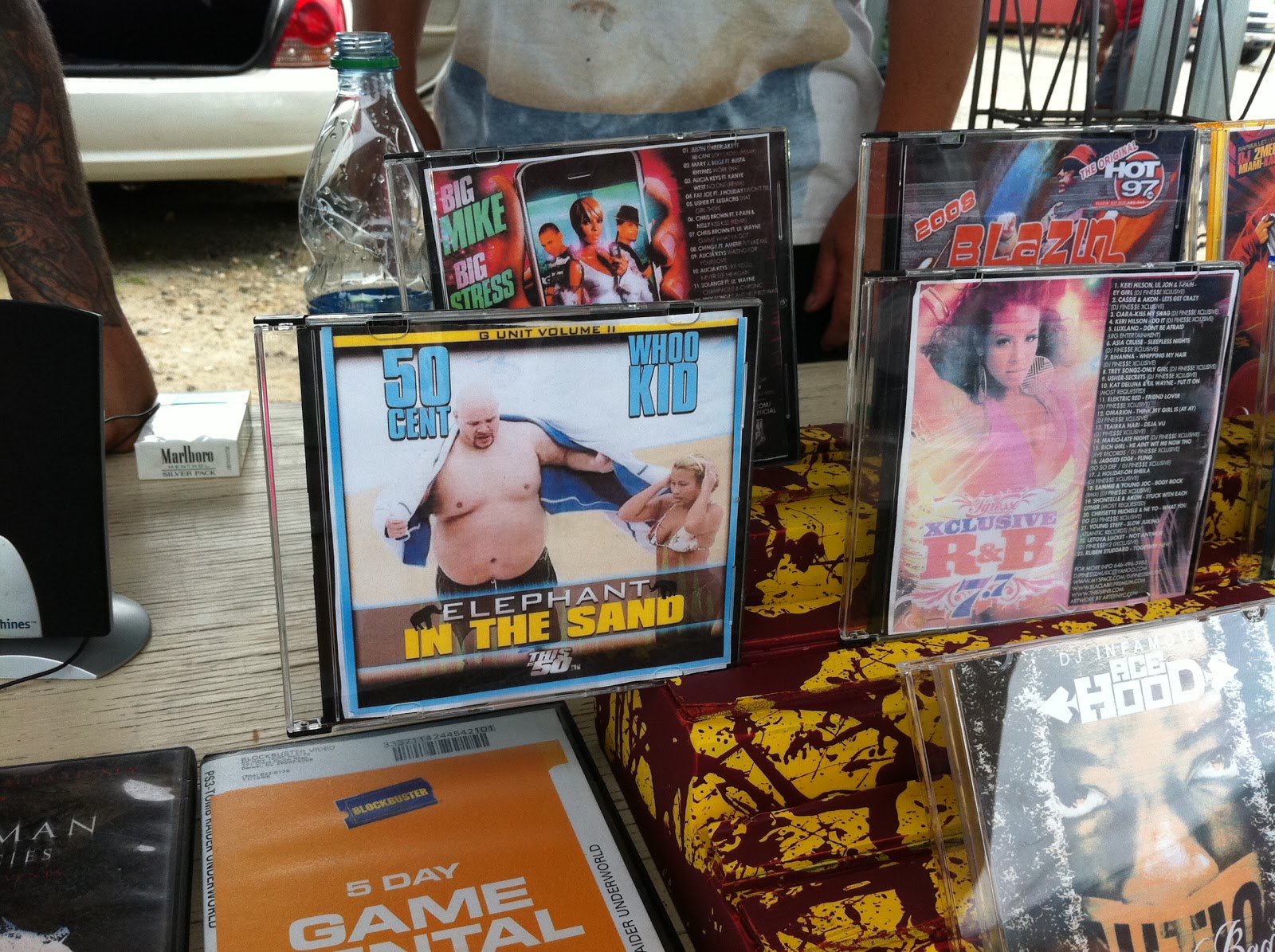
The Dallas flea market offers a fine indicator of the economic and demographic changes that have reshaped Gaston County over the last twenty years.  Home to trucking and bartering in all things cheap, defective, reused, copied, stolen, unregulated and possibly illegal, it offers a place for enterprising people to make something out of next to nothing, from bootleg CDs and bizarre household nicknacks to low-priced necessities for families struggling to stretch every dollar.  Its complexion has surely changed in the years since it was a dusty outpost of good old boys chatting and haggling in the Southeastern Sunday morning heat, and the material culture of the flea market -- Mexican wrestling masks and pinatas side by side with Confederate flags, 50 Cent remixes and Earnhardt encomia -- reveals how commerce can bring people of different origins and ideologies into the same space.  Indeed, it is one of the few spaces in Gaston County where people of different races, religions, and immigration status regularly come into contact with each other.

A Saturday Morning at the Flea Market


KY gel and a gonorrhea test -- everything you need to plan for a big weekend.


Many of our photos were taken from oblique angles.  People often do not like having their picture taken, of course, but the flea market brings with it many other issues of intrusion and anxiety where documentation is concerned.  Anyone with a camera who comes into another person's world may be an unwelcome intruder, and although I went to high school around the corner and have been coming to the flea market for years, I am still an outsider -- especially when I'm holding up my phone to take pictures.  Some shoppers and sellers at the market might have their own suspicions about who was taking pictures: undocumented immigrants, for example, might wonder if the INS or the local police were monitoring them, especially given the recent passage of bills in states such as Arizona and Georgia that gave local authorities the right to profile and harass immigrants.  At least one food seller instructed his employees not to let me take pictures of the food they were selling.  When I was asked why, the young woman said, "I just work here," although I imagine they might have been concerned about a visit from the Gaston County Health Department.  We also did not take many direct photos of the "Out of My Cold Dead Hands"-style gun dealers because they might think we were agents of Obama's oppressive regime and they are, of course, armed.
.


1990s R&B and 1970s punk are neighbors at the Inner Hippie Shop, one of the vendors that operates within several closed hangar/warehouse buildings at the market.  Other memorabilia includes framed photographs of classic jazz musicians, Bob Marley, and Dale Earnhardt -- an amalgam that strays over the boundaries of standard head-shop/counterculture fare.


Ismaili, a Turkish emigre, sells iPhone accessories.  Note his scowling colleague with the eye patch in the back.


We generally tried not to take pictures of people's faces when they could be targeted for any kind of prosecution for what they were selling (e.g. see photos of bootleg CDs and DVDs without the merchants).  It is no guarantee that a local cop or an RIAA/MPAA crusader will not randomly click on this blog and decide to "crack down" on these small sellers; indeed, in the IRB era, our project of documenting the flea market raises a lot of thorny issues.  Are we obligated not to take photos of this social arena for fear that somehow, someone there might be threatened as a result?  Is there any scholarly or journalistic imperative to create a record of this place and the people there?  Should we have to get permission from everyone whose photo we would take, and if so, what are the implications for photojournalism?  Should people only be depicted in the way they want to be depicted -- and not depicted at all if they say no?


Sandra's Simply Sinful Side Items, home of the fried Oreo, fried cheese danish and, of course, funnel cakes.


At the end of the morning we sample the legendary fried Oreos, drizzled with chocolate syrup and caramel.

.
The Flea Market as Historical Crossroads

It goes without saying that people have long associated trade and marketplaces as transnational spaces of interaction. In the pre modern and early modern world, Timbuktoo, Baghdad, London, and what was then Constantinople and today Istanbul, provide only a few spaces of this economic cosmopolitanism. Adam Smith saw civilization in free markets and capitalism’s invisible hand. The Islamic religious prophet Muhammad was a trader. Any high school history teacher worth his or her salt will tell you that trade is one of the main forms of cultural diffusion, enhancing the spread of language, religions, ideas, and products. These seem to be obvious facts.


So perhaps it should come as no surprise when Professor Cummings points to the Dallas, NC flea market as an amalgamation of transnational kitch. The professor’s points about immigration are well taken. A 2004 Economist article pointed out the increasingly suburbanized nature of immigration. For example, as of 2000, more immigrants resided in suburbs than cities and the numbers continued to rise. Furthermore, this suburbanized migration proved as true in New York and Chicago as it did in newer sites like Las Vegas, Washington D.C., and yes, Raleigh Durham. It happens fastest in the new “emerging gateways” of Dallas, TX and Professor Cummings’s southern jewel, Atlanta (Economist, “Immigration into the Suburbs”, March 11, 2004).


Cities like Chicago have long exhibited this sort of travel vista via marketplaces. For example, Maxwell Street market in Chicago began on Chicago’s west side over 120 years ago. The flea market, located on predictably, Maxwell Street, stretched from 16th Street all the way to Halsted Avenue. Forced to move in 1994 by a larger more moneyed transnational institution, the University of Illinois Chicago, the market landed on Canal Street in 1994 staying there until 2008 when it was forced by area businesses to relocate to the River North area along Desplaines Street between Roosevelt Road and Harrison Street. As one vendor admitted, “Flea markets such as Maxwell Street don't fit the changing image of the area.” Though it has long been heralded as multicultural space, who predominated usually developed accordance with migration to the city. What began with Russian Jews gave way to Poles who then receeded as African American migrants from the South became a dominant presence to today, where Mexican immigrants define the market. In fact as a Chicago chef Rick Bayless pointed out on a recent episode of the Travel Channel’s Bizarre Foods, Chicago has become the artisanal tortilla capital of the world. Moreover, some traditional Mexican cooking is more available in the city of Big Shoulders due to the wider availability of ingredients, which partially reflects the Midwestern agricultural hinterland that supports the metropolitan area. As with any change, some viewed the market’s current configuration with a sense of loss, "I miss the hot dog stands and the smell of onions," noted on longtime customer. "And pork chop sandwiches. Some of that comes with the changes in ethnicity. Today, you have a lot of taco stands."


Still, one should always remember the multi directional nature of these kind of spaces even when located in “semi-rural” or suburban locals. Mike Davis explores these locations in his work on Latino immigrants in America. In Magical Urbanism, Davis notes the more traditional insights in this regard such as whole “transnational communities” residing in one city block in L.A. but also draws attention to the place transnational suburbs have come to occupy for Latino immigrants. Remittances from work fuel rural development in Mexico, while creating a transnational flow of capital and people to these burgeoning suburban/metropolitan communities. “More than ever, repatriated “migradollars” (an estimated $8 billion to $10 billion annually during the 1990s) are a principal resource for rural communities throughout Mexico and Central America. Surpassing sugar and coffee, they are now the largest source of foreign exchanged in the Dominican and Salvadorean economies.” (Davis, 80) Global restructuring forces traditional communities to juggle capital and people between “two different, place rooted existences.” (80) Davis describes these connections between places like Dallas, NC and Puebla, Mexico as “economic and cultural umbilical cords.” (80) In this way, the “sending communities” serve as “transnational suburbs” distant from places like Atlanta, New York, or Miami, but as “fully integrated inot the economy of the immigrant metropolis as their own nation-state.” (80)


The power of these places is not confined to economics. Mexican politicians have been known to purchase media advertisements in American urban areas enticing Mexican nationals to vote from their homes in metropolitan areas of San Diego, Chicago, New York, and elsewhere. When the Dominican Republic’s dictatorial president Joaquin Balaguer exiled leading Dominican dissidents to New York, the Big Apple became the “main base for the country’s oppositional politics.” When political reforms relaxed the once authoritarian government’s grip on the nation, New York remained “the second home for the republic’s turbulent political life.” Davis notes it probably should then be no surprise that when Leonel Fernandez Reyna, who grew up on New York’s upper west side, won the nation’s 2004 presidency. Reyna still held a green card and fully expected to split his time between Manhattan and the D.R making Reyna perhaps the first transnational migrant ever elected to such an office. (84)


Still, if one believes the Economist, the Sunbelt is the future of immigration. After all, sprawl, a defining trait of many Sunbelt metropolitan areas, attracts immigrants. “Now, as sprawl consumes an ever-widening swathe of cornfields and meadows, immigrants are close behind," the Economist declares. "Who else will cut the grass, clean the houses or flip the burgers of suburbanites?” However, as has been seen in Queens, NY and elsewhere, immigrants can also generate what Saskia Sassen has called “low level gentrification.” Immigrant purchases and home starts in the greatest borough of New York spurred development. This points to the bifurcated nature of today’s immigration where on the one hand you have English speaking college educated legal immigrants and non-English speaking, poorly educated, and largely unskilled undocumented migrants: “Indian doctors and engineers represent the first group, Mexican day-labourers the second.” Granted, it is unlikely the Dallas flea market serves as a site for the H-1 Visa set, but as Leonel Fernandez Reyna illustrates, that vendor you bought the velvet Bob Marley picture from just might the next President of somewhere.

Monday, June 6, 2011

Seven Ways of Looking at a City


Assumptions about human nature have long shaped the way people think about politics, economics, and even their own personal relationships. Often these assumptions take the form of metaphors or tropes, as when we think of an election as a horse race or the workplace as a rat race, with all the unspoken implications about greed, success, failure and fulfillment they entail. A famous example of these tropes can be found in the literature on immigration, where a classic work of history, The Uprooted, approached the subject with a very different set of assumptions in 1951 than The Transplanted did in 1987. Newer literature eschews both the themes of ripping people out of one culture and planting them in another, focusing on the complex flow of people back and forth across national boundaries and cultural contexts.

Indeed, language and imagery structure how we solve or even define different problems.[1] In the study of cities, this truth is particularly salient. The urban panorama has always given people plenty to work with as they try to fit its grime and poverty, ensembles of colorful characters, and spectacular knots of wealth and power into some kind of coherent scheme. Is a city just a crossroads where capital, labor, and the state converge momentarily before dissembling and scattering elsewhere? Does a city have an identity, a personality, like a coherent being? Or is it just a big machine, taking in people and spitting out iPods, dollars, and pathology? 


Geographers, sociologists, and philosophers, as well as novelists and historians, have wrestled with these questions for years. Based on their work, we can sort out the metaphors into six (or seven) distinct categories:

The City as an Arena

This view is characteristically liberal or pluralist, supposing that there are many different actors that compete and interact with each other across the urban landscape. It is similar to the dialectical and often Marxist assumptions that underlie much American historiography – the idea that history unfolds through “contest” among different interests – although the Marxist version emphasizes polarization while the liberal model emphasizes multiplicity, as in a market. In either case, the city or the world is an arena, a space where a variety of agents connect and disconnect, help or harm, transact and steal from each other unpredictably. This view resembles the vision of society advanced by the famous political scientist Robert Dahl, who disagreed with sociologist C. Wright Mills’s idea of politics as controlled by a unified and homogeneous power elite; Dahl instead saw society as a “polyarchy” where various elites and established interests compete with each other for influence.

The City as an Organism 

If the idea of the arena is classically liberal, the organic view underlies both conservative and anarchist views of society. All the constituents of society (people and families; workplaces, churches, and other institutions) are part of an interrelated and interdependent whole, each with its own functions and traditions that have developed over time and are somewhat autonomous from conscious changes of policy, politics, etc. Each piece affects each other piece in a coherent way, as the relationships among them have naturally developed without a great deal of conscious intervention. The emphasis here is on roles, traditions, and relationships, rather than ideology, intent, and policy.


The City as a System 

The systems perspective is similar to the idea of the city as an organism, but with a more mechanical than organic view of relationships. It envisions society as a machine or computer, operating according to rules, whether regulatory (policy/laws), psychological (neurology or human nature), or economic (institutions such as businesses, banks, and states, as well as human nature). Some rules can be changed and some cannot, but the important thing is to understand how rules govern relationships and produce events/effects, such as economic output, crime rates, and so forth. Oscar Newman’s Defensible Space, a 1972 book that claimed that the design of public housing projects made crime and insecurity inevitable, would be a good example of this view, as would much of neoclassical economics. Saskia Sassen’s The Global City also positions metropolises like Tokyo, New York, and London as the nerve centers of a worldwide system of production, trade, finance, and communication.

The City as Emporium  

The city is a panoply of goods. Similar to the arena/market metaphor, but with less emphasis on work (making things, providing services) and communication (reading, viewing, listening, performing) and more on the idea of consumption, with little atoms seeking pleasure and other atoms providing it. Following Jurgen Habermas, a number of scholars have proposed that his “public sphere” could be made up of many “counterpublics,” communities of interest that contend with the dominant culture and each other. Here the city is made up on many different public spheres. In the world of the gentrified, hypermediated city of the twenty first century, the urban landscape can become a shopping mall of different identities (hipster, foodie, tea partier, Vampire Weekend preppie in boat shoes) that people can consume by the books they buy, the music they listen to, the clothes they wear, and so forth. As Ian Svenonius has remarked:
The city was reborn as the super mall, its allure augmented by its storied history, born of the diversity which would be abolished [by gentrification]. Cheap white labor, in the form of aspiring artists, could be lured via this history, mythologized in books which marketed the city through the very idiosyncratic or marginal character its advertisers had helped to systematically exterminate.

The city’s new privileged inhabitants would wear their city’s outlaw image as a badge of honor and even venerate it with fervor, fiercely proud of a history they had never experienced, let alone contributed to – like suburbanites living on a Civil War battlefield and boasting about Pickett’s charge.[2]

Svenonius’s diatribe against the delusional identity fetish of the new urban pioneers sets us up for our next metaphor.


The City as a Stage  

Indeed, the theatrical view resembles the emporium to the extent that the city is a pleasurescape of sorts. The city is a place where people perform various roles, as workers, family members, and actual performers. Consumption remains key because acting out an identity on the urban stage often involves consumption (where one eats, what one wears) as well as the fact that people can consume by viewing and by consuming the attention of others. David Harvey discussed this perspective in his analysis of Jonathan Raban’s 1974 book Soft City:
To the thesis that the city was falling victim to a rationalized and automated system of mass production and mass consumption of material goods, Raban replied that it was in practice mainly about the production of signs and images. He rejected the thesis of a city tightly stratified by occupation and class, depicting instead a widespread individualism and entrepreneurialism… To the supposed domination of rational planning Raban opposed the image of the city as an ‘encyclopaedia’ or ‘emporium of styles’ in which all sense of hierarchy or even homogeneity of values was in the course of dissolution… The city was more like a theatre, a series of stages upon which individuals could work their own distinctive magic while performing a multiplicity of roles.[3]

As Harvey pointed out, this was very distinctly the perspective of “a young professional newly arrived in London,” and he suggested that Soft City prefigured the rise of yuppies and the revamping of the city as an affluent, cosmopolitan playground in the 1980s and 1990s.
.
The City as a Process

The city as a process is much like the city as a system, except that this view imagines the city never as static but rather as a set of unstable variables that are constantly in a state of flux. Buildings deteriorate, political machines rise or fall, and schools become better or worse as children grow up, teachers change, and newcomers arrive. There is no true city at any given time but instead a jumble of developing processes, some of which are tightly connected and others only distantly related, if at all. A key example of the city as a process would be Manuel Castells’s idea of the urban landscape as a “space of flows,” a terrain where goods, people, information, and wealth circulate instantaneously in multiple places across a global, high-tech economy.
.
Root Metaphors ‘n More

The philosopher Stephen Pepper tried to group these divergent viewpoints into four different clusters back in 1942, linking each to a fundamental “root metaphor” that shaped how people interpreted the world around them. Formism is a sort of platonic perspective, seeing the world as a thing that can be represented in a map that corresponds directly to the actual features it depicts. As Michael Bluth once explained to his brother Buster, “The blue part is the water.” A rounded shape is a lake, and a brown line is a road, and the world that can be mapped can be known in this way. “Its world picture is a dispersed one,” geographer Anne Buttimer writes. “Each form may be analyzed and explained in terms of its own nature and appearance.”[4] Mechanism, in contract, portrays the world as a set of predictable, measurable processes, whether retail supply chains or traffic flows. Fields such as management and economic geography have sometimes envisioned cities, enterprises, even entire economies as essentially complexes of mechanistic relationships, although such an interpretation can fall prey to accusations of being too reductionistic or deterministic.


Pepper’s last two root metaphors were organicism and contextualism – the first, predictably enough, interprets the city as an organism, and the latter sees it as a loose tangle of individuals, events, and forces, where processes dynamically interact and unfold. “The city as ‘organism’ was a favored image among scholars who described the social experience of immigrant groups, patterns of competition, succession, and anomie, being considered as critical indicators of people’s level of adaptation to new milieux,” Buttimer writes.[5] Contextualism, as one might expect, appeals to the liberal or pluralist sense of society as a mix of distinctive and competing forces, where each individual or event needs to be viewed in light of the “context” of the factors surrounding it.

Clearly, these root metaphors differ from the ones I’ve outlined above, blurring some categories while introducing other ways of knowing, such as formism, that I had not really considered. My formula of the city as a dynamic set of processes, for instance, fits well into both Pepper’s idea of the city as an organism as well as a mechanism; the city could be viewed as a process whether it is a coherent set of systems (traffic=circulatory, telecommunication=nervous) or as a machine made up of other, smaller machines acting in loose concert. Similarly, the city of rules, mores and codes that urban geographers and sociologists found among urban communities could just as easily describe those who act out their roles on a stage or pursue their interests in the liberal or Marxist arena of social conflict.

That these metaphors overlap and even bleed into each other is not surprising. As Buttimer noted, “Rarely, if ever, are particular authors identifiable with one of these root metaphors,” but rather most choose to combine different interpretive tools as the occasion demands.[6] Few of us see the world only as a terrain of endless competition or a garden of shopping delights when we look out the window, nor do we see ourselves only and exclusively as mere parts of greater social organisms with a life of their own. We do, of course, feel this way when we think of extended family, or identify with a nation or a neighborhood. Anyone who has lived in a so-called “transitional neighborhood” is apt to understand how one can feel like part of a locally based, amorphous social entity that nevertheless exists in tension with other groups that have their own web of social relations and rules of conduct (whether you find yourself on the side of the locals or the interlopers, or somewhere in between).


Networks ‘r Us

Indeed, the thought of a web offers a possible point of convergence. A network is like an arena or market, with many different people at many different points interacting in flexible, independent ways; it is like a machine, where many different parts are structured to perform tasks, albeit with open and indeterminate edges. A network is governed by rules and constitutes a social process always in the process of becoming, never sitting still long enough to be conclusively studied. Amazon and eBay have already shown us a network’s potential as an emporium, while blogs and online video have revealed a web’s nature as a stage of a strange shape. We have also heard of collective intelligence and digital swarms – new kinds of supra-organisms that blur the line between metaphor and real living thing. The network has become an all-purpose metaphor for understanding how we relate to each other, as networked computers and phones have permeated our lives, work, and play. Stephen Pepper wrote his classic work on root metaphors in 1942, in the heyday of mass culture and on the eve of great leaps in computer technology. Anne Buttimer wrote her piece in Geografiska Annaler back in 1982, almost a decade before the launch of the World Wide Web.

The network may not have seemed as salient a metaphor when they wrote, but today it seems inescapable. Numerous scholars have taken up the network as a paradigm in the last twenty years. For example, Castells’s The Rise of the Network Society (1996) used the concept to explore the changing economic and social landscape of a post-industrial economy; Mark Taylor imported the notion into religious studies with his Moment of Complexity: Emerging Network Culture (2003); and Yochai Benkler explored its implications for the economics of media and culture in his The Wealth of Networks (2006), a clear nod to Adam Smith that implied an update of Wealth of Nations for a new global era. (Benkler’s book is also available for free online under a Creative Commons license.) The network, it seems, had superseded the nation state as the level of organization that matters.
.
.
This is the dominant metaphor of our era – for better or worse, take it or leave it – but it may not be always. In the age of antiquity, it might have made sense to think the world is and always was a canvas of platonic forms; in the age of the steam engine, the world is and always a machine. Now it is a network, its components each little dynamic information processing machines. This metaphor is not just a handy way of interpreting the world, of course. The idea of a network has a concrete and undeniable correspondence with actual stuff that happens out there in the world, not just in our daydreams or philosophical attempts to fit all of society into one schema that makes sense of everything.

It is not, however, the only metaphor available, as centuries of human thought have given us many ways of configuring our world. And if we treat networks and information processing as the only meaningful tools for doing so, forgetting about maps and organisms and arenas, we might fail to understand even how networks themselves work as well we otherwise could. We would fall into the old formalist trap of mistaking the map for the territory and end up understanding neither.

Alex Sayf Cummings