Showing posts with label media studies. Show all posts

Monday, August 29, 2011

Building the Perfect Echo Chamber: The 1970s and Political Discourse in the 21st Century


Just before Bob Dylan breaks into “Like a Rolling Stone” on his 1966 Wembley Hall Bootleg series album, one audience member yells “sell out” while another cries “Judas” -- both references to Dylan’s famous transformation from earnest urban folkie to ironic electric hipster. Dylan growls into the microphone, “I don’t believe you,” then as several moments pass by bellows, “You’re a liar!” As the band cranks into the song, you can clearly hear an angry Dylan scream “Play it fucking loud!” Ten years later, during his Rolling Thunder Revue (1975), a crowd member sarcastically begged Dylan “to play a protest song.” The audience laughed and Dylan and the Band ripped into “Oh, Sister.” Not quite the ideological heights of 1966.
.

Regardless of one’s musical preferences, one can agree the career of Bob Dylan spans several decades, often reflecting the currents of the time. If the 1966 concertgoers mirrored the self-righteous sincerity of the 1960s, Dylan’s jaded ironic 1975 audience epitomized the kind of altered consciousness of the decade that followed. As Bruce Schulman has noted,“[s]eventies sensibility then offered a kind of antidote to the melodrama of Sixties sensibility, an antidote devised by a generation of youth just plain sick and tired of being told how they missed out on the glory days.” (158) In many ways, the 1970s laid the groundwork for the mi x of ambivalence and divisiveness that have come to characterize late 20th century and early 21st century American life. Swaying between ironic indifference and froth mouthed partisanship, it would seem Americans either check out completely or are compelled to descend into sharp divide.
For those born in the latter half of the 1970s, for much of our lives, Republicans and the New Right seemed to be the driving force in American political and cultural life. Gerald Ford, Ronald Reagan, Bill Clinton (zing! Ok, not fair, but undoubtedly Clinton’s agenda was heavily influenced by Reaganite philosophies that even former members of the New Left felt obligated to adopt or engage) and both Bushes served as presidents for the vast majority of Generation Xers’ lives. It would be foolhardy to claim that it had no effect; my own understanding – and I suspect others born within a similar time frame – was colored by this experience. From birth to adulthood, America appeared to be center right, conventional, big business oriented, and increasingly privatized. Culturally, outside of L.A., NY, San Francisco, and a handful of other U.S. cities, America seemed more invested in conservatism than the avant garde or bohemianism.
.

Of course, this view ignores the long trajectory of 20th century political history. In fact, for decades the New Right appeared an unattractive aberration to the largely Democrat-led consensus governments that ruled throughout much of the postwar period. From some vantage points, the 1970s appear liberal to a fault. Even looking at the high school yearbooks of some of my older high school teaching colleagues revealed a very different America from the one most of Generation X experienced. One of my coworkers shared her early 1970s yearbook with me pointing out thinly veiled pot jokes - the kind that would have earned me a suspension in the 1980s or 90s- and odd sexual innuendo. Politically, both presidents Nixon and Carter seriously considered decriminalization and even legalization of cannabis. While the medical marijuana issue continues to gain converts, for much of the 1980s and 1990s, the drug remained an anathema. Three relatively new books examine how, as Professor Alex Cummings related in an email to the author, “white, straight, homogeneous, New Deal-era American culture began to fragment in the 60s and 70s": Rick Perlstein’s Nixonland, John McMillian’s Smoking Typewriters, and Edmund White’s City Boy.

If one wanted to think about this more simply (like primate simply), consider popular culture. Children coming of age in the 1980s had St. Elmo’s Fire, Wall Street, Ordinary People, and The Breakfast Club. Adolescents and adults of the 1970s had Five Easy Pieces, Easy Rider (okay, not quite the 1970s but pretty damn close), Chinatown, and Breaking Away. So what happened? How did a country that appeared worried about endemic corruption (Chinatown) and viewed the promise of the American dream warily (Easy Rider/Five Easy Pieces) become a nation of navel gazing yuppies (St. Elmo’s Fire/Breakfast Club) that only occasionally deemed the actions of big business as nefarious (Wall Street)?
.

Certainly, economic shifts of the 1970s had a deep effect on American culture and politics. As T of M has explored, many historians trace the shift to the early 1970s connecting deindustrialization, the end of Fordism, stagflation, government corruption and a brutal energy crisis as the driving forces of this change. In addition, the rise of New Right figures such as Barry Goldwater, Richard Nixon, Ronald Reagan, William F. Buckley, and Bill Kristol harnessed a right wing movement, once populated by John Birchers and anti-Semites, into a political juggernaut that would dominate the country’s politics in the last third of the century. Yet, by the 21st century, the conservative movement of the 1970s no longer satisfied modern day right-wingers. Richard Nixon would probably struggle to win a Republican primary today, let alone a national election. Where did this shift begin? How did the “Silent Majority” emerge? Who were they responding too? What countervailing forces affected it? What about those who placed themselves outside the suburban Silent Majority, who chose to reside in New York City, the epitome of 1970s decline?

Nixon and Smoking Typewriters .
Nixonland: it is the America where two separate and irreconcilable sets of apocalyptic fears coexist in the minds of two separate and irreconcilable groups of Americans … Nixonland is what happens when these two groups try to occupy a country together. By the end of the 1960s, Nixonland came to encompass the entire political culture of the United States. It would define it, in fact, for the next fifty years. (Rick Perlstein, Nixonland: The Rise of a President and the Fracturing of America, 46-47)

Modern day America, if one were to oversimplify, often seems split between those who watch Fox and those who watch MSNBC . I guess everybody else watches CNN or more likely just doesn’t pay attention. “The parties have reorganized themselves along ideological lines, as white conservatives have abandoned the Democrats and northern liberals the Republicans,” a recent Economist article observed. “The ideological factions have built mighty propaganda machines stretching from Washington think tanks to the studios of Fox and MSNBC. And ideologues have resorted to previously taboo weapons, such as the threat of default.” (Economist, “American idiocracy”, Aug 13, 2011) How we got here is the subject of Rick Perlstein’s Nixonland: The Rise of a President and the Fracturing of America.
.

The value of Nixonland lies in Perlstein’s ability to contextualize Nixon within the zeitgeist of late 1960s and early 1970s America. In reality, Nixon was less ideologue than political operator. According to Perlstein, Nixon’s main interest lay in foreign policy. In Tricky Dick’s mind , domestic politics served as little more than political theatre. Speaking to Theodore White Nixon once opined, “I’ve always thought the country could run itself domestically without a president.” (393) However, Nixon utilized the stage as few others. In language eerily reminiscent of today, Nixon castigated the “liberal media,” gave cultural but not economic recognition to the working class, and critiqued anti-war protesters and others by claiming their work emboldened the enemy. Take Nixon aid Bob Haldeman, for instance, telling Barbara Walters on the Today show that “Democrats still opposing the president were aiding and abetting the enemy of the U.S.” Nixon followed this up shortly after arguing that Democratic opposition regarding his decisions in Vietnam, “might give the enemy an incentive to prolong the war after the election.” (623) Sound familiar?

Perlstein portrays the late 1960s and early 1970s as a rapid fracturing of the American public. The Vietnam War, leftist and rightist radicalism, and a faltering economy combined to place strain on the very seams of public life. Though many writers highlight the violence of the extreme left like the Weatherman, Perlstein points out, far right extremists employed similar tactics just as frequently but the media reported on these events far less frequently. Perlstein illustrates how a chastened media felt compelled to represent America’s great middle classes more equally. When journalists critiqued Mayor Daley’s handling of the 1968 Democratic Convention, letters poured in chastising the media and praising the aggression of the Chicago Police Force. When in 1972 National Guardsmen shot dead four Kent State University students, citizens opposing the student protests provided their own response. “I extend appreciation and whole hearted support of the Guard of every state for their fine efforts in protecting citizens like me and our property,” wrote one. Another lamented “When is the long suffering Silent Majority going to rise up?” A local resident speaking to a researcher uttered a common feeling for many of the period. “Anyone who appears on the streets of a city like Kent with long hair, dirty clothes, or barefooted deserves to be shot,” related the Kent City citizen. (489) Letters and responses greatly circumscribed media coverage in the decades that followed. Nixon successfully exploited this hostility.
.
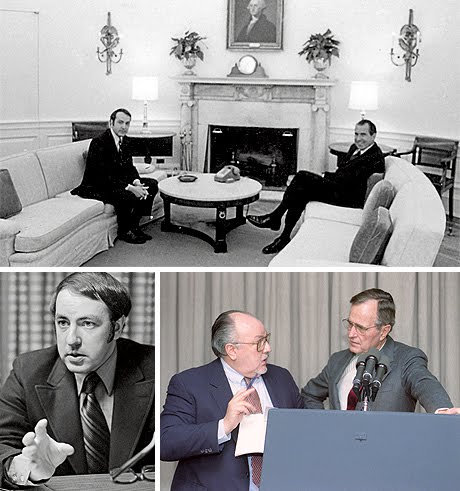
Contrary to popular belief, youth movements of the day were not dominated entirely by leftists. At Queens College, where radicals “rampaged” through the library and occupied administration buildings, another conservative group referred to as the Students Coalition held a sit in in the registrar’s office in order to protest the “college president’s failure to call the police to evict the students occupying the administration building.” (380) Similar scenes unfolded on other campuses as well. As Perlstein points out, the Left did not monopolize youth. Roger Ailes, Pat Buchanan, Ron Ziegler, and others were only in their mid to late twenties when Nixon plucked them from obscurity.

Of course, while the mainstream press seemed fixated on the antics of leftists, left leaning editors and writers in what became know as the Underground Press (UP) purposely sought to make waves. In Smoking Typewriters: The Sixties Underground Press and the Rise of Alternative Media in America, John McMillian explores the milieu of radical journalists and publishers of the period. McMillian tracks the initial emergence of radical newspapers like the Free Press (Los Angeles), the Rag (Austin, Texas), Berkeley Barb (take a guess) and the Paper (East Lansing, Michigan aka Michigan State) noting that in the very early stages each operated in isolation from one another, a symbol of the very uncoordinated leftism that emerged in the mid 1960s and early 1970s.
.

However, with the establishment of Underground Press Syndicate (UPS) and the Liberation News Service (LNS) all that changed. For McMillian, the underground press played a vital role in institutionalizing the New Left: “Although historians are fond of referring to an overarching ‘youth community’ in the 1960s, before the advent of the underground press, the youth revolt was marked more by fragmentation than cohesion.” (McMillian, 73) Though UPS came first and provided much needed organization, the LNS proved even more influential. “A kind of radical alternative to the Associated Press,” McMillian writes, “LNS aimed to centralize news gathering and dissemination in the underground media.” (83) The ability of LNS to distribute materials widely served as critical factors when reporting on major protest events like the 1968 Columbia University Revolts.

Though the journalistic practices of some UP writers remain questionable, they nonetheless highlighted aspects of protest that New York Times an others ignored or purposely obscured. Moreover, the UP projected a culture that united readers. “Underground newspapers functioned as vital institutional bases for radical political and aesthetic communities,” McMillian argues. “In their pages, they replicated the creativity, zaniness, humor – and otherworldliness – of the youth movement at large.” (81) Through their influence, the world of alternative weeklies developed soon after, often eschewing the kind of politics the UP celebrated but clearly shaped by the UP’s successes and failures. Without the UP, publications like the Chicago Reader probably would not exist.

Considering the level of paranoia that pervaded both the Left and the Right in the late 1960s and early 1970s, the UP’s radical take on political affairs had to rankle and frighten many a conservative. In all likelihood, the promotion of Marxism and bohemian lifestyles did little to ease the fears of the Silent Majority. The fact that many writers and UG editors professed a desire to shake things up only added to the tensions that had been mounting.

City Life

During this period, few sites elicited trepidation like cities. Many of the UPs developed on college campuses or in urban settings. McMillian acknowledges this development, noting, “many of the ideas that gave rise to New Left journalism had an important material context – they were generated in urban spaces.” (36) Moreover, while many fled cities for the suburbs, others took solace in the caverns of metropolises like New York City. In his 2008 memoir, City Boy: My Life in New York During the 1960s and ‘70s, Edmund White recounts his own experiences, recasting New York as a space of danger but also artistic and social ferment:
It is difficult to convey the intensity and confusion in our minds back then in the sixties and early seventies as we tried to reconcile two incompatible tendencies – a dandified belief in the avant-garde with a utopian New Left dedication to social justice, both of which in my case could be overruled by an admiration of the simple humanity of the Great Russians or Singer. Looking back now, I’d say that because we were Americans emerging from the stultifying 1950s, we were extraordinarily naïve about both politics and esthetics – humorless, unseasoned, dogmatic – because untested. (White, 38)

White’s memoir reveals the complexities of identity for those the Silent Majority deemed unworthy. White’s homosexuality would have clearly stigmatized him among the suburban masses that Nixon attempted to woo through naked patriotic tropes. “Not that concepts like ‘patriotism’ meant anything to me,” White recalls. “As a gay man I didn’t think that I was American or that I belonged to a society worth defending … I felt powerless to affect national policy, and I also knew that any policy might be devised by any government present or future would contain a clause condemning me as a homosexual.” (24) As White notes later, it was to the city they felt devoted, a city that nurtured the artistic creativity and sexuality of himself and others: “Perversely, we were proud to be New Yorkers but not Americans.” (211) As a native Midwesterner, White came from the very stock that made up the Silent Majority. However, despite his own origins, White claimed that Midwestern transplants like himself were the only ones who truly loved the city. As White recounts, 1970s, New York “was so shoddy, so dangerous, so black and Puerto Rican, that the rest of white America pulled up its skirts and ran off in the opposite direction.” (210) Ignoring White’s gendering, the longtime literary critic and author represents a central irony of the “Silent Majority”. Its dissidents, self perceived outcasts like White – whether due to sexuality, political beliefs, or other like factors - provided the very life blood to the nation’s symbol of urban decay. Throughout City Boy, White continually returns to this theme. For White, “no one loved New York except us, the gay and the artsy misfits from the Midwest.” (210)

If many Americans portrayed New York as a city of negative energy filled with malcontents, criminals, and angry minorities occupying public spaces White saw it differently. Clearly, White agrees with Perlstein’s assertions regarding violence. “Suburbia, television, and the automobile had isolated everyone – perhaps a good thing in such a potentially violent country.” (224) Still, also like Perlstein, White points to the kind of mindset that befell American suburbanites, people in gated communities “miles away from the nearest ghetto” so petrified they fortified their homes with weapons or karate training. In fact, despite White’s own proximity to the alleged urban trouble spots, “it was precisely in those places that were the safest that the sheltered populations most often expected imminent violence.” (224) To be fair, White himself acknowledges that simmering tensions in New York meant that by the late 1970s, the 1977 blackout revealed “how racially divided we were, how much anger seethed just below the surface, how rapacious and every man for himself we’d become.” (225). The larger point here is how fear and anger had pervaded the nation especially in places where violence and protest seemed a distant possibility.
.

Whether Perlstein hangs this on Nixon or simply positions him as a knowing conduit through which fear and anger could be broadcast remains less important than the fact that regardless of where it originated, the divisions that seem so stark today emerged then. If Bob Dylan’s sarcastic ironic audience of 1975 seemed comfortably ambivalent, other citizens felt anxiety ridden and furious. Vietnam, assassinations (Bobby Kennedy, MLK to name only two), campus protests, Kent State, the 1968 DNC, various rights movements, and the resentments of the “Silent Majority” collided. In the years that followed, Americans increasingly placed themselves in camps that operated like political and cultural echo chambers. John McMillian’s Underground Press at the outset provided the New Left with a vehicle for a clarion call of beliefs that initially won converts, but soon after devolved into the very echo chambers that plague public discourse today. Responses to recent events such as the London Riots illustrate this tension as Conservatives harnessed arguments that blamed the riots on immorality and a bureaucratic nanny state, while liberals portrayed all rioters as victims who simply needed more government intervention. The best remedy to these issues is probably something between the two poles: one that accounts for law and order, but also provides social and economic measures that address poverty and racism. Unfortunately, when the only voice you hear is an echo of your own, real solutions become that much harder to divine.
.
Ryan Reft

Tuesday, July 26, 2011

American Arab Kitsch: From Ahab to Abed and Back Again


When I was a kid, I thought Pinkard & Bowden were pretty funny. The comedy duo’s parodies of famous country songs were often promoted on TV for just $19.95 plus shipping and handling, and I got a kick out of them. “Blue hairs driving in my lane.” “Won’t you help me make it through the yard?” I never heard their song “Arab, Alabama” back then, and I wonder what I would have thought of it when I was 9 or 10. I might have thought it was funny just because they were referring to Middle Eastern stuff (the PLO!), and I was generally interested in anything that had to do with my Arab background. After six long years of grad school, though, I can’t not see some of the bizarre ethnocentrism underlying the song, which proudly declares, “There ain’t no PLO in Arab, Alabama!”

Not long ago, Tropics of Meta discussed the pop cultural portrayal of Asians and Asian-Americans, whose coming-out party in the US might well be considered Harold and Kumar. After years of being confined to subservient side roles (Sulu) or one-dimensional running gags (Apu), Asians could headline a major Hollywood movie. They could also be perfectly normal Americans, in a certain understanding of the term: pot-smoking college kids with a crippling lust for tiny cheeseburgers.


Arab and Muslim characters have enjoyed a similar kind of enhanced visibility in the early twenty-first century, albeit in a series of still-stereotypical roles. There was Whoopi Goldberg’s Iranian sidekick in her ill-fated 2003 sitcom, played by comedian Omid Djalili, who appeared as a similar character in Paul Reiser’s miserably failed NBC show: a paunchy businessman who always “knows a guy” who can get you what you need. In contrast to this stereotype—the stocky supporting character (mustache-optional) who provides comic relief—there was, of course, Sayid on Lost. The show could be accused of practicing mild Orientalism, given how Sayid was a soulful, mysterious lover with near-superhuman skills for fighting and fixing stuff, but it also deserves points for introducing American TV viewers to a diverse range of characters of different ethnicities, nationalities and languages.

Middle Eastern peoples have long occupied a liminal and confused place in American culture: the oil-gouging sheikh (think of Ned Beatty’s speech in Network: “The Arabs have taken billions of dollars out of this country, and now they must put it back!”); the amusing shopkeeper or small businessman (a role shared with South Asians and, to a lesser extent, East Asians); the mortal enemy of Western civilization and cartoonish film villain (Osama/True Lies); as well as the technical Caucasian and honorary white person. As America shifts from a white-black racial binary to a more complex understanding of diversity, Arabs and Arab-Americans still find themselves “othered” more often than not. Yet a look at the recent past shows how American pop culture has constructed the Arab Other in much more awkward and problematic ways. Tony Shalhoub’s journey from vaguely ethnic foreigner/sidekick in Wings to essentially not-nonwhite Adrian Monk might symbolize the slipperiness of the Arabic place in pop culture; the actor has played Italian, Cuban, Arab and many other characters in film and television, serving as a sort of all-purpose off-white.

Why There's No Gorbachev in Moscow, Idaho
.
Pinkard & Bowden’s 1980s anthem “Arab, Alabama” is both a celebration of American exceptionalism and a way of identifying that uniqueness with the pride of the white working class. Like so many country songs, it hangs on a jokey hook - there are lots of places in America that are named after rather different places, such as Palestine, Paris and Moscow. America is both unoriginal and thoroughly authentic, because New Madrid is full of proud, peaceable folk, poor in style but rich in pride. Pinkard & Bowden can’t resist a few throwaway jabs at hoity-toity Europeans, especially given the largely European origins of the settlers who named many of these towns: “In Paris, Tennessee they don’t eat escargot.” Most of the song, though, is dedicated to contrasting American wholesomeness with foreign dysfunction and violence. Gorbachev, Castro, and the PLO come in for ridicule. Notably, the singers suggest that we take Fidel to Kentucky, “put a coal shovel in his hand, marry him off to one of Loretta’s sisters, and we’ll never hear from him again.” To my ear, they seem to be saying that Loretta Lynn, the icon of coal country womanhood, would have no trouble muzzling the obstreperous dictator, the man the CIA could not shut up despite numerous ridiculous assassination attempts. Communist despotism is nothing next to the ferocity of a coal miner’s daughter.

 
It would be easy to say Pinkard & Bowden are racializing the foreign nemesis, and perhaps they are. But a few stray references complicate the picture. The dig at Gorbachev contrasts the Kremlin capital of godless Communism with a town in famously white and conservative Idaho. The Russians may be honorary nonwhites – more red, in a sense, than white despite their skin tone. They also throw in a line about Dublin, Georgia, noting that “Irish people don’t shoot each other” there. At first I thought this was a general reference to bar-brawling Irish drunkenness and criminality, but it actually fits well into the no-PLO theme. We don’t have such terrorist organizations in the USA, although we do have right-wing extremists who blow up government buildings and Irish-American politicians who like to contribute to the IRA while inveighing against Islamic terrorism. (See King, Rep. Peter [R-NY].) Overall, the message seems to be “We don’t have that here”—“that” being the problems of dictatorship, terrorism, and war that plague the rest of the world. The theme is an old one, stretching back to the Founders’ disdain for the corruption and poverty of Europe, as well as the isolationist impulse of later Americans who saw their nation as a happy island far from the endless wars overseas.

Nationalism and exceptionalism may be the core of Pinkard & Bowden’s message, but they still cannot escape race. They suggest we take the “sheetheads” up to Alaska and “make them be Eskimooooooesssss…” as if white Americans can swap one troublesome race out for an apparently less threatening one. The music video for the song shows a cartoonish Castro and Arab sheikh jamming on a Kalashnikov, while lots of modest white people grill out, wave flags, and generally act goofy. This is America: a big, funny, all-white cook-out where caricatures of the nation’s deranged enemies are the hired clowns. The specific thrust of the song is ridiculing the Other, but the general mood of the video is simply one of exultation in the virtues of old-fashioned, homespun American whiteness.

Chubby Checker and the Crimson Jihad


Comedian-musician Ray Stevens has dipped his toe more than once into the Sea of Galilee, so to speak. I remember hearing his song “Ahab the Arab” many times when I was a kid, as I had relatives who loved screwball songs like “The Mississippi Squirrel Revival.” “Ahab” seemed like a fairly innocuous ditty about “the swingin’ sheikh of the burnin’ sands”—lacking the somewhat nasty edge of Pinkard & Bowden’s song, if also missing the progressive self-awareness of 1953’s “Istanbul (Not Constantinople).” Here is the rich Arab, “with rubies and emeralds just dripping off a him, and a ring on every finger.” But the lyrics also turn on a familiar tale of foreigners embracing American culture:
He brought that camel to a screeching halt
At the rear of Fatima's tent jumped off Clyde,
Snuck around the corner and into the tent he went
There he saw Fatima laying on a Zebra skin rug
Wearing rings on her fingers and bells on her toes
And a bone in her nose ho, ho.
There she was friends lying there in all her radiant beauty.
Eating on a raisin, grape, apricot, pomegranate,
bowl of chitterlings, two bananas, three Hershey bars,
sipping on an ice cold Coca Cola listening to her transistor,
watching the Grand Ole Opry on the tube
reading the Mad magazine while she sung,
"Does your chewing gum lose its flavor?"
and Ahab walked up to her and he said,
(imitates Arabic speech)
which is Arabic for, "Let's twist again like we did last summer, baby."
You know what I mean! Whew!
The “zebra skin rug” and “the bone in her nose” are a more than a little cringe-inducing, but overall the song is more ignorant than racist. It could be trumpeting the superior appeal of US consumerism, or it could be simply saying we’re all the same, even the sheikh of the burning sand: everyone loves Coca Cola, Chubby Checker, and Hershey bars. The song was first released in 1962, years before the oil embargo helped begin Arabs’ long career as go-to villains in pop culture.
.


Of course, Ray Stevens has always gone with the times. His goofy song “The Streak” was one of the finest meditations on 70s exhibitionism; he touched on Middle Eastern kitsch again in his 1980 country hit “Shriner’s Convention,” which described the shenanigans of an “Illustrious Potentate” named Bubba at a Holiday Inn where a lot of redneck Shriners with Harley Davidsons and big-haired girlfriends come to meet. The video for the song features at least one African American character – not a common sight in country music videos or the traditionally white, middle class Shriner membership – who gets to join in the fun of wearing fez hats and driving tiny cars. The Shriners themselves were founded in the nineteenth century by a Mason who had attended a party thrown by an Arab diplomat and decided to start a men’s fraternity that aped Middle Eastern styles, traditions, and architecture. Playing Arab dress-up has a long history in the US, but the practice has clearly taken a more mean-spirited turn in recent years.


Indeed, the more recent work of Ray Stevens makes Shriner shenanigans look like good clean fun. Stevens may once have been a harmless spinner of novelty songs, yet his career in the early twenty first century speaks to an increasingly bitter tone in the way his mostly white, conservative audience imagines the ethnic Other. Ironically, the author of the syrupy Gospel ballad “Everything Is Beautiful” panders to racial resentment and lust for revenge nowadays, making his bread by catering to the Walker, Texas Ranger demographic with songs like “Obama Nation” and “Caribou Barbie.” His 2010 single “Come to the USA” offers an appalling portrayal of the persecution suffered by native English speakers at the hands of immigrants and big government. Such leanings were suggested by his 2002 “Osama Yo Mama,” a minor country hit that exploited the reaction to the September 11th terrorist attacks. Opportunistic and undoubtedly conservative, the song is more about revenge than race. “Osama, yo mama didn’t raise you right, she musta wrapped your turban too tight,” Stevens sings, as he dances around in a pink costume. A tiny cartoon Osama darts across the screen while, randomly enough, Stevens fires at him as an ersatz Rambo. We’ve come a long way from Ahab eating Oreos on the burning sands.

Muslims in a Liberal Mirror
.
 

If YouTube videos by Ray Stevens were all there were to American pop culture, of course, we would be in serious trouble. Meanwhile, liberal Hollywood has tried to portray Arabs and Muslims in a favorable light, in an awkward quest to build intercultural bridges through the time-tested means of TV. The networks once sought to build sympathy for urban people of color by placing them under benevolent white tutelage (The White Shadow, Webster, Diff’rent Strokes), and the 2007 sitcom Aliens in America seems to fit into this history. The show, which only lasted a season on the CW, tells the story of a Wisconsin family that takes in a foreign exchange student from Pakistan named – wait for it – Raja Musharraf. For some reason, Raja is always wearing a shalwar kameez, presumably because that’s what all people from Pakistan wear. The family tries to adjust to this Muslim “alien” in their home, and everybody does their best to overcome the cultural misunderstandings that provide much of the grist for the plot. The show did not quite work; even though the Pakistani character was overdone, the dynamic between him and his hosts never created enough real dramatic frisson or humor. Tip-toeing around cultural sensitivities may be the problem – how do you make a Muslim-Christian conflict funny without offending someone? The show’s writers made Raja into a sweet, innocent soul who almost always tried to do the right thing, like a smarter version of Balki, the Perfect Stranger. If the producers wanted to cast a Muslim character in a favorable light, they likely went too far. The  problem with humanizing the inhuman is that you run the risk of coming up with something in between.

.
Which brings us to Abed, the star of NBC’s well-loved but still-struggling postmodern sitcom Community. The show depicts its Palestinian character as a robotic sponge for pop culture, who quickly identifies the film and TV tropes that each episode parodies. It plays with the idea that Abed is “different” while he is “just like us” in his love for everything American. In one episode, the cranky boomer played by Chevy Chase is surprised to find out that Abed loves Christmas: “Don’t your people spend this season writing angry letters to TV Guide?” Yet the Muslim character still loves the holiday for its TV specials, colorful gifts, and general (secular) spirit of camaraderie. Community tries hard to situate Abed in the show without pandering to Muslim or Arab stereotypes or going the opposite direction by making him completely “normal” – say, a dumb jock who loves Ed Hardy, Katy Perry and disc golf. This is part of the reason why Abed is so appealing, and works as a sitcom character better than the pious Raja. He is different, and that difference may derive in part from the conditions of his origin as an immigrant – he seems to possess a detached, outside view of American pop culture, like Chance the Gardener in Being There – yet the writers have not constructed his difference in direct response to some set of expectations about race or religion.

Arab as they wanna be

I would count that as progress – getting out of the straightjacket of the Crimson Jihad and writing a unique character on his own terms. What does not work so well is casting. Danny Pudi plays Abed, yet he is half-Indian and half-Polish. Sayid, the Iraqi character from Lost, was played by the Indian-British actor Naveen Andrews. Even the evil terrorist Salim Abu Aziz in True Lies was played by a Pakistani-British actor. Tony Shalhoub, who is Lebanese, is one of the only Arab actors in Hollywood and he gets cast as almost everything but Arab. Shalhoub has, of course, made a conscious effort not to play stereotypical terrorist characters and has worked to promote different kinds of roles for Arab actors. Yet Arab and Muslim identities continue to be fraught with tension in the US; even as shows like Lost, Aliens in America, and Community attempt to present characters who are more varied and three-dimensional, we still see political abortions like the preposterous election year campaign against the “Ground Zero Mosque.” Such events not only gin up fear and hostility toward Muslims. They cast doubt on whether certain groups will ever be fully admitted into the privileges and the imagination of American citizenship.

Also known as Masih ad-Dajjal

This blog does not accept the pessimistic premise that Arabs and Muslims, from the Barbary Pirates down to Pamela Geller, are doomed to be a permanent out-group in America, forever barred from possessing full citizenship. (For a compelling overview of the argument, see this piece by Steven Salaita.) Dearborn is as much America as Arab, Alabama. So are Edison, New Jersey and what we like to call “Little Edison” in Decatur, Georgia. People on the Right may bloviate about our Judeo-Christian heritage, as if Islam were not an inheritor of the exact same tradition; a novelty country singer may whip out the word “sheethead” in a general screed against the outside world; and no doubt, the receptiveness of country music and talk radio listeners to racist name-calling is troubling; but such mischief is not equal to the reality of American culture, and certainly not its potential. Why Americans have fixated on the Arab Other from the Shriners down to Barack Obama (our “Arab American” president, according to some theorists) is a question for another day. Perhaps their indeterminate place in the US spectrum of race makes people from the Middle East an ideal screen on which Americans can project our jumbled hopes, desires, anxieties, and fears about the politics of identity. If that’s the case, Abed may represent a turning point: a mirror, not a screen, that reflects us back at ourselves.

Alex Sayf Cummings


Monday, July 11, 2011

Learning from Tiny Tower: Mobile Gaming and the Post-Industrial Society


Ever since Wii came along and swept everyone from me to my seventy year old retired Teamster uncle into the world of gaming, I’ve had a sneaking suspicion that video games have become a tool by which our future robot overlords are retraining us to perform various tasks after the big takeover.[1] Big Brain Academy, in particular, reminded me of those later scenes in 1984, when the Party had smashed every bone in Winston’s hands and he had to learn to write again using a big pencil, like a kindergartener. 4423… 3244. Do-re-mi…mi-re-do. Memorize the faces and match the frog to the dog. When a game tells me to take an order on the phone and then tell it back to the game – “calzone, risotto, and a soda, to go please!” – I begin to wonder. Having worked in restaurants before, I can safely say that taking someone’s order on the phone is an experience I would never have expected to repeat for fun. How far are we, really, from learning to change a robot’s diaper?


Mobile gaming introduces a whole new wrinkle to this dystopian scenario, and oddly enough games like Angry Birds and Tiny Tower bring with them an agenda that is much more ideological and allegorical than physical. I say oddly because these apps appear to be cheap, fleeting, and even disposable – who would have thought a 99 cent game that’s all about throwing birds at pigs would have been the blockbuster cultural production of the last year or so, not a movie that cost $100 million to make and $12 to see? Yet these games have a message and they’re on a mission. If the Wii is teaching us the cognitive and tactile skills to function better within a human-computer interface, then games like Tiny Tower are providing a complete social, ethical, and emotional blueprint for how a future cybernetic market society will work.

Welcome to the reeducation camp. Cost of admission is free, but you can upgrade to a better bunker for 99 cents.

I was first introduced to Tiny Tower earlier today, and I feel comfortable writing a neo-Marxist exegesis of it after a few hours. I resisted the iPhone for a long time – longer than I resisted the iPod but not as long as I held off getting any kind of cell phone in my younger, stronger, more idealistic days. Getting the iPhone opened the door to apps, which has finally led to mobile gaming. I have always despised Scrabble and yet I find myself screaming at the friend sitting next to me for scoring a preposterous number of points with the equally preposterous word “Jee.”

In any case, Tiny Tower is its own strange little world, like any good game. The game consists of building one floor after another of a highrise building, and populating it with stores, restaurants, apartments, and people. The player accumulates money over time from sales and rent to spend building another floor and stocking the stores; one can also use real world money to buy extra money in the game to speed things along (a “hurry” gets things done faster, but at a price), although it’s entirely possible (and wise) to play the game without spending any actual cash. Time is the key element, along with (secondarily) complying with the game’s demands, such as finding various tenants when a package or a guest arrives for them.

Real-life bitizens in their natural habitat

The strangest thing about the game is the role of the player. My friends first explained it to me as “Sim City meets Sim City,” which is true up to a point – the player is the planner/developer/mayor/God who builds a world, although the latitude of choice in Tiny Tower is far more constricted. (One can choose whether to put a retail outlet or dining establishment on a floor, but they don’t decide whether it’s a coffee shop or a women’s clothing store.) The player is the owner of everything; the Tiny Tower is a giant mill village without the mill, where the potential tenants show up, move in, and get a job in one of the restaurants or shops in the tower. My first tenant, G. Simmons (if I were a landlord, I think I would want some pretty good references before I let Gene Simmons move into my property), was rapidly hired in the coffeeshop right above the “Plainlake Apartments” that occupied my first floor. Talk about selling your soul to the company store.

And what a company store it is. Who lives in this 21st century, mobile, e-mill village, and what do they do there? What does the economy of Tiny Tower look like? There are only five options for a new floor – retail, food, service, entertainment, and creative. This is a fine image of the post-industrial information economy. There are photo studios, comedy clubs, coffee shops, apartments – in other words, we have a handful of industries that cater to people’s needs for shopping, dining, and other services, plus the all-important “creative class” of artists, graphic designers, musicians, and the like. It is a video game vision of the live-work-play environment that New Urbanist intellectuals have championed and developers have marketed to arty bohos and Trader Joe-jos since the 1990s.

Tiny Tower approaches this new economy of service and entertainment in some strange ways. A few of the classifications raise eyebrows; for instance, a “soda brewery” clearly appears to be a family-friendly version of a microbrewery, with little vats and kegs. One would expect a brewery to be categorized as food or service or even manufacturing, but it is “creative.” So is a photo studio. Meanwhile, a comedy club is “recreation.” In any case, the overall picture is one of a dense urban landscape of hip consumerism: sushi bars, glass studios, arcades, bookstores, and the all-important foundational element, the coffeeshop. The comedy club sells “LOLs,” “LMAOs” and “ROFLs,” and the tower's residents post about the minutiae of their little lives on a social network called Bitbook. “Someone stole my rug,” resident Clayton Wood said earlier today.[2] “It really tied the room together.” One “bitizen” offers bagpipe, tuba and drum lessons while another tries to generate interest in starting a band by announcing his skill with the accordion. The bitizens are defined both by their work and what they consume.  The player gets extra points for matching a worker to his or her "dream job," and the word bubbles above the bitizens' heads are always filled with the products they want to buy.

Even your imaginary friends are obsessed with The Big Lebowski and Justin Bieber

Notably, some among these shopping, gossiping bitizens are “VIPs,” who possess greater financial resources and cultural influence. When they arrive on the scene, they can buy out the entire stock of any store they visit or cause it to have many more customers.  When they attend a shop, suddenly many more bitizens want to go there. They resemble those influential consumers, coveted by marketers and advertisers, who possess the income and prestige to drive trends by their shopping choices. In Tiny Tower, every industry may be created equal, but some consumers are more equal than others.

Beyond sushi, shoes, and music, there are two other industries that are essential to Tiny Tower – obvious even, to the point of being “hidden in plain view.” Construction and real estate can be added to the post-industrial menu of economic options in the game, but with a profound and subtle difference. Construction is absolutely necessary for the game to function, and when each new floor is built a crew of men in orange jumpsuits and hard hats show up to do the work. (Each floor is more expensive than the last, for reasons of cost as well as the fact that the player should have more money from rent and sales to spend as the building rises.) These characters are ubiquitous but silent – they have no needs, no deliveries, no consumption, and they certainly don’t live in the tower. They recall the Doozers in Fraggle Rock, who were always there working but were still separate and alienated from Fraggle society.

More welcome on Tiny Tower than Laugh-In

The other essential industry is real estate – the role of the player, who has all the agency that peripheral yet necessary characters like the construction workers lack. The barristas and artists who pay the rent, work in the businesses, and consume the goods are all pawns of the owner, who is visually absent, not represented by an avatar or icon, yet omnipresent in the form of the person who is playing the game. Not a bad schema for the finance-insurance-real-estate (FIRE) economy of the post-industrial future, right?

Mo money, mo problems

Time, again, is literally money in Tiny Tower, further underlining the importance of finance. By doing good deeds, complying with the game’s demands, and making wise choices about inventory and management, the player can accumulate more money faster, but the game still fundamentally depends on a constant flow of new money to make the process of continual expansion work. No one knows where the money comes from, and it doesn’t matter at all. (Presumably, the stream of cash comes from a mutual fund or rent from other Tiny Towers, in tiny cities in other tiny states. Maybe it is my TIAA-CREF income from investment in Minnesota’s Mall of America.) The point of the game is, of course, accumulation – more floors, more business, more people. There are always more people who show up looking for housing and work. If Tiny Tower has an underlying economic theory, it is one of continual growth – a demand-side policy with a ready supply of easy money, always satisfying new and different needs, but primarily those of residence and leisure. Manufacturing is generally absent, except to the extent that new housing and new space are manufactured; the working class is present only in the form of the old-line “hard hats” who build floors and the new working class of the coffeeshop.

From a media studies perspective, there were things about the game that were hard for me to understand at first. Unlike the Sim line of games, Tiny Tower is far more limited in the player’s freedom to be creative. One does not get to name the characters or the retail establishments, for instance. And in terms of “play,” the dynamic is hard to understand – there are rules and procedures, of course, like any game, but who is one playing with or against? You can see friends’ towers and compare to see what they are getting and how high they’ve built, but there is no direct interaction between towers as far as I can tell. Much of the game seems to be simply pushing buttons and doing what the computer asks you to do—take this person to the third floor, restock the coffeeshop, and so forth. When does nagging end and gaming begin?


There are aspects of Tiny Tower and its peers that are truly innovative, though. For example, mobile games have both more and less “immediacy” (a favorite media studies term) than traditional games, whether one compares them to Solitaire or Trivial Pursuit or Super Mario Bros. They do not require one or two or three people to be together in the same time and space to play a game, and they are of no particular or constant duration. The game is always with you when you have your phone, and can be played on impulse and at one’s convenience, rather like the old, cumbersome practice of playing a chess game from afar and mailing one’s moves to a distant opponent. The games allow and even encourage a light degree of engagement over a long period of time, like the broad web of “thin” or “weak” ties that sociologists and other scholars have discerned in social networking sites. In fact, because the player has to wait for new floors to be built (which can take hours), inventories to be restocked (minutes), and even for new visitors to arrive (seconds), the game almost requires a sporadic, elongated form of play that fits as well into an hour of continued activity as it does into the occasional free moment.

Ironically, I instantly saw Tiny Tower as a mini-capitalist utopia – the high-tech, post-industrial mill village – while my friend Derek saw it as basically communistic. Despite the game’s emphasis on constant consumption and control by the landlord/boss, he has a point. Tiny Tower is a world where everyone who shows up can get an apartment, where everyone can get a job, and a steady flow of resources allow infinite catering to people’s needs – a sort of Soviet tower of babel, reaching to the Heavens, where the boss (substitute “the state”) assigns everyone a job and decides what gets built. The world exists in a bubble where it is impossible to know where the people or the money come from, but it is a world of infinite security and satisfaction, where no one but the construction workers and the occasional delivery person gets their hands all that dirty. (Maybe they live in Shanty Towers or Fawlty Towers – who knows?) Is this the world that the robots will be providing for us? And if it is, will we be the construction workers or the “creatives”? You can be sure we won’t be the landlord.

Alex Sayf Cummings


[1] My wife and I were already considering this issue when we bought a Roomba several years back. We felt like we ought to take advantage of the opportunity to make friends and get on good terms with the robots while there was still time.

[2] It’s also hard not to notice that almost all the bitizens have very Anglo names (Gardner, Garrett, Wheeler, Wilson), while the only “ethnic” names are Spanish (Alvarez). No Changs or Patels or Muhammads seem to be living or working in Tiny Tower.


Suggestions for Further Reading


Katie Salen and Eric Zimmerman, Rules of Play: Game Design Fundamentals


Noah Wardrip-Fruin and Nick Montfort, The New Media Reader