Showing posts with label Islam. Show all posts

Thursday, August 25, 2011

Madison on the Mediterranean: What Lies Ahead for Libya?


[Note: I write this not as a scholar of Libyan history or an expert on the Middle East and North Africa, but as a person with family in Tripoli who follows events there closely.  If I have erred on the facts or the analysis, let me know in the comments.]

Libya, it seems, just went from a civil war to a revolution.  At least that’s what the title cards on Al Jazeera suggest, as “The Libyan Revolution” replaced headlines like “The Crisis in Libya” after opposition forces appeared to take Tripoli over the weekend.  Speaking of the Confederacy, Eric Foner once said that an uprising is just a rebellion until you win; only then does it become a revolution.  The Declaration of Independence gives people license to overthrow an unjust authority, but the overthrowers’ authority only becomes accepted and legitimate once they have successfully pulled off the overthrowing.  Otherwise, you are no more than a riot or a rebellion that got snuffed out – not unlike what is happening in Syria, where Bashar al-Assad’s regime has cracked down ruthlessly and relentlessly on dissenters.

Libya stands quite apart from many other participants in the so-called “Arab Spring” – a term that was coined by Western journalists, apparently alluding to the “Prague Spring” of reformism that was so brutally crushed by Soviet intervention in Czechoslovakia back in 1968.  The term always seemed to evoke “Springtime for Hitler” for me, along with a sort of soap commercial way of describing political change – Get Fresh with the Arab Spring – but for whatever reason the term has stuck.  It stuck so well that you hear people speaking of a “Libyan Summer” – one stickier, uglier, and plainly more violent than its closest parallels, more so than Tunisia and Egypt, though not as vicious as the repression occurring in Syria or Bahrain.

Click to enlarge

What set Libya apart is that a protest movement rapidly shifted into armed resistance, with the emergence of a nascent rebel authority in Benghazi and the emergence of a shambolic military presence in the east, in the western city of Misrata, and in the mountains west of Tripoli.  Whereas Egyptians protested peacefully in Tahrir Square, and the military establishment felt somewhat (if not entirely) constrained in dealing violently with them, Muammar Qaddafi’s regime responded aggressively right away and the opposition moved to resisting authority on a military basis, with the result, more or less, of a civil war breaking out.

Now that the rebels have swept into Tripoli with less initial resistance than expected, the opposition appears close to gaining control of the country.  The smiling, sneering appearance of Saif al Islam, Qaddafi’s favored son, among crowds of regime loyalists Monday, after he was already reported arrested, shows how foolish it is to rush to judgments, positive or negative, about what is happening in Libya.  The eastern and western halves of the resistance, which grew up mostly apart from each other, could break out in conflict even after the regime is definitively beaten; certainly, the Transitional National Council (TNC) has been dominated by people from the eastern city of Benghazi, while those who actually stormed Tripoli were rebels from the western parts of the country like Misrata, which are closer to the capital city.  Divisions could emerge between the Benghazi crowd and everyone else; ethnic conflicts between Berbers and Arabs could erupt; and people who depended on the old regime may find themselves on the outs and seek whatever means to destabilize the new government.  All these things are possible, and more – the simple inability to keep the lights on or the water running could prove the undoing of the seemingly triumphant rebels.
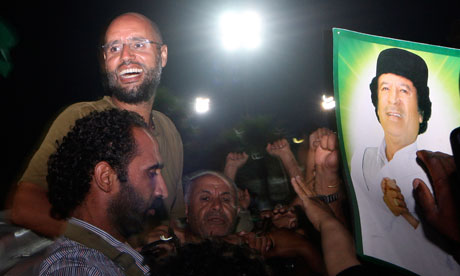
The theme to Flashdance is clearly playing in his head

But Libya has certain things going for it.  It is a small country, with a population about the size of metro Atlanta’s in a space the size of Alaska (America’s biggest state).  Though tensions between Arabs and minority Berbers exist, the country is still relatively homogeneous compared to other nations in the region; it lacks the stark sectarian divisions of Iraq or Bahrain.  The leaders of the TNC have so far evinced a commitment to moderate Islam, as well as reconciliation with former Qaddafi collaborators.

If anything good ever came from the Iraq War, it is that people have learned from the neoconservatives’ tragic experiment in “nation-building” (which consisted primarily of dismantling the nation and selling it off for scrap).  Most Libyans realize that liquidating the entire police and army and disempowering anyone who had any ties to the regime is unrealistic; the US tried dissolving the security forces in Iraq and denying anyone with Baathist connections a role in the new government, but this move ostracized huge numbers of people.  In Libya, blacklisting anyone who had anything to do with Qaddafi just would not work, since anyone who held any kind of position of influence or responsibility in the country had to work with him in some way or another.  The rebels have so far shown a considerable openness to figures with ties to the former regime, though the assassination of Abdul Fatah Younis, a very close ally of Qaddafi who resigned to lead the opposition's military forces before his killing under mysterious circumstances, suggests that old scores may be settled and supporters of the dictatorship might not get off with a free pass.


Conservatives at National Review have suddenly lost interest in Arab democracy

In any case, the outcome of this conflict is sure to be rough – as the leader of the TNC said, a revolution is not a “bed of roses.”  But the profile of the opposition movement is promising, at least as far as prospects for an open society are concerned.  The instigators of this revolution are lawyers, doctors, writers, professionals – the liberal bourgeoisie, backed by untold numbers of young, jobless, frustrated working class and middle class youths in a country that had 20% unemployment before the revolution, despite having immense mineral wealth and one of the higher GDP per capita ratios in the world – if not amazing, certainly out of line with the ratio of wealth to population in most Arab and African countries. 
.
The gentleman in the blue cardigan has a two part question

Libya, perhaps, has a better chance of achieving a liberal democratic revolution and public sphere than some of its neighbors.  The country lacks the same deep-set, entrenched, immovable military establishment that is inevitably a giant part of the political landscape in Egypt, even after Mubarak’s humiliating departure – the “deep state,” to borrow a term from Turkish politics.  The opposition forces say they will retain as many members of the old army and police force as possible, barring only those closest to Qaddafi and with the most blood on their hands.  Still, the possibility remains that a hardcore of loyalists will continue to make life miserable through bombing and the like.  An Iraq-style insurgency of disenfranchised hardliners could ensue, though many seem to doubt that Qaddafi has the committed ideological supporters to sustain such a campaign of resistance or terror.  My own father, who knows far more about Libyan politics than I do, seems remarkably sanguine about the prospects for a peaceful transition.  He believes that most of the people working for Qaddafi are simply opportunists, lackeys, hangers-on, and sycophants, who lack a deep sectarian or ethnic allegiance to Qaddafi himself.  He is perhaps too optimistic – indeed, those allied with Qaddafi’s family and tribe in his hometown of Sirte may be willing to fight on, for the sake loyalty or simply revenge – but it is safe to say that a long-smoldering insurgency is, at least, not inevitable.

Libya may have the ingredients for a prosperous, liberal society: a rebel leadership that claims to support religious moderation and political reconciliation; the lack of any one interest with a preponderance of power, whether military, business, feudal landowners, clerics, etc.; a highly literate population; a wealth of expatriates with skills who are ready to come back to the country; and, of course, oil.  What it lacks is a charismatic cleric, who could seize the initiative and try to steer the revolution in a more Islamic direction, as occurred in Iran’s revolution of the late 1970s.  Some Islamist groups have participated in the rebellion, and some observers believe they were behind the assassination of Younis.  But Islamist rhetoric and ideology has not been especially conspicuous in Libya’s rebellion; the TNC’s leaders have taken pains to emphasize that, while Libya is a Muslim country, it will not pursue a fundamentalist policy after the revolution.  TNC Chairman Mustafa Abdel Jalil described their intentions in this way:
We are on the threshold of a new era ... of a new stage that we will work to establish the principles that this revolution was based on. Which are: freedom, democracy, justice, equality and transparency, within a moderate Islamic framework.

As many nervous observers in the West have been happy to see, protesters throughout the Arab world have eschewed religious or even ethnic nationalist language in favor of a broad rhetoric of human rights.  Pan-Arabism and Islamism have not been the dominant paradigms driving these rebellions, even if religious conservatives have backed and participated in them.  As one excited young Libyan told al Jazeera on the streets of Tripoli, he and his compatriots had no interest in “Islamists and racists.”  If religious language has suffused the rebellion at times, it is only to the extent that people of faith see a higher power guiding them in the course of dramatic events, not necessarily because of an agenda to impose fundamentalism on society at large.  It is by no means uncommon for people to see their own political struggle in spiritual terms.  In other words, the protesters who appeal to Allah in the streets are more Martin Luther King than Pat Robertson.


To me, one of the most emblematic moments of the remarkable events of recent weeks was an interview al Jazeera conducted as rebels shocked the world by storming Tripoli far faster than most expected on Sunday evening.  The reporter began the interview by saying she would not ask for his name, but she wanted to know what he was experiencing.  Before she could finish her question, he told her he was not afraid to give his name.  She said okay, and he stated his first name.  She went on trying to ask her question, and then he gave his last name, and then he began to spell out his name for the channel’s viewers.  “I am not afraid anymore,” he said.  “It’s over.”  Not only the ability to speak his mind, but the freedom to state who he was and stand by his views was a euphoric feeling for him. He wanted to be known, perhaps for the first time.

This is the hope of a new public sphere in a region where outside experts long characterized the people as passive and the politics hopelessly stagnant.  Not long ago Mubarak and Qaddafi both looked likely to pull off the repugnant succession of power to their smooth, Western-educated sons, Gamal and Saif.  Now there is at least an opening for something better, even if remnants of the establishment hold onto power as tenaciously as possible.  The challenges of building a new, open civil society remain daunting after years of stifling authoritarianism.  Countless protesters are still being held in Egypt, even after Mubarak and some his lackeys lost power.  The military government there claims to be moving toward a new, democratic regime, but it will only let go of as much as of its power as it absolutely has to – just like Mubarak and every other venal power-hoarder in the region. 

The challenges Libya faces will be different, and the threat of tribal, ethnic, and regional conflict looms especially large.  So does the perennial problem of “petrocracy,” the inefficiency and corruption that haunts so many countries that are blessed with mineral wealth.  To top it all off, actually finding jobs for the dispossessed and frustrated youth who set off protests throughout the region will be no small order in the midst of political and economic upheaval.  But compared to its huge neighbor Egypt, Libya seems to be moving toward a kind of democracy unencumbered by the burdens of a powerful military or Islamist political constituency, and the rebel leaders represent a capable, technocratic, seemingly open-minded lot. 

University of Michigan professor Juan Cole has a list of suggestions for how Libyans could best manage the transition and minimize these pitfalls – including a proposal that Libyans avoid letting their national resources be privatized and sold off to corporate interests, as occurred in Iraq under the regency of L. Paul Bremer.  Like me, Cole is more of an optimist about the revolutions and rebellions in the Arab world.  Things could, of course, take a turn for the much, much worse, if, say, the wily Qaddafi had some kind of plan to destabilize the country even after his fall from power, or his loyalists prove to be much more determined than expected.  The old line about making God laugh by telling him your plans is especially true where the Middle East is concerned.  The Libyan people may not create a classic Madisonian democracy or Habermasian public sphere in Tripoli, but there remain many reasons to hope – not the least of which is the shocking fall of the world’s longest “serving” despot at the hands of a motley band of rebels (and, of course, NATO jets).
 
 
Earlier this week, a young man who was among the rebels to storm Qaddafi’s Bab al-Aziziyah compound captured this hope when he spoke to Sky News.  He had just raided Qaddafi’s bedroom and rather comically put on his hat and elephant scepter, looking a bit like a character from an early 90s Brand Nubian video.  His comments reflect the unifying rhetoric common among many members of the opposition, which is conciliatory, not particularly religious in character and nationalist (a “Libyan” identity that transcends tribe, ethnicity and sect) if anything:
Now we should forget all the past.  We should take a better stance, and we should work together as Libyans, the Arabians and the Berbers.  And I am sure Libyans will shock the world, because we would like to do something, since Qaddafi has put us in a bad situation these past years… I wouldn’t have this feeling to have revenge against those people that stood with Qaddafi. I would like to ask them to be with us, to shake our hands, and to start a new beginning, a new life, a new future, a new Libya, as we all Libyans would like to have.

Alex Sayf Cummings

Tuesday, July 26, 2011

American Arab Kitsch: From Ahab to Abed and Back Again


When I was a kid, I thought Pinkard & Bowden were pretty funny. The comedy duo’s parodies of famous country songs were often promoted on TV for just $19.95 plus shipping and handling, and I got a kick out of them. “Blue hairs driving in my lane.” “Won’t you help me make it through the yard?” I never heard their song “Arab, Alabama” back then, and I wonder what I would have thought of it when I was 9 or 10. I might have thought it was funny just because they were referring to Middle Eastern stuff (the PLO!), and I was generally interested in anything that had to do with my Arab background. After six long years of grad school, though, I can’t not see some of the bizarre ethnocentrism underlying the song, which proudly declares, “There ain’t no PLO in Arab, Alabama!”

Not long ago, Tropics of Meta discussed the pop cultural portrayal of Asians and Asian-Americans, whose coming-out party in the US might well be considered Harold and Kumar. After years of being confined to subservient side roles (Sulu) or one-dimensional running gags (Apu), Asians could headline a major Hollywood movie. They could also be perfectly normal Americans, in a certain understanding of the term: pot-smoking college kids with a crippling lust for tiny cheeseburgers.


Arab and Muslim characters have enjoyed a similar kind of enhanced visibility in the early twenty-first century, albeit in a series of still-stereotypical roles. There was Whoopi Goldberg’s Iranian sidekick in her ill-fated 2003 sitcom, played by comedian Omid Djalili, who appeared as a similar character in Paul Reiser’s miserably failed NBC show: a paunchy businessman who always “knows a guy” who can get you what you need. In contrast to this stereotype—the stocky supporting character (mustache-optional) who provides comic relief—there was, of course, Sayid on Lost. The show could be accused of practicing mild Orientalism, given how Sayid was a soulful, mysterious lover with near-superhuman skills for fighting and fixing stuff, but it also deserves points for introducing American TV viewers to a diverse range of characters of different ethnicities, nationalities and languages.

Middle Eastern peoples have long occupied a liminal and confused place in American culture: the oil-gouging sheikh (think of Ned Beatty’s speech in Network: “The Arabs have taken billions of dollars out of this country, and now they must put it back!”); the amusing shopkeeper or small businessman (a role shared with South Asians and, to a lesser extent, East Asians); the mortal enemy of Western civilization and cartoonish film villain (Osama/True Lies); as well as the technical Caucasian and honorary white person. As America shifts from a white-black racial binary to a more complex understanding of diversity, Arabs and Arab-Americans still find themselves “othered” more often than not. Yet a look at the recent past shows how American pop culture has constructed the Arab Other in much more awkward and problematic ways. Tony Shalhoub’s journey from vaguely ethnic foreigner/sidekick in Wings to essentially not-nonwhite Adrian Monk might symbolize the slipperiness of the Arabic place in pop culture; the actor has played Italian, Cuban, Arab and many other characters in film and television, serving as a sort of all-purpose off-white.

Why There's No Gorbachev in Moscow, Idaho
.
Pinkard & Bowden’s 1980s anthem “Arab, Alabama” is both a celebration of American exceptionalism and a way of identifying that uniqueness with the pride of the white working class. Like so many country songs, it hangs on a jokey hook - there are lots of places in America that are named after rather different places, such as Palestine, Paris and Moscow. America is both unoriginal and thoroughly authentic, because New Madrid is full of proud, peaceable folk, poor in style but rich in pride. Pinkard & Bowden can’t resist a few throwaway jabs at hoity-toity Europeans, especially given the largely European origins of the settlers who named many of these towns: “In Paris, Tennessee they don’t eat escargot.” Most of the song, though, is dedicated to contrasting American wholesomeness with foreign dysfunction and violence. Gorbachev, Castro, and the PLO come in for ridicule. Notably, the singers suggest that we take Fidel to Kentucky, “put a coal shovel in his hand, marry him off to one of Loretta’s sisters, and we’ll never hear from him again.” To my ear, they seem to be saying that Loretta Lynn, the icon of coal country womanhood, would have no trouble muzzling the obstreperous dictator, the man the CIA could not shut up despite numerous ridiculous assassination attempts. Communist despotism is nothing next to the ferocity of a coal miner’s daughter.

 
It would be easy to say Pinkard & Bowden are racializing the foreign nemesis, and perhaps they are. But a few stray references complicate the picture. The dig at Gorbachev contrasts the Kremlin capital of godless Communism with a town in famously white and conservative Idaho. The Russians may be honorary nonwhites – more red, in a sense, than white despite their skin tone. They also throw in a line about Dublin, Georgia, noting that “Irish people don’t shoot each other” there. At first I thought this was a general reference to bar-brawling Irish drunkenness and criminality, but it actually fits well into the no-PLO theme. We don’t have such terrorist organizations in the USA, although we do have right-wing extremists who blow up government buildings and Irish-American politicians who like to contribute to the IRA while inveighing against Islamic terrorism. (See King, Rep. Peter [R-NY].) Overall, the message seems to be “We don’t have that here”—“that” being the problems of dictatorship, terrorism, and war that plague the rest of the world. The theme is an old one, stretching back to the Founders’ disdain for the corruption and poverty of Europe, as well as the isolationist impulse of later Americans who saw their nation as a happy island far from the endless wars overseas.

Nationalism and exceptionalism may be the core of Pinkard & Bowden’s message, but they still cannot escape race. They suggest we take the “sheetheads” up to Alaska and “make them be Eskimooooooesssss…” as if white Americans can swap one troublesome race out for an apparently less threatening one. The music video for the song shows a cartoonish Castro and Arab sheikh jamming on a Kalashnikov, while lots of modest white people grill out, wave flags, and generally act goofy. This is America: a big, funny, all-white cook-out where caricatures of the nation’s deranged enemies are the hired clowns. The specific thrust of the song is ridiculing the Other, but the general mood of the video is simply one of exultation in the virtues of old-fashioned, homespun American whiteness.

Chubby Checker and the Crimson Jihad


Comedian-musician Ray Stevens has dipped his toe more than once into the Sea of Galilee, so to speak. I remember hearing his song “Ahab the Arab” many times when I was a kid, as I had relatives who loved screwball songs like “The Mississippi Squirrel Revival.” “Ahab” seemed like a fairly innocuous ditty about “the swingin’ sheikh of the burnin’ sands”—lacking the somewhat nasty edge of Pinkard & Bowden’s song, if also missing the progressive self-awareness of 1953’s “Istanbul (Not Constantinople).” Here is the rich Arab, “with rubies and emeralds just dripping off a him, and a ring on every finger.” But the lyrics also turn on a familiar tale of foreigners embracing American culture:
He brought that camel to a screeching halt
At the rear of Fatima's tent jumped off Clyde,
Snuck around the corner and into the tent he went
There he saw Fatima laying on a Zebra skin rug
Wearing rings on her fingers and bells on her toes
And a bone in her nose ho, ho.
There she was friends lying there in all her radiant beauty.
Eating on a raisin, grape, apricot, pomegranate,
bowl of chitterlings, two bananas, three Hershey bars,
sipping on an ice cold Coca Cola listening to her transistor,
watching the Grand Ole Opry on the tube
reading the Mad magazine while she sung,
"Does your chewing gum lose its flavor?"
and Ahab walked up to her and he said,
(imitates Arabic speech)
which is Arabic for, "Let's twist again like we did last summer, baby."
You know what I mean! Whew!
The “zebra skin rug” and “the bone in her nose” are a more than a little cringe-inducing, but overall the song is more ignorant than racist. It could be trumpeting the superior appeal of US consumerism, or it could be simply saying we’re all the same, even the sheikh of the burning sand: everyone loves Coca Cola, Chubby Checker, and Hershey bars. The song was first released in 1962, years before the oil embargo helped begin Arabs’ long career as go-to villains in pop culture.
.


Of course, Ray Stevens has always gone with the times. His goofy song “The Streak” was one of the finest meditations on 70s exhibitionism; he touched on Middle Eastern kitsch again in his 1980 country hit “Shriner’s Convention,” which described the shenanigans of an “Illustrious Potentate” named Bubba at a Holiday Inn where a lot of redneck Shriners with Harley Davidsons and big-haired girlfriends come to meet. The video for the song features at least one African American character – not a common sight in country music videos or the traditionally white, middle class Shriner membership – who gets to join in the fun of wearing fez hats and driving tiny cars. The Shriners themselves were founded in the nineteenth century by a Mason who had attended a party thrown by an Arab diplomat and decided to start a men’s fraternity that aped Middle Eastern styles, traditions, and architecture. Playing Arab dress-up has a long history in the US, but the practice has clearly taken a more mean-spirited turn in recent years.


Indeed, the more recent work of Ray Stevens makes Shriner shenanigans look like good clean fun. Stevens may once have been a harmless spinner of novelty songs, yet his career in the early twenty first century speaks to an increasingly bitter tone in the way his mostly white, conservative audience imagines the ethnic Other. Ironically, the author of the syrupy Gospel ballad “Everything Is Beautiful” panders to racial resentment and lust for revenge nowadays, making his bread by catering to the Walker, Texas Ranger demographic with songs like “Obama Nation” and “Caribou Barbie.” His 2010 single “Come to the USA” offers an appalling portrayal of the persecution suffered by native English speakers at the hands of immigrants and big government. Such leanings were suggested by his 2002 “Osama Yo Mama,” a minor country hit that exploited the reaction to the September 11th terrorist attacks. Opportunistic and undoubtedly conservative, the song is more about revenge than race. “Osama, yo mama didn’t raise you right, she musta wrapped your turban too tight,” Stevens sings, as he dances around in a pink costume. A tiny cartoon Osama darts across the screen while, randomly enough, Stevens fires at him as an ersatz Rambo. We’ve come a long way from Ahab eating Oreos on the burning sands.

Muslims in a Liberal Mirror
.
 

If YouTube videos by Ray Stevens were all there were to American pop culture, of course, we would be in serious trouble. Meanwhile, liberal Hollywood has tried to portray Arabs and Muslims in a favorable light, in an awkward quest to build intercultural bridges through the time-tested means of TV. The networks once sought to build sympathy for urban people of color by placing them under benevolent white tutelage (The White Shadow, Webster, Diff’rent Strokes), and the 2007 sitcom Aliens in America seems to fit into this history. The show, which only lasted a season on the CW, tells the story of a Wisconsin family that takes in a foreign exchange student from Pakistan named – wait for it – Raja Musharraf. For some reason, Raja is always wearing a shalwar kameez, presumably because that’s what all people from Pakistan wear. The family tries to adjust to this Muslim “alien” in their home, and everybody does their best to overcome the cultural misunderstandings that provide much of the grist for the plot. The show did not quite work; even though the Pakistani character was overdone, the dynamic between him and his hosts never created enough real dramatic frisson or humor. Tip-toeing around cultural sensitivities may be the problem – how do you make a Muslim-Christian conflict funny without offending someone? The show’s writers made Raja into a sweet, innocent soul who almost always tried to do the right thing, like a smarter version of Balki, the Perfect Stranger. If the producers wanted to cast a Muslim character in a favorable light, they likely went too far. The  problem with humanizing the inhuman is that you run the risk of coming up with something in between.

.
Which brings us to Abed, the star of NBC’s well-loved but still-struggling postmodern sitcom Community. The show depicts its Palestinian character as a robotic sponge for pop culture, who quickly identifies the film and TV tropes that each episode parodies. It plays with the idea that Abed is “different” while he is “just like us” in his love for everything American. In one episode, the cranky boomer played by Chevy Chase is surprised to find out that Abed loves Christmas: “Don’t your people spend this season writing angry letters to TV Guide?” Yet the Muslim character still loves the holiday for its TV specials, colorful gifts, and general (secular) spirit of camaraderie. Community tries hard to situate Abed in the show without pandering to Muslim or Arab stereotypes or going the opposite direction by making him completely “normal” – say, a dumb jock who loves Ed Hardy, Katy Perry and disc golf. This is part of the reason why Abed is so appealing, and works as a sitcom character better than the pious Raja. He is different, and that difference may derive in part from the conditions of his origin as an immigrant – he seems to possess a detached, outside view of American pop culture, like Chance the Gardener in Being There – yet the writers have not constructed his difference in direct response to some set of expectations about race or religion.

Arab as they wanna be

I would count that as progress – getting out of the straightjacket of the Crimson Jihad and writing a unique character on his own terms. What does not work so well is casting. Danny Pudi plays Abed, yet he is half-Indian and half-Polish. Sayid, the Iraqi character from Lost, was played by the Indian-British actor Naveen Andrews. Even the evil terrorist Salim Abu Aziz in True Lies was played by a Pakistani-British actor. Tony Shalhoub, who is Lebanese, is one of the only Arab actors in Hollywood and he gets cast as almost everything but Arab. Shalhoub has, of course, made a conscious effort not to play stereotypical terrorist characters and has worked to promote different kinds of roles for Arab actors. Yet Arab and Muslim identities continue to be fraught with tension in the US; even as shows like Lost, Aliens in America, and Community attempt to present characters who are more varied and three-dimensional, we still see political abortions like the preposterous election year campaign against the “Ground Zero Mosque.” Such events not only gin up fear and hostility toward Muslims. They cast doubt on whether certain groups will ever be fully admitted into the privileges and the imagination of American citizenship.

Also known as Masih ad-Dajjal

This blog does not accept the pessimistic premise that Arabs and Muslims, from the Barbary Pirates down to Pamela Geller, are doomed to be a permanent out-group in America, forever barred from possessing full citizenship. (For a compelling overview of the argument, see this piece by Steven Salaita.) Dearborn is as much America as Arab, Alabama. So are Edison, New Jersey and what we like to call “Little Edison” in Decatur, Georgia. People on the Right may bloviate about our Judeo-Christian heritage, as if Islam were not an inheritor of the exact same tradition; a novelty country singer may whip out the word “sheethead” in a general screed against the outside world; and no doubt, the receptiveness of country music and talk radio listeners to racist name-calling is troubling; but such mischief is not equal to the reality of American culture, and certainly not its potential. Why Americans have fixated on the Arab Other from the Shriners down to Barack Obama (our “Arab American” president, according to some theorists) is a question for another day. Perhaps their indeterminate place in the US spectrum of race makes people from the Middle East an ideal screen on which Americans can project our jumbled hopes, desires, anxieties, and fears about the politics of identity. If that’s the case, Abed may represent a turning point: a mirror, not a screen, that reflects us back at ourselves.

Alex Sayf Cummings


Monday, June 13, 2011

Scattershot Politics: Sport and Its Serpentine Political Meanings


Over the past fifteen to twenty years, historians have increasingly emphasized the role of sports as both a driver and reflection of society. The recent Bill Simmons inspired and ESPN produced 30 for 30 documentary series tackled a number of difficult subjects via Sport. In "The Two Escobars," directors Jeff and Michael Zimbalist traveled through 1980s Columbia, following the lives of Pablo (international drug dealer/murder/local philanthropist) and Andres Escobar (captain of Columbia’s 1994 World Cup team murdered in a nightclub alteration several months later). The two unrelated protagonists encapsulated the travails of late 20th century Columbia. Drug money filtered into the nation’s soccer infrastructure, boosting its competitive success but also adding layers of complexity and violence to a nation already struggling with decades of conflict. Writing for the Onion’s AV Club, Todd VanDerWerff summarized its importance similarly: “The film's portrayal of Colombia as a nation that made its compromises and learned to live with the hell they unleashed is also particularly good, as the story of the two men at the center slowly radiates outward to encompass more and more of the nation's society.”

This is not a wholly unusual conclusion for the series. In “Pony Exce$$,” director Thaddeus Matula explored the corruption and ultimate destruction of Southern Methodist University’s (SMU) then dominant football program as booster money flowed in from the oil wealth that defined the Southwest US in the 1980s. Though the Southwestern Conference consisted of eight schools (Baylor, Rice, SMU, Texas, Texas Tech, Texas A&M, Arkansas, and Texas Christian University), Dallas served as a hub for numerous successful graduates of each school. As several observers note in the documentary, football rivalries crackled in the board room meetings of Dallas high rises as alumni from all schools engaged in recruiting practices that seemed to define the decade.

Likewise, Billy Corben’s film, “The U” about the dominance and bravado of Miami University’s 1980s football teams reflects similar themes. Miami’s football team served to unite a divided city behind a collection of local talent that also rewrote the rules of the game. Miami’s players excelled spectacularly on the field but stoked controversy with their trash talk and exuberance. If oil money shaped SMU, Miami’s notoriously tough African American neighborhoods, embraced by Miami’s first successful coach Howard Schnellenberger, came to symbolize “The U’s” power. Along with cultural productions like Scarface, Miami Vice and the notorious Two Live Crew, players like Michael Irvin challenged college football and its fans. Unlike “Pony Exce$$”, “The U” reveals the racial undertones that marked some of the criticism faced by the Miami program. When teamed with Steve James’ masterful “No Crossover: The Trial of Allen Iverson” and the recent “Fab Five” film about the innovative early 1990s Michigan basketball team, “The U” reveals so much more about American life than just college football. Race, money, and a changing cultural landscape collided. As one writer observed, James’ movie looks at Allen Iverson “more as a phenomenon, a human inkblot whose polarizing effect on people often says more about them than it does about him. They see whatever they want to see, and that may or may not be the truth.” In essence, all these films and others in the 30 for 30 series function to elevate sports to a level of political and social importance that might have been derided in early decades.
Architecture is the simplest means of articulating time and pace of modulating reality and engendering dreams. It is a matter of not only of plastic articulation and modulation expressing an ephemeral beauty, but of a modulation of producing influences in accordance with the eternal spectrum of human desires and the progress in fulfilling them. The architecture of tomorrow will be a means of modifying present conceptions of time and pace. It will be both a means of knowledge and a means of action.
- Ivan Chtcheglov, Formulary for a New Urbanism, 1953

Writing in 1953, nineteen year old architect and devotee of the Situationist movement Ivan Chtcheglov published his sweeping indictment of mid-century urban planning. For Chtcheglov, the architecture of cities past reflected the dead life of capitalist production. City dwellers had been hypnotized by the built environment, thus, focusing exclusively on capitalist accumulation to the extent that when “presented with the alternative of love or a garbage disposal unit, young people of all countries have chosen the garbage disposal.” One can see parallels with sport, most clearly in the above examples regarding SMU and the Escobars. The excess capital of drug and oil money created a vehicle for the egos and dreams of ruling classes that were then imposed. (To be fair, soccer teams as several interviewees in The Two Escobar note, serve as great money laundering devices. One might suggest the same of Enron and other corporate entities in recent years.)


For Americans, sports provided both meaningless entertainment and incredible important cultural moments of resistance. Dave Zirin documents athlete resistance of the twentieth century in his 2005 work, What’s My Name, Fool? Sports and Resistance in the United States. To Zirin’s credit, What’s My Name, Fool? gathers countless examples of political acts by athletes across the sports spectrum, engaging in issues of race, gender, and class. For example, Zirin traces the complicated politics of Jackie Robinson who, despite his bravery in desegregating MLB, came to be unfairly seen by radical Black nationalists of the late 1960s as a sell out. Some have described Zirin as sort of Howard Zinn of spors journalism. Perhaps. He does look at major historical events like the 1968 Mexico City Olympic protest by Tommy Smith and John Carlos, in which both athletes upheld closed black gloved fists. Zirin explores many facets of the event that had gone unnoticed. Unfortunately, while Zirin collects valuable stories worth reflection, he too often veers in the direction of soap box oratory. Moreover, Zirin seems to feel the need to conclude paragraphs with zingers. For example, how about this gem regarding the failure of several WNBA sports franchises: “while some franchises found success, others have folded faster than a rib joint in Tel Aviv.” (186) When discussing Allen Iverson, Zirin notes Iverson’s role as an anti-corporate anti-hero summarizing his nickname may have been A.I. but “there was nothing artificial about him.” (163) Nuance is not the most prominent feature of What’s My Name, Fool. Still, even if the equivalent of street corner radical, Zirin contributes something to our knowledge of American culture and sport.

If baseball and to a lesser extent American football and basketball have served as venues for political expression, predictably, football occupies a similar position for Europeans. How Soccer Explains the World: An Unlikely Theory of Globalization, Franklin Foer traipses through countries around the world, but predominantly Europe, exploring the meanings and processes that manifest themselves in the sport. Throughout How Soccer Explains the World one thing becomes clear, the political complexity of football and more generally, sport, radiates in countless directions. When Foer presents Barcelona’s “bourgeois nationalism” as a model for 21st century cosmopolitanism, he goes so far as to claim that it “redeems the concept of nationalism.” (198) For Foer, Barca never demonizes opponents the way supporters at Red Star (Belgrade- the subject of a previous chapter, one that found soccer fan bases and clubs of the former Yugoslavia as germs for the paramilitary organizations of the Balkan wars in the 1990s) have. Instead, Barca illustrates that “fans can love a club and a country with passion and without turning into a thug or terrorist.” (197)


A central aspect of Barca’s identity rests on its foundational myth, its role as a means of Catalan resistance toward the post Spanish Civil War fascist Franco regime. According to this myth, Camp Nou, Barca’s legendary stadium, enabled Catalan fans to express themselves in ways forbidden by Franco. Camp Nou allowed for political and social subversiveness. “Its fans like to brag that their stadium gave them a space to vent their outrage against the regime,” writes Foer. “Emboldened by 100,000 people chanting in unison, safety in numbers, fans seized the opportunity to scream things that could never be said, even furtively, on the street or in the cafĂ©.” (204) Yet, as Foer acknowledges, there is another way to view Barca’s history. More likely, Franco saw Camp Nou and Barca as harmless outlets for his repressed populations. Unlike the Basque region and its terrorist/separatist movement ETA, Catalonia never developed any similar liberation fronts. Instead, Catalans pragmatically went to work, benefitting from subsidies and tariffs that contributed to Barcelona’s metropolitan industrial boom. This success may go far in explaining Barca’s place in the Catalonian psyche. Foer argues, many Catalonians have a self conscious suspicion, that unlike their forefathers and other Spanish regions, “they feel as if they have lived lives devoid of struggle and without epic dimension. They worry that their fathers would be disappointed with their staid existence.” (214) Catalans employ Barca as a “balm” for a guilty conscience and resentments over “Castilian centralism.” Even in this less than ideal motivation, Foer finds strength. Catalans hold contempt for a concept ("Castilian centralism,” as represented by arch rival Real Madrid) rather than a people, hence the reason Barca lacks the kind of history of hooliganism or violence that seems so prevalent at other clubs. If anything, the history, identity, and place of the Barca (this year’s Champion’s League victor) in Spain points to a deep complexity that lay at the heart of sport in the West. However, one needs to ask, what does sport mean outside the West?

Decolonizing Cricket

It is no exaggeration to suggest that cricket came closer than any other public form to distilling, constituting and communicating the values of the Victorian upper classes in England to English gentlemen as part of their embodied practices and to others as a means for apprehending the class codes of the period. 

“Rock star” anthropologist (probably the equivalent of “rock star” bands like the Soft Pack—what never heard of them? Exactly) Arjun Appadurai also believes sport reveals deeper issues than won loss records. In Modernity at Large: Cultural Dimensions of Globalization, Arjun devotes an entire chapter to the “decolonization of Indian cricket.” Appadurai’s interest lay in what he labels the “indigenization” of cricket on the subcontinent. The former University of Chicago anthropologist (he's currently at NYU) identifies four processes that interacted in ways that led to cricket’s unique indigenization in India:

  1. the “implicitly corrosive” affect the “elite Victorian values” embedded into the sport on the “bonds of empire”
  2. internal sustainability of the cricket due to its ability to develop talent outside urban
  3. issues of post colonial masculinity in which spectating came to be associated with “bodily competition and virile nationalism”
  4. the ability of media and language to disconnect Englishness from the sport

Perhaps the most intriguing of Appadurai’s processes is the paradoxical affect that the initial values of the sport exerted. “Quintessentially, masculine,” the codes of cricket regulated broader male behavior. These codes consisted of four essential tenets: 1) sportsmanship 2) fair play 3) emotional control over one’s person 4) loyalty to team and sublimation of personal interests to the group. Yes, it functioned to socialize and discipline subjects, but it also provided an “an instrument of elite formation.” As Appadurai points out, “it both confirmed and created sporting solidarities that transcended class.” (92) The field allowed lower and middle class competitors a limited equality with their Victorian superiors. Appadurai also credits the lower classes with doing “the dirty subaltern work of winning so that their class superiors could preserve the illusion of gentlemanly non competitive sport.” (92) The greater importance, he argues, is that as an elite sport, cricket nonetheless emphasized an idea of fair play that demanded “openness to talent and vocation in those of humble origins … a key to the early history of cricket in India.” (92) English officials believed it to be the perfect way to “socialize natives into new modes of intergroup conduct and new standards of public behavior.” (93)


With that said, one of the most critical developments unfolded as Indian princes began paying English and Australian professional players to train their own squads in India. This line of patronage and the coaching it brought with it proved critical to the sport’s development. Princes loved cricket because it confirmed their own masculinity, provided avenues for furthering their English contacts, and enabled them to extend their places in “royal public spectacles” seen as integral to the intrigue and responsibilities of Indian royalty. This resulted in a class of players form outside India’s major colonial cities. The monies given to them by these Princes allowed for many to occupy a space in the cosmopolitan world of cricket. As these new class configurations compiled, Indian cricket exhibited a class complexity that Appadurai argues “persists to today.” (95) “In the circulation of princes, coaches, viceroys, college principals, and players of humble origin between India, England, and Australia,” writes Appadurai, “a complex imperial class regime was formed.” Functioning as a sort of network of Indian and English “social hierarchies”, by the 1930s the various interactions occurring within this nexus of empire had created a “cadre” of non elite Indians who identified as both legitimate cricketeers and “genuinely Indian.” (96)

Unlike in England, where cricketing organization represented territory and nationhood, Indian organization refracted this meaning instead focusing on community and cultural distinctiveness. This meant Indian clubs were organized around local religious identities. Thus, spectators and players developed distinct ideas about their identities as Hindus, Muslims, and Parsi through the public spaces of cricket. When contests between English sides and those of indigenous colonial players expanded, the idea of India had to be invented. In other words, in order to field a team to play British sides, there existed a need to construct a team that represented Britain’s South Asian possession, India. At the very least, the teams constructed embodied protonational visions of an Indian state. In the post 1948 world, cricket as a vehicle for Indian nationalism seems obvious. Moreover it ties the tangled ends of empire together servings as a space for Indians, Pakistanis, Australians, English, their respective Anglo colonial counterparts, to engage and interact. While Appadurai also notes what he sees as the negative influence of globalized financial flows and commodization, he nonetheless recognizes its powerful undercurrents. “[Cricket] is an agnostic reality, in which a variety of pathologies (and dreams) are played out on the landscape of common colonial heritage. No more an instrument for socializing black and brown men into public etiquette of empire, it is now an instrument for mobilizing national sentiment in the service of transnational spectacles and commoditization.” (109)

Operation Iraqi Freedom

"Iraq as a team does not want Mr. Bush to use us for the presidential campaign," [Iraqi midfielder Salih] Sadir told SI.com through a translator, speaking calmly and directly. "He can find another way to advertise himself."
-- Grant Wahl, Sports Illustrated, “Unwilling Participants” August 4, 2004

Appadurai’s exploration of cricket through the tentacles of imperialism points to the multivalent nature of sport. Though employed as a means to inculcate imperial pride and English Victorian values, cricket served to sculpt communal identities while contributing to post colonial imaginaries that envisioned an independent subcontinent. With the rise of an increasingly globalized mass media, cricket provided the state with cost free way of emphasizing nationalist tropes to a transnational diaspora.

While American occupation of Iraq differs in many ways from the English equivalent a near century before, many Iraqis view it as neocolonialism. Take, for example, George W. Bush’s attempt to appropriate the newly reconstituted Iraqi soccer team for electoral gain. Linking the team’s achievements at the 2004 Olympics (they ultimately took fourth, a remarkable achievement for a nation at war) with those of his administration, Bush attempted to use it as evidence of his administration’s efficacy. On the eve of the 2004 election, in speeches and ads, Bush lauded the fact that had the US not intervened, Iraq would not have fielded such a successful team. “It wouldn't have been free if the United States had not acted." While all players acknowledged that none wanted a return to the days when Uday Hussein tortured Iraqi athletes, neither did they appreciate Bush’s line of logic. Coach Adnan Hamad summed up the general tenor of the team’s opposition: “My problems are not with the American people . . . They are with what America has done in Iraq: destroy everything. The American army has killed so many people in Iraq. What is freedom when I go to the [national] stadium and there are shootings on the road?" Of course, the attempt by an American president to take credit for Iraq’s soccer exploits is ironic for several reasons. Unfortunately for Iraqi players, more than a few observers will conclude American intervention did improve their team’s chances. After all, its fourth place finish remains its highest Olympic finish in soccer. In this way, soccer performs a contradictory function to at once provide a unifying expression of Iraqi identity, one couched in resistance to US prerogatives, while also serving as measure of justification for the very occupation they resent.

Iranian Revolution


Perhaps few places in the world today represent the political power of sport more than Iran. Again, this power flows simultaneously in two directions. Two recent events help convey the duality of soccer. The recent death of Iranian goalkeeper Nasser Hejazi underscores its disruptive effect on the Persian nation’s coercive government. Known as the Eagle of Asia, by most accounts, Hejazi was considered the greatest Iranian goalkeeper in history. Yet, the regime refused to celebrate him, nor did he celebrate it. Banned from national competition due to an arbitrary age limitation placed on the national team by the newly triumphant regime in 1979, Hejazi remained a thorn in the government’s side from then on. In 2004, Hejazi attempted to run for office but was denied by authorities. He later commented on the Iranian government’s failed promises. “I am agonised,” he said, “to see [the authorities] interpret poverty as contentment, inefficiency as patience and, with a smile on their faces, they call this very stupidity wisdom.” (Economist, June 2, 2011) The remark earned him a temporary ban from Iranian television. Even in death, the Iranian government remained fearful. The first half of his funeral drew over 20,000 mourners. As the Economist noted, the chanting of anti-government slogans pervaded the event and authorities quickly whisked the body away to a secret burial where contrary to tradition, no prayers were uttered.

Hejazi complicated football for Iranian rulers. The government had hoped to use the Iranian national team for its own purposes. The 1998 World Cup victory over America provided one such opportunity. However, an unexpected victory over Australia the year before sparked controversy within the regime as Iranians bounded into the streets in celebration. Of course, this being Iran, gender comingling remains distinctly discouraged. One particular English periodical commented sarcastically: “In their delight, men and women surged onto the streets of Iran’s cities and—O tempora! O mores!—celebrated together uninhibitedly.” When the Iranian team lost to Bahrain in 2001, the team played lethargically or as some argued “inertly.” Many Iranians suspected the team had been bribed or threatened by the powers that be. Hejazi had long advocated women attending games with men, and the fact that women attended his funeral was seen as an indictment of official policy.

Clearly, football represents a risky proposition for rulers. Speaking to NPR, Middle Eastern soccer expert James Dorsey noted the careful balancing act that some governments experience via sport. According to Dorsey, Middle Eastern football remains a “battlefield in which governments - certainly authoritarian governments - try to keep tight control of the game because the pitch is potentially, and often is, a venue for expression of dissent.” Recent events in Egypt, where soccer fans have disrupted games to make political statements, illustrate that Dorsey’s reflections ring true outside of Iran as well.

Nonetheless, Iran’s government continues to use football as a means for its own ends. FIFA’s ban on the Iranian women’s team for refusing to stop wearing the hijab has given the regime a talking point about western corruption and bias. Iran's President Mahmoud Ahmadinejad called FIFA "dictators who just wear the gown of democracy." Granted considering FIFA’s current state (corruption scandals abound with prominent periodicals like the Economist labeling the organization “rotten” and “awful”), any ruling by football’s governing body appears suspect. However, consider the fact that Iran continues to ban women from attending games and demands that its team wear a hijab and long pants. FIFA had been holding talks with officials to work out a compromise when a Bahrain FIFA official refused to allow the Iranian women’s team to take the field against Jordan. Of course, the New York Times noted that Bahrain’s own religious make up consists of a Shiite majority ruled by a Sunni minority. Sporting politics can tumble into transnational spaces. As for Iran, the Economist obituary frames the temptation of football succinctly: “Thanks in part to Mr Hejazi, Iran’s regime knows that the circus of the football stadium holds as many hazards as rewards.” Bread and circus are everywhere, but in some places, maybe they mean just that much more.

Ryan Reft

Thursday, January 27, 2011

From Bethlehem to Baku: Bandali Jawzi and the Origins of Postmodernism


In Interpreting Islam: Bandali Jawzi’s Islamic Intellectual History, Tamara Sonn brings new attention to a figure who has been mostly forgotten in Western historiography, at least until recently. The details of Bandali Jawzi’s life remain murky, but its trajectory offers a remarkable vantage point on the political and cultural convulsions that roiled the early twentieth century. With little more evidence than an unpublished dissertation from an Azerbaijani university and a footnote in a 1973 text, Sonn had to piece together the writer’s origins. One scholar had heard that Jawzi was a born a Tatar in the Russian city of Kazan. Another source indicated that Jawzi was an Arab Christian from Palestine; indeed, it turned out that he was born in Bethlehem in 1872.

Over the course of a career that took him a monastery in Tripoli to the University of Baku, Bandali Jawzi led the way in rethinking the intellectual history of Islam in the early twentieth century. Many Arabic reformers hoped that Western-style liberalism would help free them from imperial domination and economic stagnation, yet betrayal of their aspirations for independence by France and the United Kingdom after World War I dimmed the possibility of reform along the lines of liberal democracy. With the Russian Revolution unfolding in the late teens and twenties, Marxism began to look like an attractive alternative for political change in the Arab world. Although the militant atheism of most Communist parties gave many Muslims pause, Muhammad and Marx could cohabitate if political circumstances favored an alliance; as Sonn points out, Muslims in Azerbaijan made common cause with the Bolsheviks in order to throw off the cruel oppression of the Czarist empire, but the partnership quickly fell apart when the victorious Communists determined that class unity (i.e. Russian hegemony) was far more important than Azerbaijanis’ aspiration for self-determination.

Jawzi, who moved to Soviet Azerbaijan in the 1920s, wrote his most famous work in the midst of this churning tumult. The History of Intellectual Movements in Islam (1928) reevaluated the long history of theological schisms within Islam from the perspective of ideology and political economy. He also unleashes a withering reading of European scholarship on Islam, pointing out the vain disregard for evidence or specificity when Orientalists made sweeping claims about the unchanging nature of society and culture in “the East.” This analysis came fifty years before Edward Said indicted Western scholars for creating a warped image of the Islamic world in the classic text Orientalism, and both authors made their case in strikingly similar terms. A sardonic Jawzi blasts revered European historians like Ernest Renan, who stated unequivocally that “It is nothing but the terrible simplicity of the Semitic spirit which oppresses the brain of man and obstructs the way of all free thought and scientific investigation, exchanging for all that the boring repetition of the shahada [the Muslim declaration of faith in God and Prophet Muhammad].” The Orientalists make an error of synecdoche, Jawzi suggests, confusing the part with the whole. For example, one concludes that all Arabs must believe in astrology or reject the scientific method if some can be found to do so. He also condemns Western scholars for identifying Eastern cultures with their most ancient form, and disregarding any new evolution of the tradition as either irrelevant or a degradation of its original state – a mistake that was common in Western scholarship prior to the self-critical reorientation of anthropology in the late twentieth century. “According to this view, one need only know a short period in the life of an ancient eastern nation,” Jawzi writes. “One can extrapolate from that to discover its overall conditions, regardless of how long it has existed or how many internal changes it has undergone.”

In fact, as Sonn makes clear, this critique only makes up a small part of Jawzi’s work. Most of History of Intellectual Movements focuses on the failings of past Islamic scholars, not Orientalists. In this spirit, Jawzi looks at new religious movements in Islamic history as vehicles of protest and reform, despite the fact that authorities in the Umayyad and Abbasid dynasties were quick to brand unorthodox groups as liars and thieves. Instead, he asks if movements like that of Babak Khorram-Din (795- 838 CE), the Isma‘ilis, or the utopian Qaramatis (tenth century CE) served as vehicles for economic discontent and a search for social justice. The Babakis, for instance, have often been characterized as a movement to assert greater Persian cultural identity under the domination of the Abbasid caliphate, based in Baghdad. Jawzi sees the Babaki movement as a quest of peasants in what is present-day Iran for social justice and economic improvement, as the farms they worked were owned by large landowners. Islamic rule had not brought a better life than an earlier regime, and the luxurious decadence and inequality of the caliphate seemed to contradict Muhammad’s original message of social justice.

In hindsight, it seems possible that Bandali Jawzi was projecting a quasi-Marxist, economic determinist interpretation onto events that do not quite warrant it. As the saying goes, when you’re a hammer everything looks like a nail. This is true of nearly all schools of thought. A historian of sexuality is likely to find a sexual dimension to any historical event or social struggle; a tut-tutting Washington pundit is likely to view everything in terms of partisanship and a personality-driven horse race. Certainly, scholars influenced by Marxism will want to find the basis for a religious insurgency in material conditions of the economy: production, property ownership, taxes, and so forth. Movements like the Isma‘ilis, who trace their lineage back to the time of Muhammad and remain a potent social force today, emerged as a result of genuine theological differences and raw political power struggles as Islam wrestled with the problems presented by geographical expansion in the years after Muhammad’s death. That economics played a role in such struggles can hardly be discounted, but the main terrain of conflict was ideology.

Moreover, this tumultuous period gave rise to theological conflicts in part because the interpretive flexibility and openness of Islam in its early days gradually gave way to a hardening orthodoxy over the eighth, ninth, and tenth centuries. Sonn lucidly explains the importance of ijtihad, the practice of using independent reason to interpret Islamic principles and apply them to new circumstances. News of this practice may surprise many westerners, especially Americans, who have the impression that Islamic law has been fixed and immutable for all Muslims for all time. In the first centuries of Islam, Muslims standardized the scriptures and attempted to figure out how to apply the model of the Prophet’s ideas, sayings and actions to changing social conditions. As the implications of Islamic law were worked out by jurists and philosophers, though, some began to believe that all the major questions had been answered satisfactorily, and further interpretation or speculation was unnecessary. Much of this hardening orthodoxy undoubtedly owes to the tendency of institutions to become more conservative and risk-averse over time, as well as the natural inclination of people to think the horizon of their own lives and times marks the limits of the world. (Remember when Americans patted themselves on the back about the “end of history” and the permanent triumph of capitalism back in the 1990s?)

In any case, it is not surprise that groups with differing interpretations would be suppressed, as they have been in so many religious traditions, as one viewpoint takes power and attempts to demonize and marginalize its competitors. Such competitors, of course, may also espouse equally unusual economic ideals and have their own material interests. The Qaramatis, for instance, set up their own government in eastern Arabia at the end of the ninth century CE, where land was distributed more or less equally and a council of six governed by consensus. While Jawzi cites this as an ancient model of socialism, Sonn is quick to note that the Qaramatis’ egalitarianism did not extend to the many Black slaves they used to work the land. Slavery was, of course, common in the ancient world at the time, and Jawzi judges the group leniently for at least attempting to implement a kind of equality and social justice among their own people. (Slaveowning democracies from ancient Athens to the antebellum United States might make for fair comparisons.)

Jawzi wrote in the context of his time and place, and much of his work drew on Soviet scholars who, despite the Marxist coloration of their work, were often far less prejudiced and blindered than Orientalists in the United States and Europe. Indeed, Jawzi’s career put him in a unique position to survey both the intellectual history of Islam and the contemporary scene. Despite being a Christian, his work expressed clear admiration for what he saw as the Islamic principles of social justice and equality. He studied at a Russian university and ultimately taught in Communist-controlled Azerbaijan, on the ethnic, religious and political fringe of the new Soviet empire. His is an unusual and oft-neglected perspective on the world of the early twentieth century, marked by rising and falling empires and shifting ideologies. The climate of anti-imperialism and insurgent socialism, from the Arab world to the Communist bloc, appears to define his intellectual stance.

In fact, Jawzi’s analysis looks not so much like proto-deconstruction or pre-neohistoricism as a thoughtful application of Marx’s idea of base and superstructure, i.e. that the ideology and culture of a society reflects the material interests of those with economic power, as well as, more broadly, the basic arrangement of the economy itself. One could say Protestant Christianity and liberal democracy are part of the “superstructure” that sits on top of American capitalism, justifying the prevailing economic system. A feudal or slave society will have cultural traditions that legitimize the arrangements for property ownership and production in its unique form. Jawzi appears to have broken ground by bringing this kind of analysis to bear on the history of Islamic thought and political culture. Perhaps the Isma‘ilis were disparaged as hash-smoking bandits not because that’s what they were, but because such a characterization serves the interests of those in power and was likely to accepted and passed down as conventional wisdom. Looking at religious offshoots as protest movements against corrupt or oppressive caliphs makes sense in Marxist terms, as it lends a potentially economic basis for the emergence of religious culture and a political one for the demonization of dissenters and their countercultures. 

It could be that the argument is older than Said or even Marx; the idea that "history is written by the victors" is hardly new.  Sonn weaves references to Foucault, Derrida and others throughout the text of Interpreting Islam, attempting to prove that Jawzi anticipated their work and that subsequent Islamic thinkers have picked up the thread of neohistoricism and deconstruction. With the exception of Said, most of the links feel secondary and tenuous. Reading texts for their political and cultural bias was no more invented by Bandali Jawzi than it was by Jacques Derrida. But the recovery of Jawzi’s work is important; that a Palestinian Christian emerged to defend the intellectual legacy of Islam at a time when Western anthropologists still breezily dismissed the simple-mindedness of the East is a story that deserves attention.


Alex Sayf Cummings