Showing posts with label politics. Show all posts

Thursday, September 15, 2011

Essence Precedes Existence? The Problem of Identity Politics in Hurewitz's Bohemian LA

What does it mean to “be” white, or black, or gay, or working-class? How might a Jewish Ethiopian-American who grew up in poverty but now has a big bank account define himself? Which identity matters most – the current status of wealth and privilege, the experience of coming from a hardscrabble background, or Jewishness or Africanness or national identity (native or adopted)? Does one dimension of identity actually have to subordinate the others? Our current president is almost always described as being black, despite having one white parent and growing up almost entirely with a white family. His own experience is far more complex than our contemporary framework of race and identity allows, a fact he explored in Dreams from My Father to much praise but little apparent understanding. When it comes to identity politics, as Ani Difranco once said, “Their eyes are all asking are you in or are you out – and I’m like, what is this about?”


Daniel Hurewitz’s impressive first book, Bohemian Los Angeles, attempts to provide a historical account of why we even ask these questions today. It shows how identity, particularly sexual identity, became a rigid and essentialized category as it became political over the course of the twentieth century. One’s political Identity has come to be associated with what Hurewitz calls one’s “essence.” Beginning in Los Angeles’s burgeoning Edendale community at the turn of the twentieth century, Hurewitz explores a world where manhood and womanhood were considered certain, consistent, even immutable; given this underlying certainty about gender, men like Julian Eltinge could “impersonate” women with thrilling exactness without compromising their identity as men.
.
A reader is right to question this schema, given Eltinge’s own clearly exaggerated self-presentation as a virile “manly man” when he was not (technically) performing. Hurewitz suggests that the star female impersonator’s PR spectacle of strength and manliness off-stage served to reinforce the remarkable quality of his transformation as a prim, demure, completely believable woman – which is no doubt true. Yet evidence suggests that Eltinge did have sex with men, a fact he was no doubt eager to keep secret, and his self conscious display of masculinity can also be read as an effort to dispel any doubts about his personal character (or what later generations would think of as “sexuality”). Other female impersonators had more feminine off-stage personalities, and they may have been suspected as being less manly (or straight) by the public. Hurewitz understandably focuses the most on Eltinge, due to his greater popularity and accessibility as a public figure, but one wonders if his dual identity as macho man and master female impersonator is really typical of or representative of men who performed in such a way (and who may have been more “queeny” than Eltinge). In short, Eltinge’s example may not adequately capture the experience of men who dressed as women or had sex with other men in this period.


Julian Eltinge at work

In any case, Hurewitz’s argument is that gender identity was more fixed in the early twentieth century, or at least undisturbed by the possibility of alternative conceptions of sexuality, such that people were more comfortable with a flexible approach to performing gender and sexuality then than in later years. Men could imitate women or have homosexual encounters in clubs and public parks without thinking of themselves as gay, bi, or transgender. Hurewitz is trying to tell a story both about how gay identity itself became conceivable and how such identity (along with others, such as race, ethnicity, and gender) became perceived as political constituencies.

It’s an ambitious project, and as a result it has many moving parts. Hurewitz attempts to link the emergence of a boho urban hipster milieu (Edendale and the broader Silver Lake area of LA) with the development of Communism as an essential identity, first for the party faithful in their tight-knit communities and then with the onset of post-World War II repression that made “being” Communist an irrevocable condition, an unwashable stain that disqualified one as a legitimate participant in political life or even the workforce. Along the way he discusses the idea of interracialism, the political fortunes of Japanese and Mexican Americans in Depression and wartime LA, and, most importantly, the influential project of the first gay rights movement in the US, the Mattachine Society. 

This epic skein of interrelated political events does not always hold together. Showing how female impersonators in the 1910s relate to the political status of Mexican Americans and the zoot suit riots of the 1940s, for example, is not easy, but Hurewitz has still accomplished a significant historiographical feat. The Mattachine Society proposed “homophile” as a public identity, not merely a furtive secret or subterranean practice, confined to fleeting encounters in bathrooms and bars. Through the vision of Harry Hay, Mattachine imagined gayness as equivalent to blackness, Mexicanness, or Jewishness – a critical and ultimately persuasive point in Hurewitz’s overall argument.

Harry Hay

But is being gay or Communist really the same as being black, Jewish, or Mexican? Perhaps they are not exactly the same, but are they even of the same order of difference? A Communist could relocate (many did) to a different state and not necessarily be marked as Red, but it was much harder for a black person to stop being black. (Hard, but not impossible for some.)

This comes to the greatest weakness in Hurewitz’s provocative and thoughtful book – his concept of essence or “inner life.” He aims to show with Bohemian LA how people’s interior worlds came to have political meaning akin to one’s outward identity as a worker or farmer or businessperson, or any other economic or political status. In other words, he seeks to answer the question of why Americans’ cultural, racial or sexual identities came to surpass class as a prime political consideration in the late twentieth century, which is, of course, a widely remarked upon phenomenon. Liberals in particular have bemoaned this shift, exemplified by exit polls that showed “moral values” to be the top concern of voters in the 2004 presidential election. Surely moral values reflect one’s “inner life” more than the economy as a political issue. (Many Evangelical Christians likely view their faith as the most salient fact about their political identity, not unlike the passionate, one might say obsessed, Communists of 1930s Los Angeles.)

Yet this argument runs into some trouble. In what is otherwise a lucid and deftly written book, Hurewitz’s language gets notably fuzzier when he starts talking about essence and the inner life. The passive voice creeps in, and the author seems to be on less sure footing. Rightly so. Skin color and race are simply not internal essences in the way being Muslim, or gay, or a postmodernist might be – though blackness or Asianness may have come to be seen as essential, unchanging identities by many Americans in the years since WWII (and not just in the generalizing and universalizing minds of racists, but in the way African or Asian Americans view themselves). Moreover, one can reasonably question whether essence or an interior life became important for American politics only in the twentieth century. Certainly, identities such as white, Irish, black, Northern, Southern, Transcendentalist, abolitionist, woman (think of republican motherhood, the domestic sphere, the suffrage movement), Democrat, Republican, or any number of ethnic self-identifications played a major role in the passionate and participatory politics of the nineteenth century.

Ultimately, the link between a gay or homophile identity and political or racial identity – the idea that one’s identity as a man with a feminine persona, or a man who has sex with other men is an essence of the same order as being Communist, or Jewish, or Mexican – still feels tenuous and hypothetical. The Mattachine Society sought to articulate such a vision of a common minority political project, but it remains unclear whether they affected the way other groups thought of themselves or were thought of by others. No doubt the author would echo the words of Michael Hardt and Antonio Negri:
Race is just as much a political concept as economic class… Neither ethnicity nor skin color determine race; race is determined politically by collective struggle. Some maintain that race is created by racial oppression, as Jean-Paul Sartre, for example, claims that anti-Semitism produces the Jew. This logic should be taken one step further: race arises through the collective resistance to racial oppression. (Multitude, 104)
In other words, race is not a fact in and of itself – it is created by racism, or, better still, in the struggle against racism that generates a self-concept shared by members of the repressed group. In this sense, it was the struggle of gays, blacks, Mexicans, Jews and Communists against exclusion and injustice that created their identities, and led to their recognition as political interests based on identity.
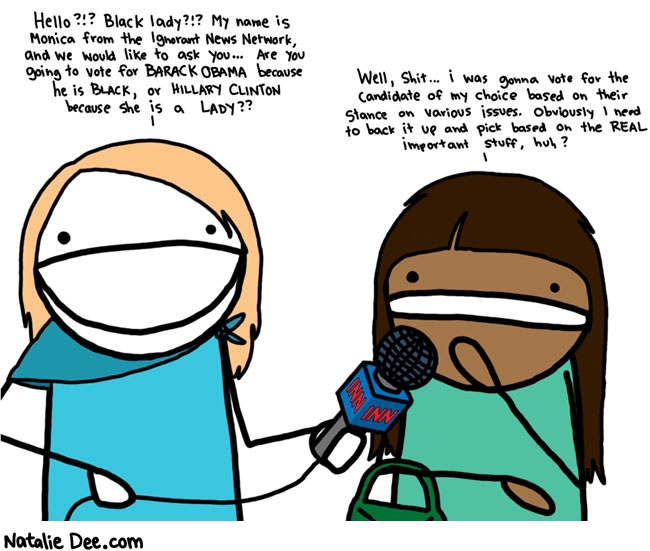
 

That this struggle created a world in which racial and sexual identity is more rigid and essentialized than before is one of the great ironies of this book. People who identify as bisexual, for instance, often feel marginalized by both straight and gay communities, thanks to the widespread belief (reinforced by the debatable view that people are “born gay”) that a person who sleeps with both men and women is simply a gay or straight person who went off the reservation. Similarly, contemporary discussions of race seem to fall into clichés of whiteness, blackness, Mexicanness and so forth – a comic goldmine that has been exploited by the brilliant (Dave Chappelle) as well as the decidedly un-brilliant (Carlos Mencia). The blog Stuff White People takes a pre-existing assumption of white racial identity and jumbles it with class and subcultural stereotypes, proposing (only half-kiddingly) that all white people are bourgeois urban hipsters who love Animal Collective and complicated sandwiches. The idea of blackness has at least received a more nuanced and intelligent discussion in recent years, though an observer like Randall Kennedy – who has been on the wrong side of accusations of selling out and racial betrayal before – still feels compelled to argue that the boundaries of blackness ought to be policed for African Americans to retain a distinct and coherent identity. Rich Harvard law professors apparently make the cut; African Americans who do not meet his definition of blackness need not apply.

Studies estimate that fully a fifth of the so-called Millennial Generation (Americans born since 1982) have one foreign-born parent. I do not have statistics close at hand for how many young Americans come from mixed-race families. Whatever the numbers may be, a new generation of multiracial, ambisexual Americans may have to find a voice to awaken themselves and the rest of society to the apparent truth that identity is, in fact, fluid, and essences are not always so essential.

Alex Sayf Cummings

Thursday, August 11, 2011

Dog Days Classics: All About Utility, Freedom, Love, Valour, Compassion

 
Daniel T. Rodgers, Contested Truths: Keywords in American Politics since Independence

This book is one that I suspected might not hold up as well today as it did when I first read it as a History major in college. At the time, Rodgers’s study of how phrases like “natural rights,” “the people,” and “the interests” evolved in American discourse over time was truly eye-opening. The garden variety insight that “natural rights” might not mean the same thing to various people over time is not much to write home about, but Rodgers goes well beyond it to show how Americans wavered between Benthamite utilitarianism and Wilsonian idealism for much of their history, from belief in the greater good of the people as a whole to the idea of democracy as a marketplace for sorting out people's conflicting interests. The book is at its best when it charts the career of pluralism in twentieth century political culture: in the Progressive Era, “the Interests” represented the venal influence of big business, which sought to warp the playing field against workers, consumers, and smaller competitors. By the 1930s, the New Dealers began to imagine the state as a broker that negotiated compromises among the many different “interests” that made up society, but the existential crises of the Atomic Age and the Cold War soon led Americans to swap liberal pragmatism for a discourse that emphasized stark lines between freedom and Communism, good and evil. The Red Menace was not to be negotiated with or accommodated like, say, business and labor, or farmers and consumers. 


This is a story that Louis Menand has told in a book with a grander narrative sweep and finer grain of detail; The Metaphysical Club (2003) beautifully unfolded the evolution of American pragmatism from the generation that survived the Civil War to the aftermath of World War II, but Rodgers captures the essential problem of how we think about the competing ends, interests, and ideas that vie for supremacy in our own democracy. Questions about what constitutes “an interest” (or “the people” or “freedom,” for that matter) are about what we think of each other, and how we envision a good life working out. Are we better off setting aside the individual demands of ourselves and our groups, or should each constituency seek to fulfill its own objectives – with democracy producing an amalgam (the legislative “sausage”) everyone can live with? These questions are part of what motivated me to want to keep learning about history; with the help of healthy dose of Orientalism, I learned to scrutinize the way Christian missionaries wrote about their converts in China or the discourse that copyright interests used to persuade others of the importance of intellectual property to the US economy. 

Sure, but will it play in Sichuan?

Language isn’t everything, though (even if some postmodern thinkers say everything is a text). As important as it is to examine why people say what they say, it also matters what people do. Ronald Reagan’s particular idea of “freedom” (the freedom to bash in the heads of radical priests in Central America, for instance) did not find favor with the public just because of its rhetorical power, or even the particular legacy of Cold War “freedom talk” that gave rise to it. Similarly, liberals have long sought to find a new language that exemplifies their idea of the public good. The linguist George Lakoff has spent much of the last decade trying to persuade progressives to drop Republican “frames” about security, social welfare, and a host of other issues, and though some progressives (notably Barack Obama) appear to have succeeded through soaring rhetoric, the current debate about public spending and debt has been framed in depressingly Republican terms. Bill Clinton’s attempt to redefine the liberal vision of the social contract as a “New Covenant” in the early 1990s failed to resonate with the public, perhaps because it did not connect or comport with life as people were then experiencing it. 

So, yes, Virginia, there is a real world in which language operates, which language also helps to construct. Contested Truths does not treat political language as if it is a system unto itself, but it does struggle to locate talk of rights and freedoms in the material world where people actually go looking for new rights and new freedoms. Other books may do a better job of the latter -- Eric Foner's Story of American Freedom is able to accomplish more by looking at how one ideal was interpreted by Americans in a variety of different contexts, from the Puritans to the New Dealers to right-wing militias -- but Contested Truths still provides an engaging tour through US history, when battles over the meaning of natural rights or pluralism exposed the various and competing ways Americans envisioned their own society. Each such contest reveals something vital about the period when one word or another became the terrain of struggle.

Alex Sayf Cummings

Past posts in this series include:

Monday, August 8, 2011

Dog Days Classics: The American Political Tradition


As the combined impact of climate change and the sweltering plague known as Atlanta in August settles upon us, we decided to take advantage of the slow-thinking stupor to go on a walk down memory lane.  This nostalgia trip takes us to the books that we found most influential in undergrad and graduate school -- the texts that were inspiring, that made us want to learn more, or that shaped the way we write about or conceptualize the past.  Each post will look at one book, generally an academic text (if we were writing about fiction or poetry, it would be a very different list), and consider why it was so powerful in its impact.  It would be a pretty dull discussion if each post consisted of "This was a great book!" and "It was very well-written!" so we will also be revisiting these books with an eye to their shortcomings, and how our own take on them has changed in the intervening years.  The earlier books will come first, and generally the ones we read as a doe-eyed college kids, before moving on to more recent works that are classics in the making.  But the first book will be one dear to my heart, that I read in the first year of grad school:


Richard Hofstadter, The American Political Tradition and the Men Who Made It

Hofstadter’s 1948 epic continues to find new readers among undergrads and grad students, as well as the oft-mentioned-but-rarely-observed “educated general interest reader of history.” Trends in historiography may have left Hofstadter far behind, but that may be all to the good in the case of The American Political Tradition. The book’s twelve chapters offer largely psychological insight into major political figures such as the Founding Fathers and the pro-slavery aristocrat John Calhoun, setting them against the social context of their time and probing the deeper casts of mind that led them to craft the Constitution, preserve the union, or oversee the corruption of the Gilded Age in their own particular way. Hofstadter portrays the giants of US political history as men of their time and place, who were nonetheless caught up in circumstances they could dimly understand and scarcely control. Grover Cleveland was an honest but simple-minded public servant, a committed believer in bourgeois virtues of thrift and propriety – in other words, the perfect cipher for an age when moneyed interests were robbing the public blind. Hofstadter cast FDR as “the patrician as opportunist,” who never set out to become a figurehead of radical discontent but who still managed to employ his personal charms and charisma to take advantage of the moment. Lincoln’s “little engine” of ambition brought him to the pinnacle of power, but it also left him with a burden of wartime leadership that he shouldered with a tragic, vaguely Christian sense of responsibility. (If Lincoln was auditioning to be Christ, he was all too aware how the story would end – and that the outcome was out of his hands.)

For me, the finest contribution of The American Political Tradition is its humane approach to people in the past. The book has often been described as “literary,” which is a way of saying it is not as stilted and dry as most academic history (or this blog post). Yet it is literary in another way: like fiction, it goes beyond examining the significance of events to introduce us to recognizable human beings, people with hang-ups, anxieties, and mixed motivations who grope for the right path, as they understand it. Not a lot of historians do this very well, even when they try. Hofstadter’s approach is marked by both irony and empathy for his historical subjects, including the vain and the powerful.

Victoria Woodhull: Non-traditional

The book may benefit from lissome prose and keen insight, but it remains vulnerable to criticism. While not quite qualifying as "psychohistory," the book does examine the past by attempting to deduce the inner mental workings of long-dead historical figures, a reflection of the vogue for Freudian psychoanalysis after World War II. It focuces almost exclusively on men, but that fact is not surprising for a study written in 1948 that deals in large part with presidents (a largely male group in the US). Although it is often classified with the work of “consensus” historians who celebrated America’s liberal democratic heritage in the 1940s and 1950s, the book’s larger insight was simply that basic assumptions about property rights and capitalism seemed to endure throughout US history, regardless of how many divergent personalities passed through the scene:
The sanctity of private property, the right of the individual to dispose of and invest it, the value of opportunity, and the natural evolution of self-interest and self-assertion, within broad legal limits, into a beneficent social order have been staple tenets of the central faith in American political ideologies; these conceptions have been shared in large part by men as diverse as Jefferson, Jackson, Lincoln, Cleveland, Bryan, Wilson, and Hoover.
Hofstadter may have believed in the sturdiness of this creed, but he did not celebrate it. A recovering Marxist in 1948, he still viewed the grasping avariciousness and blind obedience to property that defined American history with bittersweet resignation. It may be that Hofstadter marked the boundaries of American discourse accurately; certainly, today’s political universe in the US seems pinched and impoverished, with even a Progressive president like Barack Obama unwilling to commit to policies that smack of socialism and “big government.” Yet he also may have overlooked the hints of native radicalism that other historians have found among the American revolutionaries, the populist farmers of the South, and the many Americans who made socialism a vital movement in the early twentieth century. Only the abolitionist Wendell Phillips comes across in Hofstadter’s study as a principled radical above the demands of self-interest and retail politics. If The American Political Tradition had been subtitled And the People Who Made It, we might have seen a chapter on Victoria Woodhull, the radical proponent of women’s rights and free love who ran for president in 1872. How did she fit into the tradition? A book like that -- which married Hofstadter’s keen eye for character with a contemporary view of the past -- might reveal a more capacious political tradition than the one found in this (still very good) book.

Alex Sayf Cummings

Monday, August 1, 2011

Not Your Parent's Gentrification: Clybourne Park's Uncomfortable Take on Neighborhood Change


Few developments in the 21st century conjure up as many economic and racial ghosts as gentrification. For urban denizens of all persuasions, debates regarding gentrification unfold like a typical over the top episode of HBO’s True Blood, complete with bloodletting and sacrifice. The problems and issues raised by this process remain complex and contradictory. While race certainly continues to be a factor, reducing the issue to black vs. white oversimplifies what has become a truly mind bending dialogue. For example, in Chicago, as public housing projects were razed, resentments toward whites moving into new “affordable” housing provided only one source of tension. Working class Blacks in historically African American Bronzeville and elsewhere viewed the influx of upper middle class Blacks (derisively described as Buppies by some local residents) with an equally wary eye.


Moreover, the influx of Mexican immigrants to Chicago and South Asian and East Asian counterparts in Queens and Brooklyn have complicated the usual black white binary. As T of M has noted continuously, authors like Saskia Sassen and Mike Davis argue that these immigrant communities in their own way bring with them a low level gentrification that may or may not threaten long established working class communities. Still, others like Josh Sides (another T of M favorite) have noted that sexuality has played a role as well, pointing out that in places like San Francisco’s Castro district, upwardly mobile and affluent gays refurbished a once working class community. While this undoubtedly raised property values and made the Castro a more economically desirable neighborhood, it came in large part at the expense of the long standing lower income residents.

All this is too say, debates about gentrification too often result in a confused jumble of explanations that, as the Atlantic’s Megan McArdle rightly notes, mix “normative and . . . positive arguments.” In other words, the debate confuses what is with what should be, which are rarely the same thing.

The 2011 Pulitzer Prize winning play Clybourne Park (currently on display at Washington D.C.’s Wooly Mammoth Theatre) wades deeply into process of gentrification. Taking place in Chicago’s well known Clyborne Park, the play consists of two acts, separated by 50 years of neighborhood change. Its first act refracts Lorraine Hansberry’s famous play, A Raisin in the Sun so that the story unfolds from the perspective of the white family selling the home. Not wanting to reveal one of the central undercurrents of the plot, the family (consisting of Russ and Bev) has chosen to move largely as result of a family tragedy that altered their relationship to the surrounding community. Indeed, the term community itself morphs into a term of derision when uttered by family patriarch Russ toward his intrusive neighbors who fear the sale of the home to a working class black family will ultimately result in neighborhood decline. The play’s first half exhibits equal parts mourning, racism, classicism, and anger. Needless to say, Russ cares little for the future of the neighborhood nor those residing in it. Though it starts slowly and at times seems cryptic, the first act moves swiftly, setting up the play’s second act well. The first act consists of six characters including Black housekeeper Francine and her dutiful husband Albert along with local minister Jim and neighborhood couple Karl Linder and wife Betsy. Yes, this is the same Karl Linder that attempted to bribe the Younger family (from Raisin in the Sun) from buying the house on Clybourne Street that Russ so willingly hopes to vacate. Having failed in his efforts with the Youngers, Karl turns his attention to convincing Russ to reconsider the sale. Ultimately, the first act operates much like, what one critic perceptively described as “a combustible mix of race, territory and property prices that it is like a hand grenade lobbed into the stalls, primed to explode in the second act.”

.

And what a second act it is. Undoubtedly, Norris refuses to provide any kind of sanitized politically correct outcome or comfort for the play’s characters and audience. New York Times critic Ben Bentley summarized the effect as the “equivalent of [Norris pouring] itching powder on his characters and on us.” Guardian theater critic Lyn Gardner agreed, “It's like watching a boil being lanced. Along with the rest of the audience, I squirmed like a worm on a hook.” Moreover, Norris undermines any sense of moral superiority or cosmopolitanism that a 2011 audience might feel watching their 1959 counterparts as the second act reveals the messiness and sometimes eviscerating conflicts that seem all too familiar in today’s urban areas. For all we have learned, we seem to have also apparently forgotten.

As the second act begins, a white couple, Steve and Lindsey, has purchased the house but has run into some resistance from a predominantly black local homeowners association that wishes to preserve the historic nature of Clybourne Park’s unique bungalow style. Steve and Lindsey want to alter the height of the home while also putting a “koi pond” in back. Needless to say, the local homeowner’s group disapproves.

In the years following the 1959 sale, the neighborhood’s demography changed from all white to all black. Economic decline followed as did some levels of struggle, but so too did the sense of community which the second act’s black characters, married couple Kevin and Lena, wish to emphasize to the new tenants. (the play basically uses eight actors total, seven of whom appear in both the first and second acts). What emerges from this constellation of personalities is a cacophony of rhetoric that obscures the real meanings that lay beneath it.

Norris cleverly allows characters to hang themselves while drawing the audience in through a rather innovative means: racial jokes. Though each joke serves as a sort of hinge around which conflict emerges they also propel hostilities. The play builds as each joke surfaces revealing as much about those hearing the joke as those telling it. When Lena tells a particularly offensive yet admittedly entertaining joke about white women, Lena’s own prejudices come into full view, as do those of pregnant new homeowner Lindsey. Still, the dialogue of the second act also provides a means to blow up the very discourse we have come to employ in discussions of gentrification and race. The Guardian’s Garner gets at this most clearly, describing it as the “most offensively delicious skewerings of the resentments and real feelings that lurk behind the euphemisms and politically correct rhetoric of racial discourse ever to erupt on a stage.” From a purely artistic perspective, if there is a criticism of the play it might be that the characters, notably its white homeowners, could be seen as caricatures (or “cartoonish” as Brantley notes), while its black characters seem almost guileless, though admittedly, Lena’s actions suggest differently.

Without question, Clybourne Park, a comedy, is worth seeing. Its dialogue spins out to address issues relating to gentrification, race, class, and military conflict abroad in postwar America. However, while Norris has consistently noted he never intended the play to encompass all of Chicago’s racial history, urbanists will see holes. For example, the black white binary upon which the play is set ignores the increasing numbers of Asian and Latin American immigrants to urban communities. Moreover, the idea that gentrification remains a process driven strictly by white interlopers (who newspapers continue to describe as “pioneers” which remains one of the more unfortunate aspects of this kind of discourse) persists. The increased presence of South Asian and East Asian American professionals in transitional neighborhoods, Black upper class couples moving into gentrifying working class white and black communities, and other examples complicate our understanding of such developments.

Undoubtedly, local demographics play a role. If a city lacks a large South Asian/East Asian or Latino population, the language of gentrification will reflect this. Take Atlanta for example. While the city has recorded gradually increasing numbers of Latino and South Asians, many hail from lower income populations so they in all likeliehood simply haven’t been able to accrue the necessary capital to participate in the process, at least not yet. Then again, the area around Atlanta referred to as “outside the perimeter” (think Buford Highway and Chamblee), has increasingly reported South Asian and East Asian homeownership. The Economist has documented this development most extensively in its March 11, 2004 issue ("Into the Suburbs"). Within Atlanta’s city limits, however, the Black white dynamic retains great resonance. Atlanta’s own identity rests deeply on its history as the “city to busy to hate”; the idea that its black and white business leaders blunted racial conflict for pragmatic entrepreneurial policies. Of course, like any other constructed identity, Atlanta’s probably oversimplifies its complex history of race relations.


In White Flight: Atlanta and the Making of Modern Conservatism (2005), Kevin Kruse questions this identity. Kruse illustrates that the “city to busy to hate” moniker disguised a troubling racial logic that eventually led to neighborhood and school segregation, even if no one described it that way. White Flight, like predecessors such as Thomas Sugrue’s seminal Origins of the Urban Crisis, explores the role class played in neighborhood transitions of the 1940s and 1950s. Working and lower middle class whites could not flee to suburban areas, so the various “coalitions” established across racial lines that allegedly made Atlanta the “city that was too busy to hate”, favored black and white elites. In Atlanta, upper class and middle class whites displayed an open attitude toward integration as they sent their children to private schools and buffered community desegregation through working class white populations. Much like the noxious Karl Linder of Clybourne Park, working class whites feared their investment would decline once African Americans moved into the community. While racism played a central role, so too did HOLC and FHA lending policies that heavily influenced private lending practices. This meant working class whites sold low out of fear of losing all their investment, while upwardly mobile Blacks paid high as they found fewer neighborhood available to them. While Clybourne Park’s Russ sold the house low out of grief, one wonders if the Youngers benefited from this discount or if the broker found a way to pocket the difference.


Patriarch Russ’s derisive use of the term "community" illustrates a similar function that Kruse points out perverted its meaning. For local Atlanta white communities, the language of community, community protection, and freedom of association became buzzwords for resistance. Initial resistance focused on constructing an “established white community” then using the language of community protection to prevent integration. However, these constructed communities often lacked the kind of social capital, institutions and connections that normally define such. As result, the encroachment of black homeowners into white areas met with predictable responses. Those closest to the transition sold their homes turning a profit as blacks often paid higher prices than whites. This of course drew the rage of fellow white homeowners who lived further away from area of transition; they viewed the actions of whites selling their homes as traitorous. Such developments exhibited the role class played in fracturing opposition to racial succession.


The working class whites who lived in transition areas assumed that they and their neighbors shared not only the common traits of race and class but also common interests in preserving segregation in their neighborhood and the status quo in local politics. During the course of residential desegregation, however, they discovered that their supposed common ground on these issues and identities was ultimately less important for them and their neighbors than each one’s self interest. (80)


Russ’s self interest lay not in economics, but his own disappointment in the alleged community to which he thought his family had belonged. Clearly, race did not amount to any sense of community for Russ and Bev.

What about third forces, like realtors, who engaged in block busting in the past and now rebrand neighborhoods, essentially obscuring their history? Over the past 15 years New York’s Brooklyn and Manhattan neighborhoods have endured an endless stream of such rebrandings. New York State assemblyman Hakeem Jeffries has attempted to legislate against realtors engaging in such practices. According to Jeffries, “neighborhoods have a history, culture and character that should not be tossed overboard whenever a Realtor decides it would be easier to market under another name,” he told the NY Times. Jeffries resented in particular, recent attempts to rename the Prospect and Crown Heights area of Brooklyn as ProCro. To be fair however, this is a process that has been unfolding for much of New York City’s twentieth century. After all, Tribeca was never Tribeca until labeled such in the 1970s.

.

So how does one contextualize Norris’ second act? A recent trip to Prospect Heights reveals a neighborhood that remains a mix of urban professionals, working class West Indian American residents, bodegas, and boutique restaurants such as Dutch Boy Burger. Wandering around with Indian American professional Suman Ganguli, a Minnesota born Prospect Heights homeowner, one can clearly see that gentrification as “white driven evil process” fails to really capture its complexities. Ganguli represents your stereotypical South Asian American striver. A University of Chicago, Cornell, and Berkeley graduate (Tea Party members might consider him of the “liberal Ivy jet set crowd” they so abhor), Ganguli and his wife recently purchased a condo in Prospect Heights. He admits that when one uses the word gentrification his “knee jerk politically correct response” is to oppose it, however, this obscures some realities Ganguli acknowledges benefit the community. For example security, infrastructure, and nice restaurants/bars not only fit nicely into his family’s lifestyle choices they also benefit many local homeowners by raising property values. While this may penalize renters, one imagines numerous minority homeowners regard rising property values as a boon.

With that said, he also worries about too much change, “I'd like to see some of the accompanying benefits of gentrification …. but I don't want to see it fully tip over, so that this becomes Park Slope,” he noted in a recent email. “It's a fine balance, perhaps an unstable equilibrium, as they say in applied mathematics/dynamical systems … I don't want to see the people on our block--which is remarkably diverse, racially and socioeconomically--that have been here priced out as a result.” This is the crux of the problem. While certainly, many homeowners benefit, there are those who will simply not be able to afford the increasingly high property taxes that accrue, thus, some working class homeowners may have to move from the very community they helped to establish.

What about race? As a South Asian in a primarily Black and West Indian neighborhood, Ganguli fits in better than say your average white guy (one might also note that West Indians in particular, because of a history of contract labor within the West Indies itself in which South Asian migrants were not uncommon, might be acclimated better toward homeowners of such persuasions). Adding even greater complexity, he has found a local Bangladeshi community within Prospect Heights that has established a foothold that no doubt has contributed to the community’s new growth. This development he suggests, upsets the usual story. “So the standard gentrification narrative gets complicated a bit, as it's not just white yuppies moving in forcing out longtime black/Hispanic residents.”

.
Ganguli's not your typical evil white man

Obviously, as both Kruse and Ganguli suggest, class matters especially in regard to consumerism. When the characters from Clybourne Park’s second act recount the travails of the local grocery store beginning as a locally owned business collapsing into a supersaver outlet (think 99 cents store) then transformed into it’s latest incarnation, a Whole Foods, the audience laughed uproariously. Yet, this laughter stems from a knowingness about our current existence: consumption. While race plays a role, gentrification represents as much about how we choose to consume and what it says about us. Writing for the Atlantic, Benjamin Schwartz noted that recent attempts by authors to address the issue of gentrification foundered on their inability to recognize this fact.
Indeed, what has changed since [Jane] Jacobs’s day—and the reason, as these books attest, that gentrification has become so intense an issue—is the speed of the transition of districts from quasi dereliction to artsy to urban shopping mall. This acceleration results from the ways consumption has become the dominant means of self-expression . . . and from—relatedly, ultimately—the acceleration of the global economy.
In several ways, Clybourne Park cleverly hints at this manifestation. Following a spiky uncomfortable dialogue in which race repeatedly surface, Lindsey turns to Lena and Kevin pointing out she resents the questioning of their ethics to which Lena responds, “It’s not your ethics I’m questioning, it’s your taste.”

Moreover, the use of the Korean War as a central plot device, the first US led war that featured an integrated military, announced America’s new foreign policy of internationalism and lacked a clear cut American victory, symbolizes more than at first seems apparent. The war ushered in numerous racial, demographic, and yes, militaristic changes in US culture. Norris embeds the war’s meaning into the play in a way that obscures this reality but upon further reflection becomes a glaring fact. After Korea, suburbanization exploded, cities declined, civil rights emerged, and America, arguably, peering back from the distance of 2011, began a slow descent from superpower to global power, all while US consumerism rampaged forward, damn the torpedoes.

In the early 1970s, sociologist Thomas Schelling put forth the now ubiquitous term “tipping point” to describe the kind of rapid neighborhood transition that unfolded in Clybourne Park. Schelling famously assigned whites “tolerance levels” for the numbers of new black residents in a neighborhood. Blacks too had their own set of expectations regarding white residents but that it allowed for far greater flexibility. However, while in no way diminishing his racial analysis, Schelling also noted that factors other than race played a role as well.
Neighborhoods will be differently defined by families with and without children, by people who work in them and people who commute, by transients, and longer term residents, and by people sensitive to particular ethnic groups and income or social classes. (176)
Ironically, Schelling argued that “well defined neighborhoods” or as Clybourne Park’s Russ may suggest “communities” illustrate faster tipping points as residents’ own definition of the community changes as result of new inhabitants while “ill defined” communities absorbed new arrivals better since their attachment to a neighborhood identity remained more diffuse. Of course, one might argue this contradicts Kruse’s earlier point about Atlanta, but it provides food for thought. Clybourne Park drops observers into central debates around gentrification encompassing race, class, and consumerism. How one views these developments hinges on these very factors, making Bruce Norris’ play a valuable reminder that gentrification, much like life itself, is pretty messy.

Ryan Reft

Friday, July 15, 2011

What Google Can Tell Us about the 2012 Field

People used to be Rockefeller Republicans, and now everyone wants to be a Ronald Reagan Republican. Will people some day be bragging that they are Michele Bachmann Republicans? Not if the number one things she is associated with continue to be chutzpah and slavery. Chutzpah and slavery -- not a good combination.
.

One also wonders how "Michele Bachmann hot" is a major search term. Most people use search engines to find out stuff. How do you change a tire? Is it bad to drink bleach? Is Michele Bachmann hot? Then again, "Michele Bachmann Jewish" is another common query on Google. This could be because she "considers herself Jewish." She worked in a kibbutz, and she loves Israel more than almost anything. But she is an evangelical Lutheran (yes, that's a thing) of the sort that may or may not think the Pope is the antichrist. One thing is certain under a Bachmann administration: Israel's security will be assured, but we may have to go to war with Vatican City.

What about Mitt Romney? One would imagine that Google searches would be like a word association game, and the likeliest terms would be "plastic," "wooden" (odd that you can be both plastic and wooden, but Mittens makes it work), "flip flopper," "Ken doll," "Brill creme." Somehow, one of the main terms associated with Mitt Romney is "skinny jeans." Who knew he was a hipster? This raises an urgent question: will Romney's cassette-only electro-folk release of Bollywood covers come back to haunt him in Iowa?  


Also, as Gail Collins has been fond of pointing out, Mitt may never overcome his dog problem. Barack Obama may be a Nazi/Communist, but he never drove to Canada with his dog strapped to the top of the car.

The lesser lights of the Republican field play more or less to type on Google. Tim Pawlenty is boring, though being associated with "definitely not gay" has to be counted as a plus in a GOP primary.  

Herman Cain hates the Federal Reserve and abortion. Back in the 1990s or early 2000s you might have wondered if if there was anything Republicans could hate more than abortion; then you found out about the Fed and Barack Obama.
.

Again, Google tells us what we already know: Newt Gingrich is a player who blings it out at Tiffany's. Basically, he's a rapper. He don't love them hos.
.

Rudy Giuliani is a cross-dresser. This may not play well in Iowa or New Hampshire, but it does explain why he focused his 2008 campaign efforts in Florida.
.

What this exercise teaches us is that Mitt Romney, again, edges out his rivals. Bachmann is a sexy Jewess (plus), but pro-slavery (generally a minus). Pawlenty is definitely not gay (plus), but we don't really have anything else to say about him. Giuliani loses points for dressing in drag (like Obama, he is viewed by most of the GOP primary electorate as a kind of foreigner, to be treated with a reasonable degree of suspicion), while Gingrich makes the only political error that really matters: failing to distract people from his odious personal behavior. Cain has the Federal Reserve but Ron Paul already owns that issue, and being against abortion in a Republican primary is like being against lice in the Gulag. It's not going to set you apart from the crowd.

This leaves Romney -- the hipster who passed sort-of universal healthcare in Massachusetts and drove to Ontario covered in dog shit. Compared to the competition, that doesn't seem half bad.

Monday, June 13, 2011

Scattershot Politics: Sport and Its Serpentine Political Meanings


Over the past fifteen to twenty years, historians have increasingly emphasized the role of sports as both a driver and reflection of society. The recent Bill Simmons inspired and ESPN produced 30 for 30 documentary series tackled a number of difficult subjects via Sport. In "The Two Escobars," directors Jeff and Michael Zimbalist traveled through 1980s Columbia, following the lives of Pablo (international drug dealer/murder/local philanthropist) and Andres Escobar (captain of Columbia’s 1994 World Cup team murdered in a nightclub alteration several months later). The two unrelated protagonists encapsulated the travails of late 20th century Columbia. Drug money filtered into the nation’s soccer infrastructure, boosting its competitive success but also adding layers of complexity and violence to a nation already struggling with decades of conflict. Writing for the Onion’s AV Club, Todd VanDerWerff summarized its importance similarly: “The film's portrayal of Colombia as a nation that made its compromises and learned to live with the hell they unleashed is also particularly good, as the story of the two men at the center slowly radiates outward to encompass more and more of the nation's society.”

This is not a wholly unusual conclusion for the series. In “Pony Exce$$,” director Thaddeus Matula explored the corruption and ultimate destruction of Southern Methodist University’s (SMU) then dominant football program as booster money flowed in from the oil wealth that defined the Southwest US in the 1980s. Though the Southwestern Conference consisted of eight schools (Baylor, Rice, SMU, Texas, Texas Tech, Texas A&M, Arkansas, and Texas Christian University), Dallas served as a hub for numerous successful graduates of each school. As several observers note in the documentary, football rivalries crackled in the board room meetings of Dallas high rises as alumni from all schools engaged in recruiting practices that seemed to define the decade.

Likewise, Billy Corben’s film, “The U” about the dominance and bravado of Miami University’s 1980s football teams reflects similar themes. Miami’s football team served to unite a divided city behind a collection of local talent that also rewrote the rules of the game. Miami’s players excelled spectacularly on the field but stoked controversy with their trash talk and exuberance. If oil money shaped SMU, Miami’s notoriously tough African American neighborhoods, embraced by Miami’s first successful coach Howard Schnellenberger, came to symbolize “The U’s” power. Along with cultural productions like Scarface, Miami Vice and the notorious Two Live Crew, players like Michael Irvin challenged college football and its fans. Unlike “Pony Exce$$”, “The U” reveals the racial undertones that marked some of the criticism faced by the Miami program. When teamed with Steve James’ masterful “No Crossover: The Trial of Allen Iverson” and the recent “Fab Five” film about the innovative early 1990s Michigan basketball team, “The U” reveals so much more about American life than just college football. Race, money, and a changing cultural landscape collided. As one writer observed, James’ movie looks at Allen Iverson “more as a phenomenon, a human inkblot whose polarizing effect on people often says more about them than it does about him. They see whatever they want to see, and that may or may not be the truth.” In essence, all these films and others in the 30 for 30 series function to elevate sports to a level of political and social importance that might have been derided in early decades.
Architecture is the simplest means of articulating time and pace of modulating reality and engendering dreams. It is a matter of not only of plastic articulation and modulation expressing an ephemeral beauty, but of a modulation of producing influences in accordance with the eternal spectrum of human desires and the progress in fulfilling them. The architecture of tomorrow will be a means of modifying present conceptions of time and pace. It will be both a means of knowledge and a means of action.
- Ivan Chtcheglov, Formulary for a New Urbanism, 1953

Writing in 1953, nineteen year old architect and devotee of the Situationist movement Ivan Chtcheglov published his sweeping indictment of mid-century urban planning. For Chtcheglov, the architecture of cities past reflected the dead life of capitalist production. City dwellers had been hypnotized by the built environment, thus, focusing exclusively on capitalist accumulation to the extent that when “presented with the alternative of love or a garbage disposal unit, young people of all countries have chosen the garbage disposal.” One can see parallels with sport, most clearly in the above examples regarding SMU and the Escobars. The excess capital of drug and oil money created a vehicle for the egos and dreams of ruling classes that were then imposed. (To be fair, soccer teams as several interviewees in The Two Escobar note, serve as great money laundering devices. One might suggest the same of Enron and other corporate entities in recent years.)


For Americans, sports provided both meaningless entertainment and incredible important cultural moments of resistance. Dave Zirin documents athlete resistance of the twentieth century in his 2005 work, What’s My Name, Fool? Sports and Resistance in the United States. To Zirin’s credit, What’s My Name, Fool? gathers countless examples of political acts by athletes across the sports spectrum, engaging in issues of race, gender, and class. For example, Zirin traces the complicated politics of Jackie Robinson who, despite his bravery in desegregating MLB, came to be unfairly seen by radical Black nationalists of the late 1960s as a sell out. Some have described Zirin as sort of Howard Zinn of spors journalism. Perhaps. He does look at major historical events like the 1968 Mexico City Olympic protest by Tommy Smith and John Carlos, in which both athletes upheld closed black gloved fists. Zirin explores many facets of the event that had gone unnoticed. Unfortunately, while Zirin collects valuable stories worth reflection, he too often veers in the direction of soap box oratory. Moreover, Zirin seems to feel the need to conclude paragraphs with zingers. For example, how about this gem regarding the failure of several WNBA sports franchises: “while some franchises found success, others have folded faster than a rib joint in Tel Aviv.” (186) When discussing Allen Iverson, Zirin notes Iverson’s role as an anti-corporate anti-hero summarizing his nickname may have been A.I. but “there was nothing artificial about him.” (163) Nuance is not the most prominent feature of What’s My Name, Fool. Still, even if the equivalent of street corner radical, Zirin contributes something to our knowledge of American culture and sport.

If baseball and to a lesser extent American football and basketball have served as venues for political expression, predictably, football occupies a similar position for Europeans. How Soccer Explains the World: An Unlikely Theory of Globalization, Franklin Foer traipses through countries around the world, but predominantly Europe, exploring the meanings and processes that manifest themselves in the sport. Throughout How Soccer Explains the World one thing becomes clear, the political complexity of football and more generally, sport, radiates in countless directions. When Foer presents Barcelona’s “bourgeois nationalism” as a model for 21st century cosmopolitanism, he goes so far as to claim that it “redeems the concept of nationalism.” (198) For Foer, Barca never demonizes opponents the way supporters at Red Star (Belgrade- the subject of a previous chapter, one that found soccer fan bases and clubs of the former Yugoslavia as germs for the paramilitary organizations of the Balkan wars in the 1990s) have. Instead, Barca illustrates that “fans can love a club and a country with passion and without turning into a thug or terrorist.” (197)


A central aspect of Barca’s identity rests on its foundational myth, its role as a means of Catalan resistance toward the post Spanish Civil War fascist Franco regime. According to this myth, Camp Nou, Barca’s legendary stadium, enabled Catalan fans to express themselves in ways forbidden by Franco. Camp Nou allowed for political and social subversiveness. “Its fans like to brag that their stadium gave them a space to vent their outrage against the regime,” writes Foer. “Emboldened by 100,000 people chanting in unison, safety in numbers, fans seized the opportunity to scream things that could never be said, even furtively, on the street or in the café.” (204) Yet, as Foer acknowledges, there is another way to view Barca’s history. More likely, Franco saw Camp Nou and Barca as harmless outlets for his repressed populations. Unlike the Basque region and its terrorist/separatist movement ETA, Catalonia never developed any similar liberation fronts. Instead, Catalans pragmatically went to work, benefitting from subsidies and tariffs that contributed to Barcelona’s metropolitan industrial boom. This success may go far in explaining Barca’s place in the Catalonian psyche. Foer argues, many Catalonians have a self conscious suspicion, that unlike their forefathers and other Spanish regions, “they feel as if they have lived lives devoid of struggle and without epic dimension. They worry that their fathers would be disappointed with their staid existence.” (214) Catalans employ Barca as a “balm” for a guilty conscience and resentments over “Castilian centralism.” Even in this less than ideal motivation, Foer finds strength. Catalans hold contempt for a concept ("Castilian centralism,” as represented by arch rival Real Madrid) rather than a people, hence the reason Barca lacks the kind of history of hooliganism or violence that seems so prevalent at other clubs. If anything, the history, identity, and place of the Barca (this year’s Champion’s League victor) in Spain points to a deep complexity that lay at the heart of sport in the West. However, one needs to ask, what does sport mean outside the West?

Decolonizing Cricket

It is no exaggeration to suggest that cricket came closer than any other public form to distilling, constituting and communicating the values of the Victorian upper classes in England to English gentlemen as part of their embodied practices and to others as a means for apprehending the class codes of the period. 

“Rock star” anthropologist (probably the equivalent of “rock star” bands like the Soft Pack—what never heard of them? Exactly) Arjun Appadurai also believes sport reveals deeper issues than won loss records. In Modernity at Large: Cultural Dimensions of Globalization, Arjun devotes an entire chapter to the “decolonization of Indian cricket.” Appadurai’s interest lay in what he labels the “indigenization” of cricket on the subcontinent. The former University of Chicago anthropologist (he's currently at NYU) identifies four processes that interacted in ways that led to cricket’s unique indigenization in India:

  1. the “implicitly corrosive” affect the “elite Victorian values” embedded into the sport on the “bonds of empire”
  2. internal sustainability of the cricket due to its ability to develop talent outside urban
  3. issues of post colonial masculinity in which spectating came to be associated with “bodily competition and virile nationalism”
  4. the ability of media and language to disconnect Englishness from the sport

Perhaps the most intriguing of Appadurai’s processes is the paradoxical affect that the initial values of the sport exerted. “Quintessentially, masculine,” the codes of cricket regulated broader male behavior. These codes consisted of four essential tenets: 1) sportsmanship 2) fair play 3) emotional control over one’s person 4) loyalty to team and sublimation of personal interests to the group. Yes, it functioned to socialize and discipline subjects, but it also provided an “an instrument of elite formation.” As Appadurai points out, “it both confirmed and created sporting solidarities that transcended class.” (92) The field allowed lower and middle class competitors a limited equality with their Victorian superiors. Appadurai also credits the lower classes with doing “the dirty subaltern work of winning so that their class superiors could preserve the illusion of gentlemanly non competitive sport.” (92) The greater importance, he argues, is that as an elite sport, cricket nonetheless emphasized an idea of fair play that demanded “openness to talent and vocation in those of humble origins … a key to the early history of cricket in India.” (92) English officials believed it to be the perfect way to “socialize natives into new modes of intergroup conduct and new standards of public behavior.” (93)


With that said, one of the most critical developments unfolded as Indian princes began paying English and Australian professional players to train their own squads in India. This line of patronage and the coaching it brought with it proved critical to the sport’s development. Princes loved cricket because it confirmed their own masculinity, provided avenues for furthering their English contacts, and enabled them to extend their places in “royal public spectacles” seen as integral to the intrigue and responsibilities of Indian royalty. This resulted in a class of players form outside India’s major colonial cities. The monies given to them by these Princes allowed for many to occupy a space in the cosmopolitan world of cricket. As these new class configurations compiled, Indian cricket exhibited a class complexity that Appadurai argues “persists to today.” (95) “In the circulation of princes, coaches, viceroys, college principals, and players of humble origin between India, England, and Australia,” writes Appadurai, “a complex imperial class regime was formed.” Functioning as a sort of network of Indian and English “social hierarchies”, by the 1930s the various interactions occurring within this nexus of empire had created a “cadre” of non elite Indians who identified as both legitimate cricketeers and “genuinely Indian.” (96)

Unlike in England, where cricketing organization represented territory and nationhood, Indian organization refracted this meaning instead focusing on community and cultural distinctiveness. This meant Indian clubs were organized around local religious identities. Thus, spectators and players developed distinct ideas about their identities as Hindus, Muslims, and Parsi through the public spaces of cricket. When contests between English sides and those of indigenous colonial players expanded, the idea of India had to be invented. In other words, in order to field a team to play British sides, there existed a need to construct a team that represented Britain’s South Asian possession, India. At the very least, the teams constructed embodied protonational visions of an Indian state. In the post 1948 world, cricket as a vehicle for Indian nationalism seems obvious. Moreover it ties the tangled ends of empire together servings as a space for Indians, Pakistanis, Australians, English, their respective Anglo colonial counterparts, to engage and interact. While Appadurai also notes what he sees as the negative influence of globalized financial flows and commodization, he nonetheless recognizes its powerful undercurrents. “[Cricket] is an agnostic reality, in which a variety of pathologies (and dreams) are played out on the landscape of common colonial heritage. No more an instrument for socializing black and brown men into public etiquette of empire, it is now an instrument for mobilizing national sentiment in the service of transnational spectacles and commoditization.” (109)

Operation Iraqi Freedom

"Iraq as a team does not want Mr. Bush to use us for the presidential campaign," [Iraqi midfielder Salih] Sadir told SI.com through a translator, speaking calmly and directly. "He can find another way to advertise himself."
-- Grant Wahl, Sports Illustrated, “Unwilling Participants” August 4, 2004

Appadurai’s exploration of cricket through the tentacles of imperialism points to the multivalent nature of sport. Though employed as a means to inculcate imperial pride and English Victorian values, cricket served to sculpt communal identities while contributing to post colonial imaginaries that envisioned an independent subcontinent. With the rise of an increasingly globalized mass media, cricket provided the state with cost free way of emphasizing nationalist tropes to a transnational diaspora.

While American occupation of Iraq differs in many ways from the English equivalent a near century before, many Iraqis view it as neocolonialism. Take, for example, George W. Bush’s attempt to appropriate the newly reconstituted Iraqi soccer team for electoral gain. Linking the team’s achievements at the 2004 Olympics (they ultimately took fourth, a remarkable achievement for a nation at war) with those of his administration, Bush attempted to use it as evidence of his administration’s efficacy. On the eve of the 2004 election, in speeches and ads, Bush lauded the fact that had the US not intervened, Iraq would not have fielded such a successful team. “It wouldn't have been free if the United States had not acted." While all players acknowledged that none wanted a return to the days when Uday Hussein tortured Iraqi athletes, neither did they appreciate Bush’s line of logic. Coach Adnan Hamad summed up the general tenor of the team’s opposition: “My problems are not with the American people . . . They are with what America has done in Iraq: destroy everything. The American army has killed so many people in Iraq. What is freedom when I go to the [national] stadium and there are shootings on the road?" Of course, the attempt by an American president to take credit for Iraq’s soccer exploits is ironic for several reasons. Unfortunately for Iraqi players, more than a few observers will conclude American intervention did improve their team’s chances. After all, its fourth place finish remains its highest Olympic finish in soccer. In this way, soccer performs a contradictory function to at once provide a unifying expression of Iraqi identity, one couched in resistance to US prerogatives, while also serving as measure of justification for the very occupation they resent.

Iranian Revolution


Perhaps few places in the world today represent the political power of sport more than Iran. Again, this power flows simultaneously in two directions. Two recent events help convey the duality of soccer. The recent death of Iranian goalkeeper Nasser Hejazi underscores its disruptive effect on the Persian nation’s coercive government. Known as the Eagle of Asia, by most accounts, Hejazi was considered the greatest Iranian goalkeeper in history. Yet, the regime refused to celebrate him, nor did he celebrate it. Banned from national competition due to an arbitrary age limitation placed on the national team by the newly triumphant regime in 1979, Hejazi remained a thorn in the government’s side from then on. In 2004, Hejazi attempted to run for office but was denied by authorities. He later commented on the Iranian government’s failed promises. “I am agonised,” he said, “to see [the authorities] interpret poverty as contentment, inefficiency as patience and, with a smile on their faces, they call this very stupidity wisdom.” (Economist, June 2, 2011) The remark earned him a temporary ban from Iranian television. Even in death, the Iranian government remained fearful. The first half of his funeral drew over 20,000 mourners. As the Economist noted, the chanting of anti-government slogans pervaded the event and authorities quickly whisked the body away to a secret burial where contrary to tradition, no prayers were uttered.

Hejazi complicated football for Iranian rulers. The government had hoped to use the Iranian national team for its own purposes. The 1998 World Cup victory over America provided one such opportunity. However, an unexpected victory over Australia the year before sparked controversy within the regime as Iranians bounded into the streets in celebration. Of course, this being Iran, gender comingling remains distinctly discouraged. One particular English periodical commented sarcastically: “In their delight, men and women surged onto the streets of Iran’s cities and—O tempora! O mores!—celebrated together uninhibitedly.” When the Iranian team lost to Bahrain in 2001, the team played lethargically or as some argued “inertly.” Many Iranians suspected the team had been bribed or threatened by the powers that be. Hejazi had long advocated women attending games with men, and the fact that women attended his funeral was seen as an indictment of official policy.

Clearly, football represents a risky proposition for rulers. Speaking to NPR, Middle Eastern soccer expert James Dorsey noted the careful balancing act that some governments experience via sport. According to Dorsey, Middle Eastern football remains a “battlefield in which governments - certainly authoritarian governments - try to keep tight control of the game because the pitch is potentially, and often is, a venue for expression of dissent.” Recent events in Egypt, where soccer fans have disrupted games to make political statements, illustrate that Dorsey’s reflections ring true outside of Iran as well.

Nonetheless, Iran’s government continues to use football as a means for its own ends. FIFA’s ban on the Iranian women’s team for refusing to stop wearing the hijab has given the regime a talking point about western corruption and bias. Iran's President Mahmoud Ahmadinejad called FIFA "dictators who just wear the gown of democracy." Granted considering FIFA’s current state (corruption scandals abound with prominent periodicals like the Economist labeling the organization “rotten” and “awful”), any ruling by football’s governing body appears suspect. However, consider the fact that Iran continues to ban women from attending games and demands that its team wear a hijab and long pants. FIFA had been holding talks with officials to work out a compromise when a Bahrain FIFA official refused to allow the Iranian women’s team to take the field against Jordan. Of course, the New York Times noted that Bahrain’s own religious make up consists of a Shiite majority ruled by a Sunni minority. Sporting politics can tumble into transnational spaces. As for Iran, the Economist obituary frames the temptation of football succinctly: “Thanks in part to Mr Hejazi, Iran’s regime knows that the circus of the football stadium holds as many hazards as rewards.” Bread and circus are everywhere, but in some places, maybe they mean just that much more.

Ryan Reft